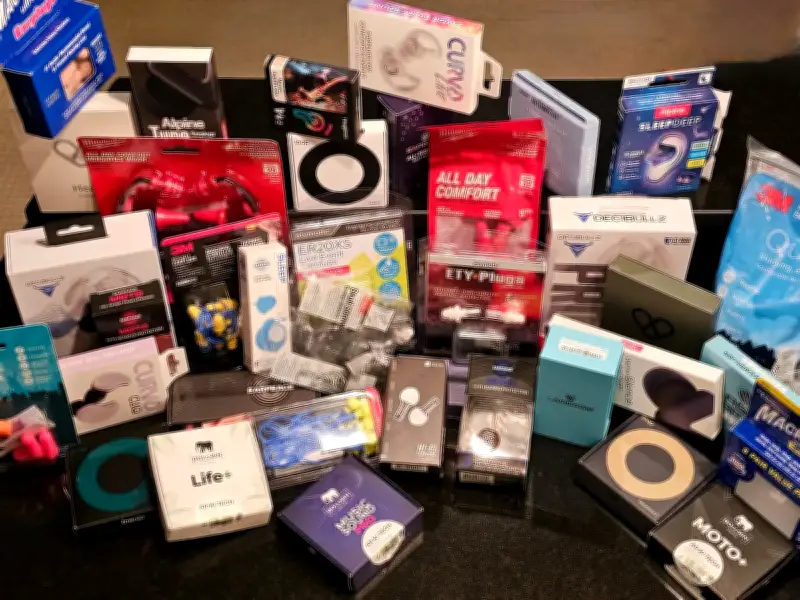
Finding the right earplugs isn’t as simple as grabbing the first pack of disposable foam offerings at a drugstore. While earplugs used to be associated with high-visibility vests and safety helmets, they’re now used to protect hearing at concerts, concentrate in busy coffee shops, or simply to sleep better. A new generation of reusable earplugs comes in different sizes, filters out different frequencies, and offers Noise Reduction Ratings (NRR) from 12 (take the edge off a concert) to 33 (blot out the world).
Best reusable earplugs: Sennheiser SoundProtex Plus
The Sennheiser SoundProtex Plus are the most expensive earplugs tested, but offer an amazing level of flexibility for both fit and function. They come with three sizes of silicone earplugs, four different sound filters (including one that blocks all sounds), plus a zippered pouch that fits in any pocket. The soft silicone is so comfortable, they were used for a six-hour day of motorcycle riding and then, after a few hours to let the ears rest, popped back in for a full seven hours of sleep.
With the “high” filter installed (the dark grey one), the SoundProtex Plus proved to be among the top five models during testing, with excellent clarity and loudness reduction. The filters are small, a bit fiddly to install and remove, and very easy to lose. Advice: try to choose the right filter before leaving home, instead of bringing all four and trying to swap them at a concert or a gas station.
Best disposable earplugs: Mack’s Ultra Soft foam earplugs
Mack’s Ultra Soft are basic foam earplugs with no special filters, cords, or case. Roll them between your thumb and finger, insert them in your ear canal, and wait about 15 seconds for them to fully expand. Once correctly inserted, they offer a claimed NRR of 33, pretty much the most noise protection you can get. They block more high frequencies than lows, so they wouldn’t be the pick for concerts, though for loud tools, loud snoring, and loud babies, they’re perfect.
They are more comfortable than any other foam earplugs tried, and the price is as little as 25 cents per pair when you buy 100 at a time. The downside is that they crush music, providing a pretty muddy mix.
Best earplugs for concerts: Etymotic ER20 ETY
The Etymotic ER20 set an incredibly high bar for sound quality. In testing, they were the best earplugs at reducing volume without affecting frequencies. Vocals remained clear and distinct, shimmery highs such as cymbal hits kept their sparkle, and bass felt natural – not boomy or bloated. It didn’t sound like wearing earplugs at all.
The included three-flange ear tips were fine for a three-hour session, and Etymotic includes both a case and a neck-cord. The slightly more expensive Etymotic ER20XS ($20) have the same acoustic filters but use a lower-profile design and come with two styles of silicone tips and one set of foams. The ER20 are not as useful outside concerts: elongated stems make them impractical for sleeping, and they only come with one size of silicone ear tip. Their single-filter NRR of 12 is right on the edge in terms of protection.
Best earplugs for sleep: EarPeace Sleep
After testing five dedicated sleep models, four different foam plugs, and two kinds of moldable silicone pillow, the EarPeace Sleep became the go-to for slumber. They’re soft, they sit securely without causing pressure, and they aced a test: a second-floor New York City hotel room above a nightclub, with an active construction site on the corner. They’re available in standard or small sizes, and each box comes with three sets and three tiny storage cases.
For back sleepers, there are many more choices, including electronic models that offer active noise cancellation. The Loop Dream was slightly more comfortable in the shape of the ear tips, but their small plastic tabs were the deal-breaker.
Best for loud power tools: 3M Skull Screws
For power tools such as chainsaws, grinders, and jackhammers, you need maximum hearing protection. 3M’s Skull Screws have a foam construction with an NRR of 32 (one level below the highest), and each set is attached by a durable cord that is long enough to drape around your neck while you take a quick pause from working. Standard foam plugs have to be rolled down for a correct fit, but the conical design allowed a gentle push and twist to get back to work much faster.
The built-in stems make them so easy to push in that you can overdo it. Milwaukee’s Banded Earplugs ($42) are an honorable mention, with a rigid plastic band with articulated hinges that keeps the earplugs more accessible than cords, and they come with both silicone and foam conical tips. However, the band had to be worn over the head, otherwise it would continually rub against clothing, sending distracting vibrations directly into the ears.
Best for motorcycling: EarPeace Moto
Like the EarPeace Sleep, the Moto plugs are exceptionally comfortable. A seven-hour riding day with only a few short pitstops caused no discomfort. They come with two sizes of ear tips, three sets of filters (NRR 11, 14, and 19), and an aluminum cylinder case with two sections: a large one for the tips and a smaller one for the filters. EarPeace includes a single backup ear tip in each size in case you lose one.
For most riding, the middle filter (red) worked best, providing excellent noise reduction of wind, road, and engine sounds, while still letting the rider hear a helmet’s built-in communication system. The Moto model comes with the same three filters as its Music model, and the clear filter (NRR 11) performed much better than the foam, though still shy of the best live music earplugs for clarity. The grey color makes them easy to lose on the side of the road; high-vis orange or yellow would be more practical, or an optional cord. 3M’s reusable earplugs are bright yellow and come with a cord.
Most fashionable: Loop Switch 2
The Loop Switch 2 are the only earplugs with a three-way built-in changeable filter (thus the name) that lets you pick your preferred NRR (14, 17, or 20). They come with multiple ear tips, making it easy to get a good fit, and they look pretty cool. The case is tiny and can attach to a keyring, but it was a bit fiddly to use.
Best for occasional sleep help: 3M Quiet
For occasional sleeping issues or for stashing in a travel bag for long flights or poorly situated hotel rooms, 3M’s Quiet foam earplugs were the most comfortable of the disposables tried. They’re just a little softer and a little squishier, which reduced the pressure inside the ear canal to the point where drifting off was easy. They have an NRR of 32.
Best for people who hate earplugs: Mack’s Pillow Soft
Most earplugs are designed to sit inside the ear canal, and some people can’t stand that feeling. Mack’s Pillow Soft are made from silicone and have an NRR of 22. They were easy to roll between the finger and thumb and mold into the ears, and were equally comfortable. They’re slightly cheaper than the alternative pick, Eargasm’s Squishies ($19 for a pack of 16), which were equally comfortable, also have an NRR of 22, and come with a little plastic case. The downside is that you can only use them a few times each.
How we tested earplugs
Every pair of earplugs was tested in the situations where they’re expected to perform. The tester logged more than 1,000 miles (1,600km) riding a motorcycle, and spent several hours running table saws, leaf blowers, and shop vacs. For sleep, each model was used for two nights in a row. As a side sleeper, particular attention was paid to comfort.
With more than a dozen models to evaluate, repeatable testing at an actual concert wasn’t possible. Instead, a JBL PartyBox 310 speaker was set up in a garage, cranked to max volume and listened to from a foot away. That setup generated consistent measured peaks of 105dB – less than the worst-case concert scenario of 120dB, but loud enough to evaluate how well each earplug reduced loudness while maintaining sound fidelity across frequencies.
Frequently asked questions about earplugs
Hearing damage rarely happens in a single moment. Noise-induced hearing loss (NIHL) is a cumulative effect that can take years or even decades to become noticeable, and it’s irreversible. According to the National Institute on Deafness and Other Communication Disorders, NIHL is the one type of hearing loss that can be entirely prevented, and it recommends properly fitted earplugs if you can’t avoid loud noise exposure.
There are two main types of earplugs: disposable and reusable. Disposable earplugs can cost as little as a few cents per pair when bought in bulk, while silicone models tend to run anywhere from $10 to $100 per pair. Disposable earplugs can be used multiple times, but most manufacturers recommend throwing them out once dirt or wax buildup becomes noticeable, and their foam eventually loses its spring. Reusable silicone can last much longer and is designed to be cleaned with gentle soap and water between uses.
To fit foam earplugs correctly, they need to be rolled and squeezed into a narrow shape, inserted into the ear canal while pulling back slightly on the top of the ear, and allowed to expand back to their original size. Silicone models follow the same steps, but without the need to roll them into shape or wait for them to expand. However, it’s easier to push silicone earplugs too far, making them difficult to extract using the attached tab.
Foam provides the highest level of noise reduction but does a poor job of reducing sound frequencies evenly, which can create a muffled, “boomy” sound. Silicone models usually use a noise filter inside the silicone eartip to provide a more even reduction of frequencies, for a more natural sound. Silicone earplugs come in different densities: EarPeace models use a very soft formulation, while other products, such as Eargasm and HearProtek, have a firmer composition that might prove more durable over time. Foam can’t be used for swimming – it will absorb the water. Disposable wax and silicone are an excellent choice for swimmers. Reusable silicone models can be used for swimming, but only if they’re specifically designed for that activity.
Fit is absolutely essential for both comfort and protection. A poor-fitting earplug won’t provide the noise reduction it’s designed for. Poor fit can even cause more hearing damage, because you’ll think you’re protected and may stay in loud environments for longer.
The level of noise reduction offered by any hearing protection is expressed using two standards: Noise Reduction Rating (NRR) in North America, and Single Number Rating (SNR) in the rest of the world. Both attempt to show how much of a reduction you’ll get in decibels (dB). For instance, an NRR of 15 will theoretically bring noise measured at 100dB down to 85dB. NRR and SNR use different testing methods and thus produce substantially different numbers, with SNR often indicating 6-7dB greater protection than NRR.
Manufacturers and the safety community also disagree on the way to interpret these numbers. The US Occupational Safety and Health Administration (Osha), for instance, encourages employers to “derate” NRR numbers dramatically to account for poor fit or poor training for use. Under Osha guidelines, an NRR of 33 gets derated to just 13. Two of the manufacturers spoken to expressed the opposite point of view, saying that when well-fitted, their earplugs offer better-than-NRR protection in the real world. Bottom line: the higher the number (NRR or SNR), the more protection an earplug will provide if correctly fitted.
Disposable foam earplugs offer the highest number (typically 30-33 on the NRR scale) you can get. If you only need them occasionally, they’re less expensive than the reusable ones. For listening to music, filters designed for concerts attempt to reduce loudness by the same amount across the entire audible spectrum. The best ones do just that: turn down the volume, not the details. Of the 38 models tested, only five managed to deliver a (mostly) uncompromised sound.
Audio earbuds can be used instead, but with a few caveats. They must have silicone ear tips. The regular AirPods style, which only partially block the ear canal, won’t offer much protection at all. Silicone ear tips seal the ear canal and can provide some passive noise isolation, just like earplugs. However, earbuds aren’t rated for noise reduction by any standardized test, so there’s no way to know their NRR or SNR. Earbuds with active noise cancellation can offer more protection than passive noise isolation, but again, it can be hard to know exactly how much. None of these products are designed for live music, loud tools, or sleeping, unless they’re specifically listed in their specifications.
Some favorite extras include: a case or zippered pouch to store the earplugs when not in use; a cord to keep them from dropping or getting lost; a variety of ear tip sizes to help get a good fit (some people may need different sizes in each ear); and swappable filters that let you pick the amount of noise reduction you need, with some offering better performance for specific activities like live music.
Earplug use is considered safe as long as you follow the manufacturer’s instructions. According to Ashley Melcher, a nurse practitioner specializing in sleep medicine at the University of Washington’s Sleep Medicine Center at Harborview, sleeping with earplugs should be an occasional solution, rather than one for every night. “You’re risking earwax buildup and bacterial or fungal infections of the outer ear canal,” she said. The best way to avoid these problems is to keep earplugs as clean as possible, and if they’re foam, replace them regularly. Rinsing earplugs in water can help remove dirt and debris, but make sure you dry them completely before using them. Introducing moisture to the ear canal then sealing it with an earplug invites bacteria to grow. If your body produces a lot of earwax, talk to your doctor about the ways to safely remove it.