A cancer survivor has been fitted with an artificial tongue in what is believed to be a first for the NHS. Dr Imogen Brooks, 30, an assistant medical writer from Newham in east London, had surgery three years ago that involved removing most of her tongue after being diagnosed with squamous cell carcinoma, the most common type of head and neck cancer.
Dr Brooks, who was 26 at the time of diagnosis, initially thought she may be “overreacting” when she went to her GP and asked them to check her tongue. Her speech after reconstruction was good, but subsequent radiotherapy shrank the tissue, leaving her reliant on speech assistance technology for phone calls and facing difficulties in person.
Speaking Challenges and Isolation
Dr Brooks told the Press Association that acquaintances and past colleagues would avoid talking to her in person. “I spent a lot of time by myself and with some guidance from the speech therapist finding approaches, but what I was finding was people would actually look at me in fear when I spoke to them for the first time,” she said.
“And it was so, so common for people to just smile and even not respond and make up in their head what I had said.” This caused issues with incorrect information, impacting her medical appointments and causing problems at work.
She described that period as “really frustrating” and thought that if she could have just a little bit of contact between the bottom of her mouth and the top, “it would be better”. After researching prosthetic tongues, she asked her clinicians at Guy’s and St Thomas’ if she would be a good candidate.
Creating the Prosthetic
“At my next appointment there were eight people in the room – everyone was willing to try,” she added. Carolyn Doughty, advanced specialist speech and language therapist at the trust, put together a multi-disciplinary team from restorative dentistry, including doctors and laboratory technicians.
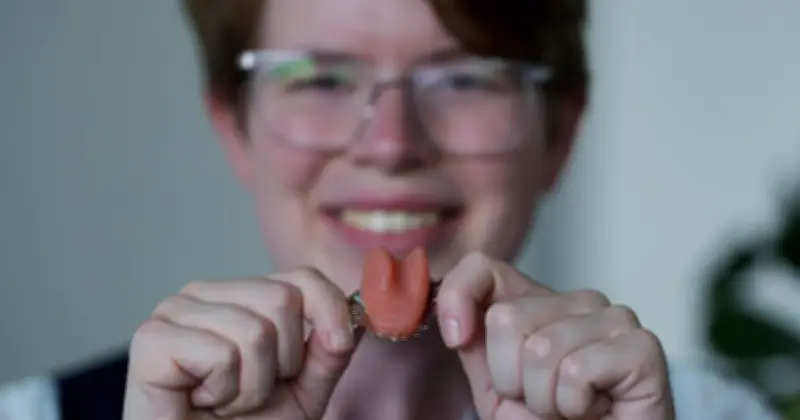
After months of research and scans, the team created two trial tongues before refining the final version, which she received last year. The prosthetic features a U-shaped frame made of cobalt chrome that clips onto Dr Brooks’ bottom teeth, with a fixed silicone tongue tailored to her.
Michael Brown, dental technician at Guy’s Hospital, said: “We’d never made something like this before, but our team loves a challenge. We based the design on a shape which would allow Imogen to make the maximum number of sounds. There was a lot of trial and error in finding a shape that would work. Imogen would work with Carolyn on making sounds with her prototype prosthesis.”
“Then she would take home a design, try it out and come back to us with lots of notes. It has been so satisfying to have worked with Imogen through this.” After presenting the findings at conferences in the UK, Ms Doughty believes this is the first time a prosthetic of this kind has been made on the NHS.
Life-Changing Impact
It took a couple of weeks for Dr Brooks to get used to the new tongue, though she noticed improvements in her speech after just three days. She has since passed an oral exam for her doctorate in skin disease therapies at King’s College London, and says the prosthetic has made a “massive difference” to her life.
“What I really notice is how much more willing people are to listen to me, how much less difficulty they have understanding me, and when they have difficulties, how much more willing they are to ask me to repeat myself,” she said.
The prosthetic has also improved conversations with her grandmother, who is hard of hearing. “I was often using very big hand gestures. I was writing a lot. If we were in a group conversation, that was a real challenge,” Dr Brooks told the news agency.
She visited her grandmother after getting the first prototype tongue, without telling her about the prosthetic. “We were having a conversation and I showed her the prosthetic, and she said this was the first time that I didn’t need hand gestures as much because she was able to follow me a lot better. It’s true with everyone, but perhaps especially with her.”
There have also been physical benefits, with Dr Brooks saying it is “much less effort for me to speak with it”. “I can speak for longer without having to take a breath in the middle of a sentence,” she added. “I don’t have to think as much about what I’m saying, so it means that my speech is much more fluid and it’s much less tiring for me to speak. That in itself is massive.”
Dr Brooks said the cancer symptoms she experienced were very mild, and she even feared she was “overreacting” when she went to her GP. She told PA that it was a “massive shock” when she was diagnosed, but there is now no sign of the disease.
“Even immediately after surgery, one of the first things I said to my speech therapist was, ‘I want to fight for every single bit of intelligibility that is possible’,” she said. “I hope this inspires other medical professionals to also collaborate with patients and to work to improve quality of life in whatever form that may be.”