

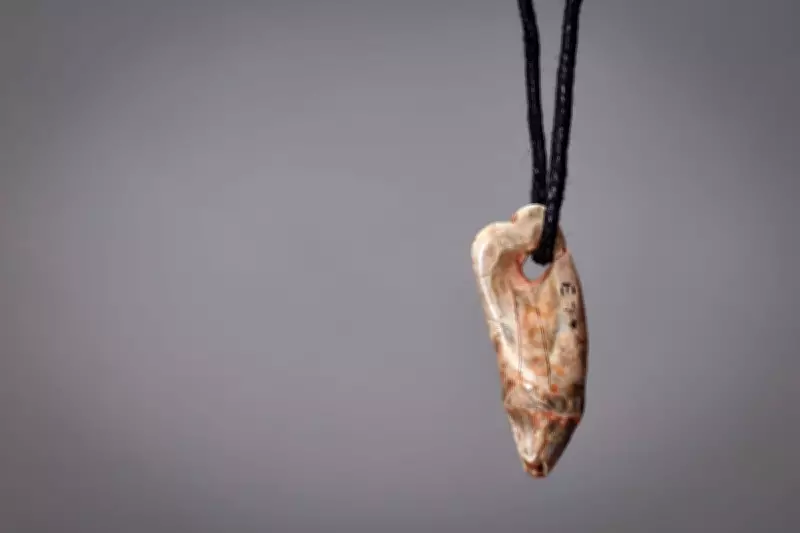
Ancient Seal Tooth Pendant Found in Devon Cave Reveals Stone Age Maritime Culture
A remarkable piece of prehistoric jewellery, discovered in a West Country cave, is shedding new light on one of Stone Age Europe's most spectacular cultures. Known as the Magdalenian, this 21,000 to 13,000-year-old prehistoric civilization dominated much of Western Europe, including southwest France, northern Spain, and parts of Britain and Germany, during the final millennia of the Ice Age.
Groundbreaking Analysis of a Unique Artefact
A detailed scientific analysis of the British Magdalenian jewellery item, conducted by researchers from University College London and the Natural History Museum, has identified it as a polished pendant crafted from a seal's tooth. This artefact represents the first such discovery in Britain and only the fourth found anywhere in Europe.
The pendant was originally unearthed in Kent's Cavern, near Torquay in Devon, and dates back approximately 15,000 years. Scientific investigation has revealed it to be a premolar tooth from a grey seal, meticulously polished and perforated by a Magdalenian artisan using a handheld flint boring tool.

Evidence of Fashion-Conscious Stone Age Society
This discovery adds substantial evidence that Stone Age Magdalenians were extremely fashion-conscious, with a particular preference for maritime-originating jewellery. Beyond the four known seal-tooth pendants, numerous sites across Europe—often located far from the coast—have yielded thousands of marine shells used as personal adornments.
These shells were fashioned into pendants, used to embellish clothing, and incorporated into necklaces, bracelets, anklets, and headwear. Microscopic analysis of the wear pattern in the hole of the Devon pendant indicates it was suspended on a cord and worn for many years, possibly even decades.
It is conceivable that this pendant served as a valued heirloom, passed down through several generations of the same family.Long-Distance Connections and Cultural Significance
The significance of this artefact to the Kent's Cavern Magdalenian community—likely an extended family living there seasonally for generations—is underscored by its origin. The seal tooth would have been imported from the seashore, which during Magdalenian times was between 50 and 100 miles away.
However, a direct river connection existed between the cave area and the sea via the prehistoric lower course of the River Teign, now submerged under the English Channel, and along a major prehistoric waterway known to archaeologists as the Channel River. This waterway connected to the Atlantic, with the Thames, Rhine, and Seine serving as its major tributaries during that era.
Even when living hundreds of miles inland, Magdalenian people maintained a strong cultural connection to the sea.
Maritime Resources and Technological Innovation
Via the Channel River and its tributaries, Magdalenians had easy access to the Atlantic. They utilized periwinkle shells, European cowrie shells, 'tusk' shells, fossilized molluscs, sea urchin spines, and sharks' teeth to create jewellery and other adornments. These items were highly valued, often imported from hundreds of miles away.
Shells were also transported to inland Magdalenian sites in France, Spain, Germany, and Czechia from the Mediterranean, some traveling up to 600 miles. Large shells, such as giant sea snails measuring up to 40 centimetres long, were converted into musical instruments, while marine mammals like seals and whales featured prominently in Magdalenian art across France, Germany, and Spain.
This maritime connection was likely facilitated by early boat technology. Magdalenians and their neighbours were probably among the first Europeans to develop and use boats, with evidence of sea journeys dating back at least 20,000 years in prehistoric Italy and 14,000 years in the eastern Mediterranean.
A Sophisticated and Complex Society
The Magdalenians are recognized as one of the earliest culturally and socially complex societies on Earth. Their sophistication is attributed to a significant increase in human population and community size—sometimes up to 100 individuals—enabled by expanded food resources from wild animals, driven by favourable climatic conditions.

While renowned for their spectacular cave art at sites like Lascaux in France and Altamira in Spain, ongoing research is revealing a more comprehensive picture of this extraordinary Ice Age civilization. Recent studies indicate that Magdalenians used domesticated dogs to enhance hunting efficiency, developed extensive long-distance trade networks, and organized large-scale inter-communal gatherings involving hundreds of people.
Over the past three years, archaeologists have even explored the possibility that the Magdalenians developed an early form of writing system.
Ongoing Research and Future Discoveries
Although the seal tooth pendant has only recently been identified, it was originally discovered in the 19th century alongside various Magdalenian tools and hunting equipment, including flint and ivory spear points. In recent years, scientists from Canada and California have conducted GIS mapping surveys of Kent's Cavern to better understand the cave's use by prehistoric inhabitants.
Meanwhile, DNA from Magdalenian human bones found in Gough's Cave, Somerset, is being studied by Natural History Museum scientists to investigate prehistoric ritual cannibalism. Excavations in southwest Wales later this year are expected to uncover additional evidence of Magdalenian culture.
The groundbreaking research on the seal-tooth pendant is published this week in the international academic journal Quaternary Science Reviews. Dr Simon Parfitt of University College London's Institute of Archaeology, lead author of the study, stated, "The pendant offers a remarkable glimpse into the symbolic and social lives of people over 14,000 years ago."
Dr Silvia Bello of London's Natural History Museum added, "Although similar seal tooth ornaments have been discovered at Magdalenian sites in France and Spain, this is the first known example from the British Isles. Its discovery adds a new dimension to our understanding of shared cultural traditions and symbolic practices across Ice Age Europe."





