

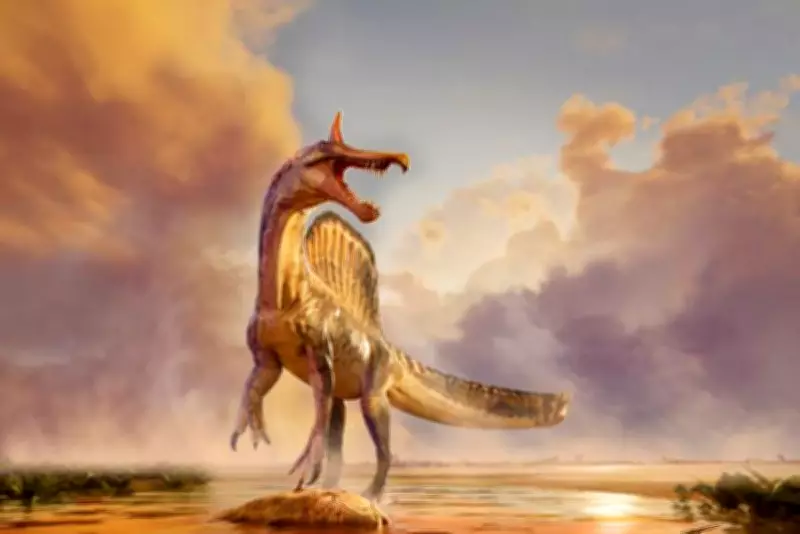
A groundbreaking fossil discovery in the Sahara Desert is fundamentally reshaping our understanding of one of the most iconic dinosaurs from Jurassic Park lore. Researchers from the University of Chicago have unearthed a new species of Spinosaurus that challenges long-held assumptions about this massive predator's aquatic lifestyle.
The 'Hell Heron' Revelation
The newly identified species, named Spinosaurus mirabilis, was discovered by a team of approximately twenty researchers in Niger's central Sahara region. This remarkable find provides crucial evidence about how these enormous creatures actually moved and hunted. Unlike previous theories suggesting Spinosaurus was a fully aquatic predator, this fossil indicates the dinosaur functioned more like a "hell heron" - wading through shallow waters rather than pursuing prey in deep marine environments.
Distinctive Physical Characteristics
Spinosaurus mirabilis possessed several distinctive features that set it apart from previously known specimens. Most notably, the species had scimitar-shaped crests on its back that were sheathed in keratin. These crests likely served as brightly colored display features, curving skyward like blade-shaped beacons. The fossil also reveals interdigitating teeth, with lower jaw teeth protruding outward and fitting between those of the upper jaw - creating a deadly trap perfectly adapted for catching slippery river fish.

Inland Habitat Discovery
Perhaps the most significant aspect of this discovery is the location where the fossil was found. Previous Spinosaurus fossils had only been discovered in coastal deposits near shorelines, leading many researchers to conclude these dinosaurs were primarily marine predators. The new fossil, however, was unearthed 500-1,000 kilometers from the nearest marine shoreline, indicating Spinosaurus also inhabited forested inland environments dissected by rivers.
After analyzing other fossils found in the same area, researchers determined that Spinosaurus mirabilis likely coexisted with long-necked dinosaurs in riverside habitats approximately 100-95 million years ago. This represents a major shift in our understanding of where and how these creatures lived.
A New Evolutionary Phase
The discovery represents a previously unknown phase in the evolution of these massive, fish-eating dinosaurs. According to the study published in Science, the evolutionary progression occurred in three distinct phases. During the Jurassic Period, these reptiles first developed their elongated skulls for fish-catching. In the Early Cretaceous Period, Spinosaurus spread as predators along the coast of the Tethys Sea.
The newly discovered species represents the third phase, where Spinosaurus specialized as shallow water predators in northern Africa. "This find was so sudden and amazing, it was really emotional for our team," said palaeontologist Paul Sereno, an author of the study. "I envision this dinosaur as a kind of 'hell heron' that had no problem wading on its sturdy legs into two meters of water but probably spent most of its time stalking shallower traps for the many large fish of the day."
Discovery Details
The research team experienced a particularly memorable moment during their discovery process. Dr. Sereno recounted, "I will forever cherish the moment in camp when we crowded around a laptop to look at the new species for the first time, after one member of our team generated 3D digital models of bones we found to assemble the skull - on solar power in the middle of the Sahara." This technological achievement in such a remote location underscores the dedication and innovation of the research team.
The Spinosaurus mirabilis discovery not only adds a new species to the dinosaur record but fundamentally alters our understanding of how these iconic predators lived and evolved. By revealing their adaptation to inland river systems rather than exclusively marine environments, this fossil provides a more nuanced picture of Spinosaurus ecology and behavior during the Cretaceous Period.






