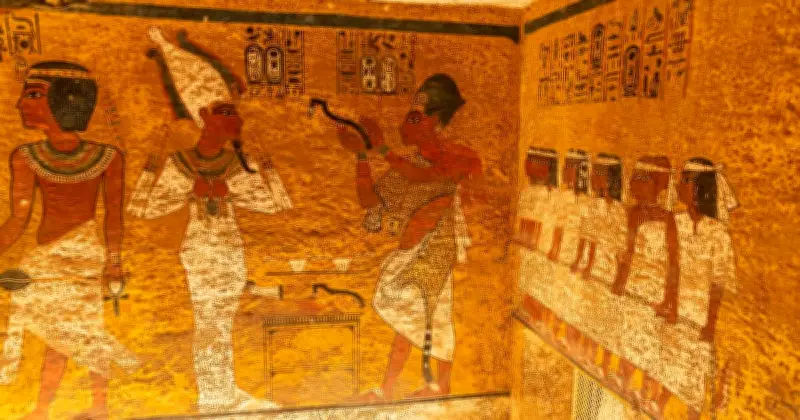
Fresh evidence suggests a hidden complex of corridors and chambers could lie beyond the walls of Tutankhamun’s tomb in Egypt’s Valley of the Kings. Researchers say a combination of geophysical surveys has identified features consistent with man-made rooms near the famous burial site, potentially reviving the controversial theory that the tomb may conceal the burial place of Queen Nefertiti.
Surveys point to hidden complex
The findings are based on new ground-penetrating radar scans, a microgravity survey and earlier studies of the structure and surrounding ground. The researchers say the evidence points to a “hidden complex” which existed before Tutankhamun was buried in the tomb, known as KV62.
Mamdouh Eldamaty, an archaeologist at Ain Shams University in Cairo and Egypt’s former antiquities minister, said that if the findings are confirmed, they could rank among the most significant archaeological discoveries of modern times. But the researchers have stressed that the evidence is not yet conclusive.

Radar detects corridor
The latest study was led by Mr Eldamaty, with structural engineer George Ballard analysing the new results alongside previous surveys. Mr Ballard said the ground-penetrating radar detected what appears to be a corridor around two metres wide leading away from Tutankhamun’s burial chamber. The passage appears to be densely packed with rubble, which could explain why previous investigations failed to identify it.
Researchers then carried out a microgravity survey, a non-invasive technique which detects tiny variations in gravitational fields caused by differences in underground density. More than 1,200 readings were taken across a 35-square-metre area around the tomb.
Anomaly 7 and the Nefertiti theory
According to the team, the results reveal features which could represent artificial chambers, including structures with right-angled shapes and lower density which run parallel to the tomb’s north wall. One feature, dubbed “anomaly 7”, is particularly intriguing. It consists of a largely low-density area containing a roughly square region of higher density. Mr Ballard suggested this could represent a chamber containing objects, although he acknowledged that the researchers are working at the limits of what the equipment can detect.
The possibility of secret chambers beneath or beside Tutankhamun’s tomb has been debated for more than a decade. British Egyptologist Nicholas Reeves suggested in 2015 that KV62 could originally have formed part of a much larger royal tomb. His theory was based partly on lines and cracks in the north wall of Tutankhamun’s burial chamber, together with alterations to the ancient wall paintings. Mr Reeves proposed that the tomb had originally been constructed for another member of the royal family and was later adapted when the young Tutankhamun died unexpectedly. One possibility was that the deeper sections had been sealed off and that they could contain the burial of Nefertiti, who is widely believed by some Egyptologists to have ruled Egypt as a pharaoh.
Caution from specialists
Previous attempts to investigate the theory have produced conflicting results, with some surveys suggesting hidden spaces while others found no convincing evidence. The new evidence has therefore been met with interest but caution from other specialists. Christopher Gaffney, an archaeologist and ground-penetrating radar expert at the University of Bradford, described the report as fascinating but said it did not provide enough information for definitive conclusions. Geophysicist Peter Styles of Keele University said the presence of chambers appeared plausible from the microgravity data, but also wanted to see more evidence.
The researchers now need permission from Egypt’s Supreme Council of Antiquities before they can investigate the suspected spaces directly. If permission is granted, miniature vehicles equipped with cameras could potentially be inserted through carefully drilled holes. Mr Ballard said such drilling could begin as early as November. The proposed chambers appear not to connect to another known entrance, meaning that if they do exist, they may not have been entered since ancient times. For now, however, the question of what lies beyond Tutankhamun’s tomb remains unanswered.