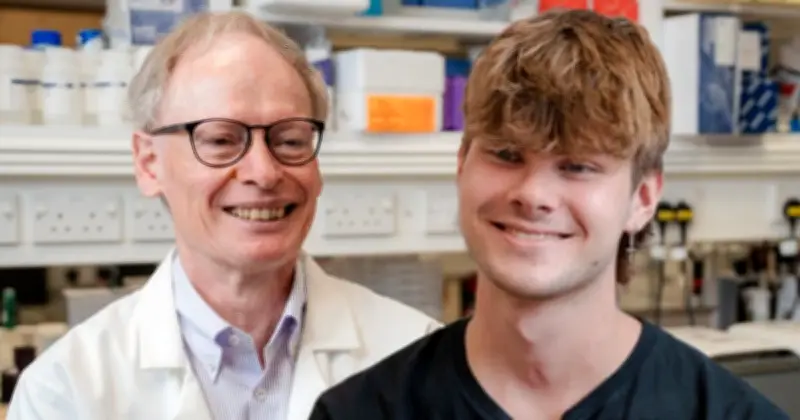
Jack Taylor, who survived a sudden cardiac arrest at 17, has met the scientist leading efforts to cure the rare heart condition he lives with. The 19-year-old visited Professor Hugh Watkins at Oxford University's Nuffield Department of Medicine to learn about research into hypertrophic cardiomyopathy (HCM).
A life-changing collapse
Jack collapsed while playing basketball and was saved by a first aider who performed CPR. He underwent open heart surgery and spent 35 days on life support. Now aged 19, he lives with an internal defibrillator that can monitor and treat abnormal heart rhythms.
Before his cardiac arrest in February 2024, Jack had no idea he had a heart condition. Genetic testing confirmed he has HCM, for which there is currently no cure. His dad and twin brother also carry the same gene variant.
The search for a cure
Prof Watkins leads CureHeart, a project awarded £30 million by the British Heart Foundation to investigate revolutionary gene therapy technology. His team is working on techniques that could edit or silence faulty genes that cause inherited heart muscle diseases.
Some types of HCM are caused by a mutated gene, or a "spelling mistake" in the DNA code. Others, including Jack's, are caused by a missing copy of a gene. Researchers hope to use tools that act like genetic scissors to make precise changes to DNA and correct these mutations.
A personal connection
During their meeting, Prof Watkins discovered he was the first to identify the HCM gene that causes Jack's specific form of the condition. He told Jack: "[The gene] is one that I discovered when I was early in my research career in 1995, and I've got scientists in the lab working on the exact gene change that you have and are trying to find ways to fix it."
Jack, who is studying software engineering at Nottingham Trent University, said: "Meeting someone who has dedicated their entire career to understanding and treating conditions like mine is pretty amazing. Hopefully one day I'll be cured of this, but more importantly, the next generation. Hopefully they won't have to go through what I've gone through."
Prof Watkins said the project is moving closer to testing new treatment approaches in patients. He added: "By the time Jack has kids, say they inherit the gene change, I really hope by that time we'll have found a cure."
Jack is sharing his story to mark World Heart Day on Tuesday.