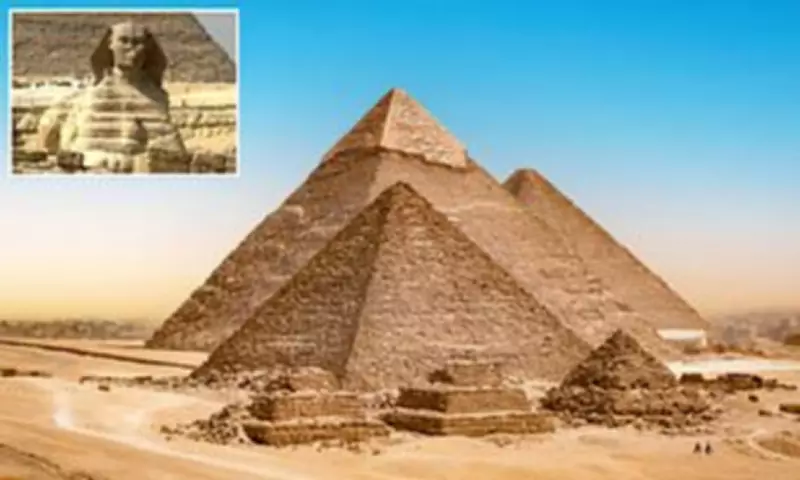
Radical Theory Suggests Giza Pyramids Predate Ancient Egypt by Millennia
An independent Egyptologist has put forward a controversial claim that could fundamentally reshape our understanding of human history. António Ambrósio, a researcher affiliated with the Autonomous University of Barcelona, proposes that the three main pyramids at Giza are not 4,600 years old as conventionally believed, but may date back up to 12,000 years.
Evidence of a Forgotten Supercivilization
Ambrósio's paper, titled 'The Pyramids of Giza: Legacy of an Unknown Civilization,' argues that these iconic structures were constructed by an advanced culture that existed long before the rise of ancient Egypt. According to his theory, the Egyptians merely discovered and repurposed these already-ancient monuments.
The researcher points to several key inconsistencies that challenge conventional Egyptology:

- No royal mummies or burial items have ever been found inside the Giza pyramids, despite their supposed function as tombs for pharaohs Khufu, Khafre and Menkaure
- The engineering precision of the main pyramids—including perfect alignment with star constellations, super-precise stone cuts, and near-perfectly level bases—was never matched by later Egyptian pyramids
- The Sphinx shows signs of water erosion from heavy rainfall, which hasn't occurred in Egypt since approximately 5000 to 3000 BC
Questioning Historical Records
Ambrósio challenges the traditional evidence linking the pyramids to Fourth Dynasty pharaohs. He notes that there are no definitive ancient writings directly connecting these rulers to the pyramids' construction. The primary evidence—the Khufu cartouche found inside the Great Pyramid—has been questioned by some scholars who suggest it may have been faked in the 19th century.
'No mummy has ever been found in the pyramids of Giza,' Ambrósio states in his paper. 'The discovery of a supposed sarcophagus of Khufu, found empty, does not prove that he built the pyramid—only that he claimed it.'
Global Connections and Lost Knowledge
The researcher's theory extends beyond Egypt, suggesting that similar megalithic structures found worldwide—including Sacsayhuamán in Peru and Baalbek in Lebanon—point to a global network of this lost civilization. These structures share architectural characteristics with the Giza pyramids, suggesting shared building techniques and knowledge.
Ambrósio theorizes that this advanced culture may have tracked cosmic cycles and embedded sophisticated knowledge about the universe into their monuments. The perfect alignment of the Giza pyramids with Orion's Belt supports this interpretation.
Supporting Research and Alternative Dating
Recent studies have provided additional evidence for the pyramids' greater antiquity. Measurements of erosion at twelve points around the base of the Great Pyramid suggest it could be over 12,000 years old. Italian engineer Alberto Donini from the University of Bologna has even suggested, based on erosion patterns, that the structure might date back 20,000 to 40,000 years.
Other researchers, including Graham Hancock and Robert Schoch, have championed similar theories about a lost civilization thriving approximately 12,000 years ago. They connect this to the Egyptian mythological concept of Zep Tepi, or 'the First Time,' which they interpret as a historical golden age rather than purely mythological narrative.
Implications for Human History
If Ambrósio's theory proves correct, it would require a complete rewriting of human history. The existence of a sophisticated civilization capable of constructing such precise megalithic structures thousands of years before the rise of ancient Egypt would challenge our understanding of technological development and cultural evolution.
The researcher notes that Egyptian pyramids built after Giza were noticeably smaller, contained construction flaws, used weaker materials, and lacked astronomical alignments—suggesting that the knowledge to build the original structures had been lost.

Independent researcher Matthew LaCroix has suggested that this advanced civilization may have hidden sophisticated codes through geometry, symbolism, and monument design across the globe to preserve knowledge ahead of catastrophic events. Recent discoveries of recurring symbols and architectural features across continents, dating back 38,000 to 40,000 years, lend further support to this theory.
While Ambrósio's paper has not yet undergone peer review, it represents a growing body of alternative research challenging conventional archaeological timelines and opening new questions about humanity's ancient past.