

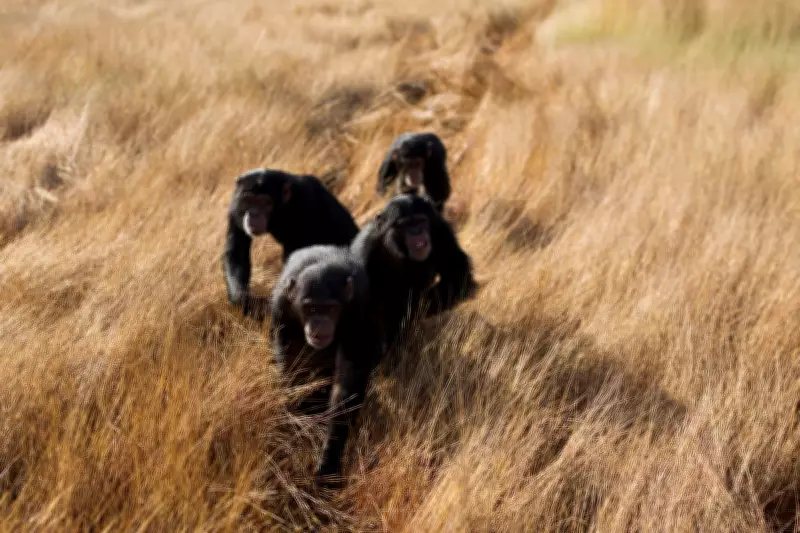
Chimpanzee Civil Conflict Illuminates Human Warfare Origins
Could a brutal internal conflict among chimpanzees provide crucial understanding about why human societies repeatedly engage in warfare? Researchers examining a rare large-scale war within the world's largest chimpanzee community believe this violent episode offers significant insights into the belligerent nature of humanity, our closest biological relatives.
Violent Split in Primate Society
The unprecedented conflict among the Ngogo chimpanzee community in Uganda's Kibale National Park has resulted in the documented killings of seven adult males and seventeen infants across ten miles of protected territory. This violent feud represents an extraordinary case of former allies turning into lethal enemies within a remarkably short timeframe.
According to Yale University researchers, the sudden deaths of several key male leaders within the Ngogo community may have served as the catalyst for this devastating war. The patriarchal group, comprising approximately 160 members, fractured into two distinct factions following these losses, creating a dramatic polarization within what was once a cohesive social unit.

Shocking Transformation of Relationships
"It was shocking to see chimpanzees that once maintained close, intimate friendships transform into violent, lethal enemies within just a couple of years!" exclaimed primatologist Iulia Bădescu in a social media post following publication of these groundbreaking findings. This rapid deterioration of social bonds provides a compelling parallel to human conflicts that escalate with surprising speed.
The research team, led by Aaron Sandel, an associate professor of anthropology at the University of Texas at Austin, documented twenty-four separate attacks by one faction against their former allies over a seven-year period following the initial polarization in 2015. These attacks specifically targeted adult males and infants, demonstrating strategic violence within the conflict.
Decades of Data Reveal Patterns
The comprehensive report draws upon multiple data sources collected over extensive periods:
- GPS-based ranging data spanning decades
- Social network analysis covering twenty-four years
- Demographic information collected over three decades
This wealth of information allowed researchers to analyze three distinct phases: the initial shift from group cohesion to polarization, a two-year period of increasing avoidance between factions, and finally the emergence of lethal aggression between the divided groups.
The findings "provide evidence that shifting relationships, independent of cultural markers, can fracture a community and catalyze collective violence," according to the published report. This challenges conventional assumptions about what triggers violent conflicts within social groups.
Implications for Understanding Human Warfare
The central question emerging from this research concerns whether these findings can illuminate human conflicts that have persisted for over ten thousand years. The debate about whether warfare represents an inherent aspect of human nature or emerges from specific circumstances remains vigorously contested within academic circles.
While the new research doesn't definitively resolve this longstanding debate, it suggests humans may need to reconsider fundamental assumptions about the factors that precipitate warfare. Sandel and his colleagues argue their work challenges the notion that human conflicts, including civil wars, originate primarily from identity differences or cultural distinctions.
"If relational dynamics alone can drive polarization and lethal conflict in chimpanzees without language, ethnicity, or ideology, then in humans, those cultural markers might be secondary to something more basic," Sandel explained. This perspective suggests that beneath surface differences, more fundamental social dynamics may drive human conflicts.

Historical Context and Comparisons
Sandel's research builds upon decades of prior chimpanzee observations and helps contextualize the only other documented instance of large-scale chimpanzee conflict recorded by renowned primatologist Jane Goodall in the 1970s. The Gombe Chimpanzee War in Tanzania lasted four years and involved killings and territorial conquests, though it eventually resulted in reunification.
A significant distinction between these conflicts involves potential human influence. While researchers provided food to Gombe chimpanzees during their conflict period—a factor whose impact remains debated—no such intervention occurred with the Ngogo chimpanzees in Uganda, making the current case particularly valuable for understanding natural conflict dynamics.
Uncomfortable Parallels to Human Society
Anne Pusey, a retired primatologist who worked with Jane Goodall in Tanzania and wasn't involved in the new study, told media outlets: "I was struck by some of the similarities of what they've described to what we observed in Gombe. It's rather uncomfortably familiar seeing how these relationships can break down and then lead to antagonisms between groups that weren't there before."
This "uncomfortable familiarity" highlights the profound connections between chimpanzee social dynamics and human conflict patterns. The research suggests that understanding these primate conflicts might ultimately help humans develop strategies to reduce societal tensions in our own communities.
Sandel concludes that if chimpanzees can experience such dramatic polarization and violence without cultural divisions, humans "may have the potential to reduce societal conflicts in our personal lives" by addressing more fundamental relational dynamics. This perspective offers both sobering insights about our evolutionary heritage and potential pathways toward more peaceful human societies.





