

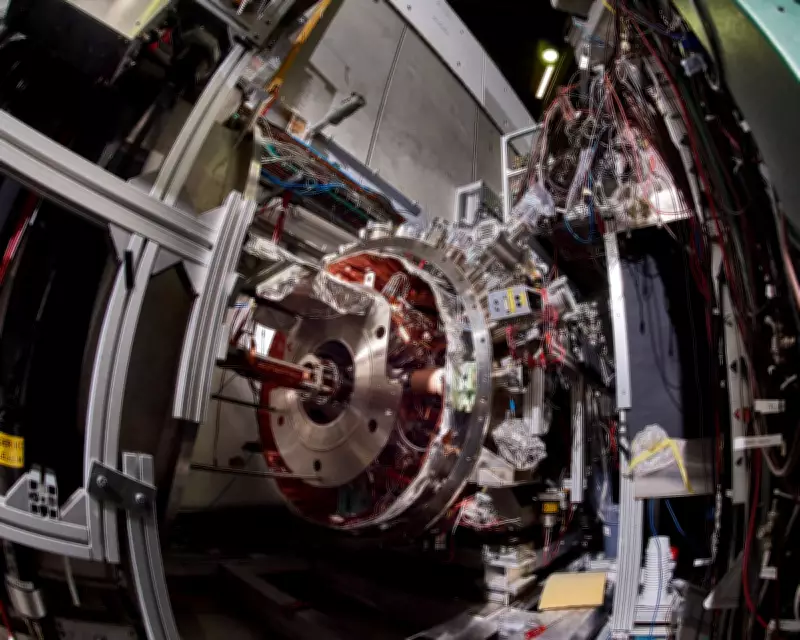
CERN's Antimatter Factory Prepares for Historic Transport Test
In a landmark scientific endeavour, researchers at CERN, the European particle physics laboratory near Geneva, are gearing up for the world's first attempt to transport antimatter. This volatile substance, which annihilates into pure energy upon contact with normal matter, will be carefully moved in a one-tonne device during a 20-minute test run around the campus later this month. If successful, this test could pave the way for transporting antimatter to other laboratories for advanced studies.
The Quest to Understand Cosmic Imbalances
Dr Christian Smorra, a physicist on the Baryon Antibaryon Symmetry Experiment (BASE) at CERN, highlights the core motivation behind this effort. "A fundamental question we seek to answer is the origin of matter in our universe," he explains. "Given the existence of antimatter, it's natural to wonder why it is so scarce. We are actively hunting for clues to unravel this cosmic mystery." According to modern cosmological models, the Big Bang produced equal amounts of matter and antimatter, yet today's universe is overwhelmingly composed of matter, a puzzle that scientists aim to solve through precise measurements.
Antimatter: From Science Fiction to Scientific Reality
While antimatter has captured imaginations in works like Star Trek and Dan Brown's Angels and Demons, its real-world presence is more subtle. For instance, bananas emit antiparticles through radioactive decay, though these are insufficient for deep cosmic inquiries. The device in CERN's test will carry approximately 1,000 antimatter particles, weighing a minuscule fraction of a gram. Should containment fail, the energy release would be negligible, not even warranting a radioactive label.

Engineering Marvels for Delicate Cargo
Transporting antimatter requires sophisticated engineering to prevent contact with normal matter. The trap used in the test maintains an ultra-high vacuum, akin to interstellar space, and is cooled to -269°C to freeze stray gases. Strong magnetic and electric fields hold the antiprotons securely, even during bumps or sharp braking. Power supply is critical; for the initial test, batteries will last about four hours, but longer journeys may necessitate an onboard generator to avoid risks like traffic delays.
Historical Context and Future Implications
Antimatter was first predicted by physicist Paul Dirac in 1928, earning him a Nobel Prize, and was detected four years later by Carl Anderson, who also received a Nobel. Since then, scientists have confirmed a full range of antiparticles, capable of forming anti-atoms and anti-molecules. Dr Jack Devlin of Imperial College London notes, "If we were all made of antimatter in an antimatter universe, we wouldn't notice any difference. The strangeness lies in why our cosmos favours matter."
The Antimatter Factory at CERN produces antiprotons by smashing high-energy protons into metal targets, but precision measurements are hindered by nearby decelerator fields. Transporting antimatter to facilities like Heinrich Heine University in Düsseldorf could enable measurements 100 times more precise, advancing our understanding of fundamental physics.
This test represents a significant milestone, as Dr Smorra emphasises: "To conduct experiments elsewhere, we must demonstrate we can move antimatter safely. This is a crucial step forward in our scientific journey."






