

Ancient Cave Figurine Offers Clues to the Dawn of Written Language
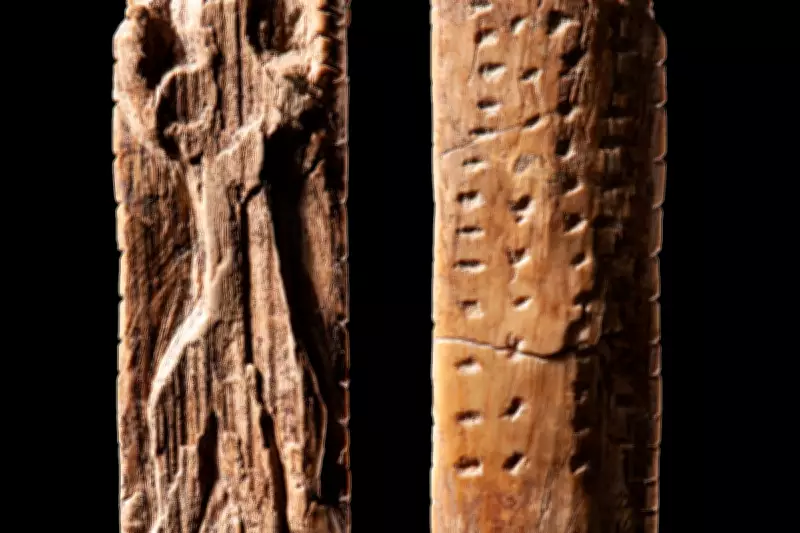
A remarkable 40,000-year-old figurine, unearthed in a German cave decades ago, is providing groundbreaking insights into the cognitive capabilities of Europe's earliest distinct cultures. The "Adorant figurine," meticulously carved from mammoth ivory and depicting a hybrid lion-human creature, bears fascinating sequences of notches and dots. These markings, also found on numerous other artefacts from the same era, are now the subject of compelling new research.
Markings Resemble Properties of Early Script
Fresh analysis suggests these ancient engravings, while not constituting a written language in the modern sense, exhibit properties strikingly similar to an early script that emerged much later in ancient Mesopotamia around 3300 BC. This system was a direct precursor to cuneiform, one of the world's oldest known forms of writing. The discovery underscores the extraordinary intellectual capacity of these ancient peoples, who lived as hunter-gatherers during a period when Homo sapiens were spreading across Europe after migrating from Africa, often encountering Neanderthals.
Researchers employ the term sign types to classify these marks, which include notches, dots, lines, crosses, star shapes, and several others. They conducted an advanced computational analysis of their usage on these artefacts, focusing on a characteristic known as information density. This concept measures the amount of information conveyed per unit, such as a syllable in language or, in this context, a single sign.

Statistical Evidence Points to Conventional Use
"We would argue that these sign sequences go beyond mere decoration intended for aesthetic pleasure. Specifically, our statistical results demonstrate that these signs were applied selectively and according to established conventions," explained linguist Christian Bentz of Saarland University in Germany, the lead author of the research published this week in the prestigious scientific journal Proceedings of the National Academy of Sciences.
For instance, the study revealed that crosses were found exclusively on tools and animal figurines, but never on human figurines, indicating a deliberate pattern of use.
Analysis of Over 200 Stone Age Artefacts
The research team examined more than 200 Stone Age artefacts bearing these enigmatic signs, dating from approximately 43,000 to 34,000 years ago. These items were recovered from four cave sites in southwestern Germany, all associated with the Aurignacian culture. The Adorant figurine itself was discovered in Geissenklösterle Cave, located in Germany's Baden-Württemberg state, and measures about 1.5 inches (38 mm) by half an inch (14 mm).
"The convention to carve specific sign types only onto surfaces of certain artefacts must have been transmitted over many generations. Otherwise, we would not detect these consistent statistical patterns in the data," Bentz emphasised.
It is important to note that the researchers' goal was not to decipher the meaning of the signs, which remains unknown, but rather to analyse their structural properties.
The Aurignacian Culture and Its Artefacts
The Aurignacian culture is renowned for producing some of the oldest-known figurative art in human history. The artefacts analysed in this study were predominantly crafted from ivory sourced from mammoth tusks, though some were made from animal bones and antlers. The collection includes figures of animals such as mammoths, cave lions, and horses, as well as creatures that appear to blend human and animal traits. Additionally, there were various tools, personal ornaments, and musical instruments, notably flutes.
Comparisons with Ancient Writing Systems
The study found that the sign sequences analysed were statistically distinct from modern writing systems. However, they displayed an information density remarkably similar to the earliest examples of proto-cuneiform, the forerunner to cuneiform writing known from the ancient Mesopotamian city of Uruk. Proto-cuneiform eventually evolved into cuneiform, a system employing wedge-shaped marks that was used for millennia across the ancient Near East.

The researchers concluded that the Aurignacian signs exhibit some design features common to written languages, though other critical features, such as a direct connection to spoken language structures, are absent.
"We can only speculate about the status of spoken languages at that time. Generally, archaeologists and linguists would assume that modern humans (Homo sapiens) 40,000 years ago possessed spoken languages structurally similar to those used worldwide today," stated archaeologist and study co-author Ewa Dutkiewicz of the Museum of Prehistory and Early History in Berlin.
This research opens a fascinating window into the sophisticated symbolic communication of our ancient ancestors, suggesting that the roots of written expression may stretch back far deeper into prehistory than previously imagined.





