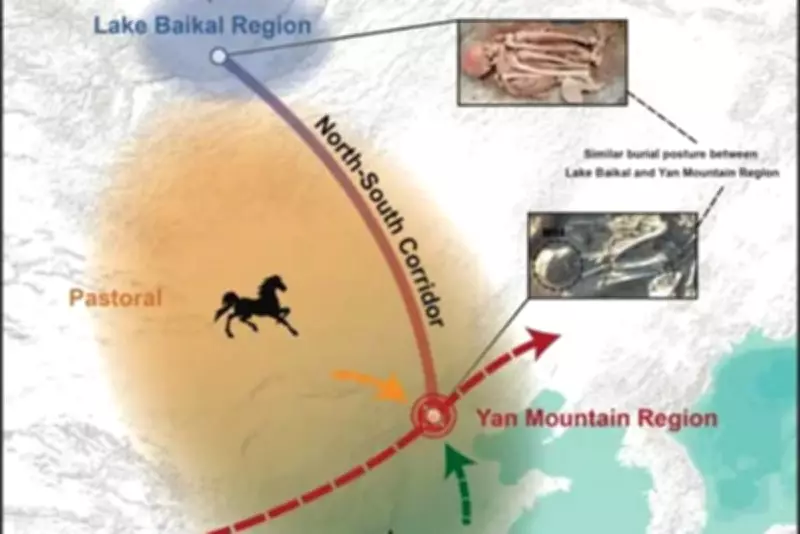
A revolutionary discovery in prehistoric DNA has fundamentally rewritten the population history of East Asia, revealing that human movement between Siberia and northern China occurred far earlier than previously believed. The findings demonstrate that a border zone encompassing these regions played a pivotal role in early human history, acting as a dynamic hub for cultural and genetic exchange.
Unearthing a Hidden Corridor
Previous scientific consensus held that populations in the Eurasian Steppe and northern China remained largely disconnected until the advent of pastoralism and metallurgy around 3000 BC. This view was based on a perceived lack of strong evidence for large-scale interaction. However, a new comprehensive study has completely overturned this long-standing belief.
The research reveals a previously unknown "north-south corridor" of cultural exchange that was active an astonishing 7,700 years ago. This corridor facilitated significant interaction between these distant regions millennia before the technological shifts once thought to have connected them.

The Genetic Link
The study's conclusions are drawn from a meticulous analysis of 42 ancient human genomes, extracted from remains at three archaeological sites. These samples date from 7,700 to 4,300 years ago, providing a deep temporal window into the past.
A key finding identifies a specific population from the early Stone Age Sitaimengguying site in northern China as the critical genetic intermediary. This group carried a distinct genetic signature directly linked to populations from the Lake Baikal region in Siberia.
"The Sitaimengguying population is the critical link," explained study author Yinqiu Cui from Jilin University. "They served as a crucial intermediary, preserving the genetic signal from the Baikal region and allowing us to trace this legacy into later populations in northern China."
Cultural Connections Beyond Genes
The evidence extends beyond DNA, with clear cultural parallels reinforcing the genetic data. Archaeologists noted that unique round-bottomed pottery vessels, found at the Sitaimengguying site, were previously documented only in the Lake Baikal region.
Furthermore, specific burial practices provided another compelling link. The custom of placing male bodies in a lateral position with overlapping limbs, observed at the Chinese site, was also prevalent in communities around Lake Baikal.
Additional genome samples from human remains unearthed in the broader Yan Mountain Region (YMR) offer further proof of this ancient population mixing. "The Yan Mountain Region was clearly a dynamic border zone, a true sphere of interaction," said co-author Choongwon Jeong. "This highlights the YMR's pivotal role in shaping the genetic landscape of northern East Asia."
Reassessing a Key Region
The study underscores the historical importance of Northern East Asia—an area encompassing Siberia, the Mongolian Plateau, and northern China. Researchers posit that the rich water and forest resources of the Lake Baikal region likely made it a crucial centre for early human cultural and technological advancements.
This new narrative, built on genetic and archaeological evidence, paints a picture of a far more interconnected prehistoric world. It challenges previous models of isolated development and highlights the Yan Mountain Region as a long-active crossroads where Siberian and northern Chinese populations met, mingled, and shaped the future demographic tapestry of East Asia.