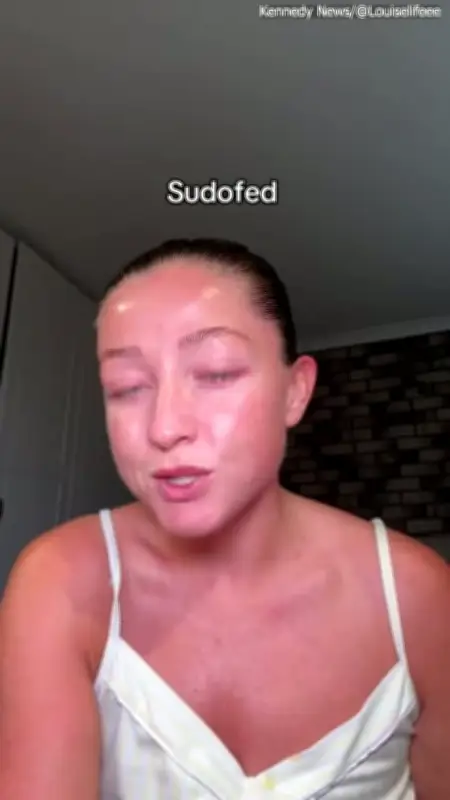
Louise Gough, a 30-year-old business owner from Caerphilly in South Wales, has revealed she struggled with a 10-year addiction to Sudafed nasal spray, which began after she used the product to relieve a blocked nose from a cold at age 18. At her worst, she was using the spray up to 15 times a day and spent an estimated £2,000 on it.
How the addiction began
Gough said the decongestant spray "instantly" cleared her stuffy nose when she first used it. She admitted she did not read the instructions on the box and was unaware that the medication should not be used for more than five consecutive days. This led to rebound congestion, a condition where nasal passages become swollen due to excessive use of nasal decongestant sprays.
To combat the feeling that she "couldn't breathe," Gough initially used the spray up to three times a day, which temporarily relieved her symptoms. However, she quickly fell into a "vicious" cycle, and at her worst, she would spray the medication up her nose up to 15 times a day and could not leave the house without it.
Impact on daily life and relationships
Gough's partner, Matthew Curtis, 38, would often get "annoyed" at her using the spray and spending so much money on it, so she would often secretly buy the product. She said her friends still call her "nasal spray girl." During a family holiday to Greece in 2022, she used two full bottles of the spray in 11 days, which prompted her to quit in August 2023.
Gough said: "I used it [when I had a cold] and instantly within 10 seconds my nose was unblocked. The relief of that was phenomenal. It's partly my fault. I didn't read the box and I didn't realise that you could only use it for a certain amount in a time period. No one ever warned me when I bought it. It just turned into a really vicious cycle. So even when I didn't have a cold, my nose would be blocked so I'd have to use the spray to unblock my nose. After some research, I've found out it's called rebound congestion."
She added: "If I had a tiny little clutch bag, you can guarantee the one thing that would be in it would be the Sudafed. It's a running joke. My best friend calls me nose spray girl even to this day. The nose spray would come everywhere with me. At the height of it, when I went on holiday in 2022, I would use a nose spray the second my nose felt a little bit stuffy. I was probably using it 10 to 15 times a day. We went on holiday and we booked 11 nights away and I panicked and had to take a couple of the nose sprays with me. I took two full bottles and I had one in my carry-on which was a quarter full. I used the two full bottles over the 11 days."
Quitting and recovery
Gough described feeling like a "prisoner in my own body" during her addiction, and she would feel "really anxious" if she forgot her spray on a day out. After going cold turkey in 2023, the first few days made her feel "claustrophobic in her own body" as she struggled to breathe naturally. After a month without the spray, she was finally able to breathe through both nostrils unmedicated.
Gough now urges others to use the medication responsibly, saying: "I would say to others to not bother using nose sprays, it's not worth it. If you have a blocked nose, it lasts two or three days and then goes back to normal. I've had a cold since then and the blocked nose you get with these has never been as bad as the rebound congestion."
Sudafed's response
A spokesperson for Sudafed said: "The safe use of our products is our top priority. Our Sudafed nasal sprays containing xylometazoline are intended for short-term use only and using the product for longer than advised may lead to worsening nasal congestion. Anyone who has been using a Sudafed nasal spray for longer than recommended, or whose symptoms persist after five days, should stop using the product and speak to a doctor for advice. As with any over-the-counter medicine, we encourage people to always read and follow the label before use."
The spokesperson added: "All Sudafed products follow strict regulatory and industry rules to ensure the correct usage information is clearly available on the pack, on the accompanying patient information leaflet, and online via our brand website. We encourage people to speak with a GP or pharmacist if they have any questions about how to use our products."