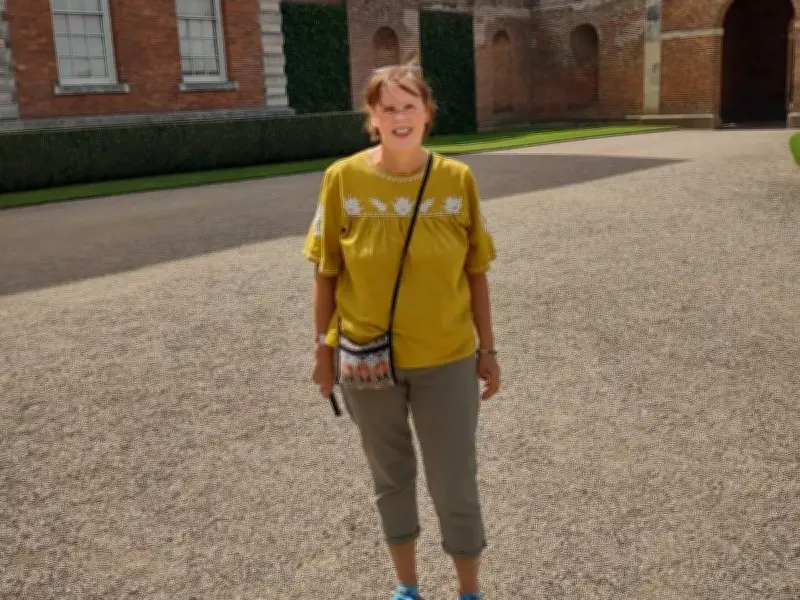
A South Tyneside mum whose husband died of cancer just a week before retirement has backed a campaign highlighting that more needs to be done to tackle crippling health inequalities that affect the North East. Tina Roche, 69, also lives with chronic illness and spoke to ChronicleLive about how motivated she is to help tackle problems which see huge life expectancy gaps.
The gaps are both those which affect the North East more broadly and those which impact people differently depending on where in the region they live. For example, the Health Equals campaign has highlighted how, within South Tyneside alone, there is an 11-year difference between how long people can expect to live.
Living with fibromyalgia
Tina, a former local authority careers adviser and trade union official who lives in Whiteleas, is backing the campaign. She told ChronicleLive about her own illness and losing husband Philip suddenly last summer.

She said: "I have fibromyalgia. It is a condition which has many different aspects to it. It tends to affect my right hand side. It can really depend on the day, and for me it has become really about learning to manage the condition. I have learned over the years how to manage it and how to navigate flare-ups - but they can still sometimes be unbearable. You might end up in bed for three to four days and it is something you can't do much about. Managing it has come with experience. It's about looking after yourself. There are things like a few years ago I lost three and a half stone and that helped. I try to take every day as it comes."
She has been dealing with this for 15 years, she said. She added: "What happened for me was I actually had campylobacter - food poisoning. I was quite poorly and was hospitalised. That was about 15 years ago - but after that I never felt completely well. I was referred to a rheumatologist. At one stage they thought I had reactive arthritis. It took quite a long time but eventually I was diagnosed. At the time I didn't really understand what it was. But what I did do was slowly come to the realisation that it was something that was never going to get better. I just carried on working and probably didn't take it [my illness] as seriously as I should have."
Husband's death highlights inequalities
Tina worked as a local authority careers advisor before moving across to support others as a trade union official. As her illness caused more difficulties, husband Philip played a key role in looking after her when the flare-ups of pain and fatigue floored her.
She explained: "We had only been married eight years but had known each other a long time before that. He was very fit and well. And as I became more unwell - and struggled more to lift things and that sort of thing - he would do so much to help. I love to be in the garden and I would be sitting there telling him what he had to be doing. We were such a great team. If I had a flare-up and was in bed, he would always be helping, leaving me a coffee for example. And he was never really ill - he was diagnosed in April and he died on August 10 last year."
Tina explained that Philip, an industrial electrician, had been just days away from retiring - and she said his death, far too young, highlighted the inequalities faced in the North East.
Campaign statistics
Health Equals is a group of health organisations including charities like Cancer Research UK and groups such as the Royal College of Physicians. It is currently running a campaign called Shelf Life - a stark reminder that people in different areas of the country can expect to live far fewer years than others.
For example, recently published Office for National Statistics (ONS) figures analysed by the campaign show that in Marylebone and Park Lane in London, the average person born today can expect to live to the age of 89. By comparison, in Blyth Cowpen you can only expect to make it to 71. Even within South Tyneside, in South Shields West the average life expectancy is 75, compared to 86 in Cleadon and East Boldon.

Tina added: "When I look at the statistics, and you see that we are still below the average for life expectancy, it's year after year. I think there is still the highest diagnoses of cancer in the North East, for example. I think it's a vital campaign and it is something I am so interested in. It's about how do we help people to keep being well. It's so important and shows we need to look at building blocks and how can we change things and make it better for the people living here."
For Tina, community is one key way in which we can break down these barriers. She explained that since stopping work due to her illness, she has become involved in a number of community and voluntary sector organisations - most notably Women's Health in South Tyneside (WHIST). She also highlighted that being involved in the community had been a huge help to her, both with her own illness and when caring for Philip.
She said: "I felt like I had a lot of skills with which I could help others - I even started just taking minutes of meetings. I got to know the voluntary sector groups and started to be involved with those, and it kept me going. It helps you to value yourself and helps you not to focus too much on the illness. You have to remember: you're not a person with fibromyalgia, you are still Tina. For me that's so important. It's about doing things a bit at a time. Family is so important too!"
TV doctor and author Dr Amir Khan is also backing the campaign. He said: "This campaign is deeply personal to me. I don't just see the impact of health inequalities in my work as a GP, I've lived them too. Growing up working class in inner-city Bradford, I know what it feels like to have the odds stacked against you and how difficult life can be when you're focused on simply getting through each day. Today, I see these same challenges affecting many of my patients. I see people living in damp homes, struggling with financial insecurity or juggling multiple jobs, and I see the impact that can have on their health. We're very good at treating illness, but health starts long before someone walks into a GP surgery. It is shaped by things like our homes, jobs, education and local environment. Your postcode shouldn't determine your shelf life. But right now, in the UK, it does. That's why these figures should be considered a national crisis, and why we need governments to commit to meaningful action to tackle the root causes of poor health and health inequalities."
Health Equals is calling for the Government to embed working to reduce health inequality across departments. The campaign also has a postcode checker tool on the Health Equals' website which can help people to find out how they are affected and to contact their MP.