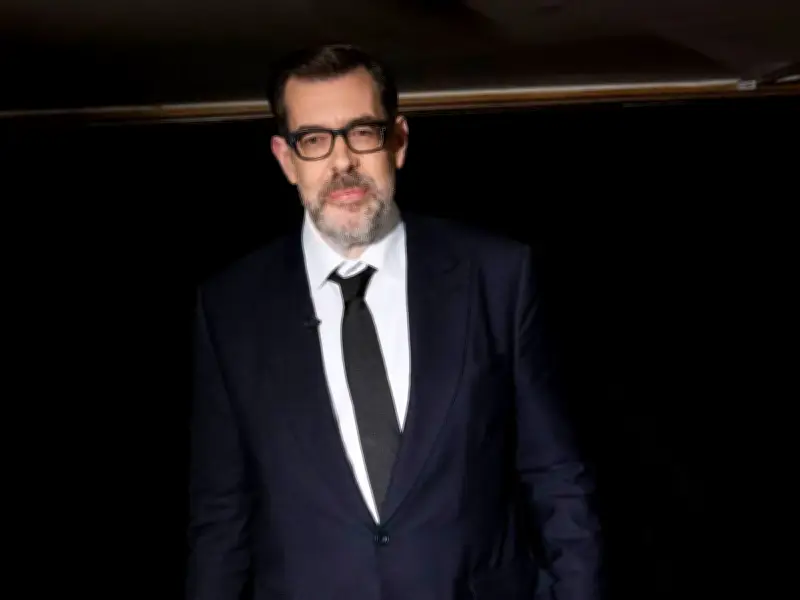
Richard Osman has spoken candidly about living with nystagmus, the incurable eye condition he was born with that causes involuntary eye movement and blurred vision. The Pointless host told The Times's Robert Crampton that his condition has shaped his life and career, and that he has "had it my whole life."
Condition from birth
Osman's nystagmus triggers continuous involuntary eye movements and impairs his sight, which has prevented him from driving. His mother Brenda instilled in him the belief that he could pursue any path he desired, though his childhood dream of joining the police force was gently steered elsewhere. She allowed him to sit unusually close to the television as a youngster, recognising this would let him see details that everyday life might obscure.
This connection with television has fundamentally influenced Osman's professional journey. He created programmes including Prize Island for ITV and Deal or No Deal for Channel 4 before moving in front of the cameras for his own creation, the BBC's Pointless.

Outsider perspective
Beyond establishing himself as a familiar face on shows such as Would I Lie to You?, QI, Have I Got News for You and Taskmaster, Osman has also built a thriving parallel career as an author. He explained that the characters in his novels are frequently outsiders, reflecting how he views himself: "I have always had empathy with people who are different. There's always some p***k letting you know. I've had it my whole life."
He quips that his condition, which leaves him seeing the world through a "dense fog," could technically qualify him for the Paralympic Games. "I could be a Paralympian," he says, ruefully adding "if I had any sporting ability."
TV challenges and advantages
During television appearances, Osman's impaired vision creates ongoing challenges. Following his debut on Have I Got News For You, some viewers incorrectly assumed he might have been intoxicated due to his eyes constantly darting about. Unable to see the autocue, he was compelled to memorise his scripts instead: "I also find looking directly at the camera pretty difficult," he told disability access charity Level Playing Field.
"Staring at a fixed point when your eyes are constantly moving can make you feel nauseous and you want to look away," he added. "I prefer my head and body to be off-centre, like in Pointless."
His limited vision, however, has become somewhat of an advantage in his broadcasting career: "When I am editing a TV programme, there is no point asking me about a certain camera angle or the lighting. I can't really see it," he said. "I want to talk about the feel of the show."
He continued: "I've found that while everyone else is thinking about what the set looks like, I am thinking hold on, that joke did not work or that relationship between those two people is not where it should be, and that is all I am focusing on, which is a useful skill."
Family concerns
Certain types of nystagmus can be passed down through families, which briefly worried Osman when he became a father: "Nystagmus was never brought up in terms of what you can and cannot do," he said. "My mum never, ever made a big deal of it."
It was only when he first had kids, with a daughter 15 years ago, that his mother mentioned it: "I remember my mum saying, after all the excitement had died down, 'Have you noticed anything about her eyes?' I said, 'No. Nothing at all,' and there was this look of relief on her face."
He added: "I thought, you've been keeping that bottled up for 27 years and you've never told me you thought it was a big deal."