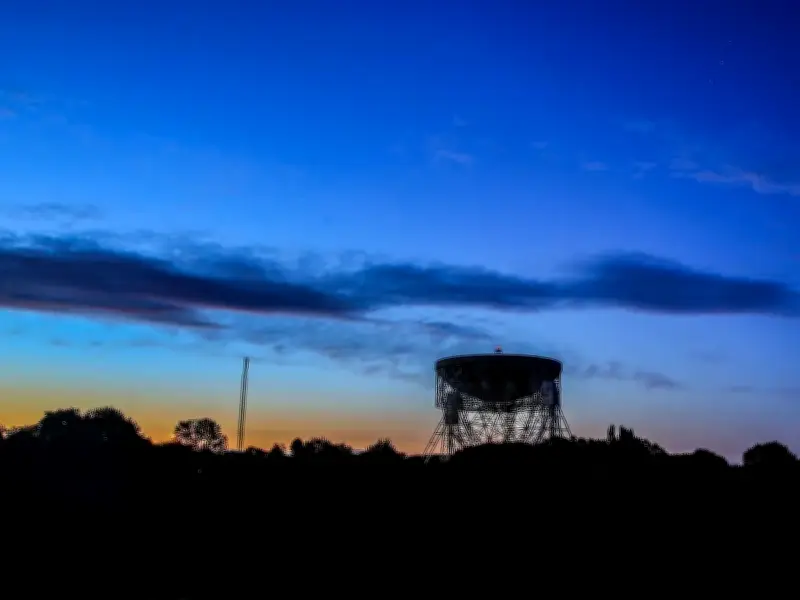
A leading cosmologist has warned that funding cuts threatening the working future of Jodrell Bank's Lovell Telescope would end a key project studying the early universe and 'greatly diminish' research at the Cheshire observatory.
Phil Bull, professor of cosmology at the Jodrell Bank Centre for Astrophysics, based at the University of Manchester, spoke out in support of the Manchester Evening News' campaign to save space science at the site, which has now passed 10,000 signatories. He accused the Government of being misleading in its assessment of what would be affected, saying the cuts would limit the UK's 'ability to turn the big ideas into something real' and lead to the collapse of a key outer space research project.
RHINO project at risk
Professor Bull said he relies on the facility for his research, and on the observatory's technical staff whose jobs are at risk due to the funding cuts. Without them, he added, a key study would go unfinished. He and others have built a new radio antenna at Jodrell Bank roughly the size of a house. It will look for radio signals from around the very first stars and galaxies in the universe. He said the 'RHINO' project was 'helping answer some of the biggest questions in astronomy at the moment', but without the technicians it won't be completed.

"The staff that we rely on are very hard to replace once gone - there are only a few people in the whole world with the right skills and experience," Prof Bull said. "For RHINO we might even have to look at moving to another country where alternative facilities are available."
"It's technically true that there will still be some research going on at Jodrell Bank after the cuts, but with most of the technicians gone, it will be greatly diminished. I think it is misleading for the Government to say that they are protecting world-leading scientific research when a direct consequence of the cuts is that they will remove our ability to pursue a lot of the best and most exciting ideas."
Measuring the first stars
RHINO stands for Remote HI eNvironment Observer - a radio astronomy experiment built to measure faint signals from the early universe. 'HI' is the technical name for neutral hydrogen gas, the type of gas that forms new stars. Prof Bull said: "One of the really big open questions in astronomy is how and when the first stars formed and clumped together to make the first galaxies. We are talking about things that happened over 13 billion years ago, so not very long after the Big Bang. Even super-powerful space telescopes like NASA's replacement for Hubble - the James Webb Space Telescope - can't give us the full picture."
"To really understand, we also have to look at the material that the first stars formed from, and that is the hydrogen gas. It doesn't light up until you have already formed stars out of it. Fortunately, it does show up at radio wavelengths, and so that very faint radio emission is what we are trying to measure."
About 10 years ago, a small table-sized radio telescope in the Australian desert, called EDGES, measured what they thought was this neutral hydrogen signal for the first time. It was extremely puzzling, as their measurements don't fit with any theories of how we think the first stars formed. RHINO, along with a few other telescopes around the world, has been purpose-built to do the best possible job of making a clear and unambiguous 'follow-up' measurement of what EDGES saw.
Impact of losing technical staff
The RHINO antenna has a horn shape and is much bigger than the table-sized Australian telescope. "This lets us focus more deeply on a patch of space, and does a better job of blocking out radio emission from human activity that makes it very, very hard to see the faint neutral hydrogen radio signal otherwise," Prof Bull, 38 and from Wilmslow, said. "This is something Jodrell Bank has traditionally been very good at - making really big things and pointing them at the heavens."
"We couldn't have built RHINO without the radio engineers, designers, electronics experts, welders and so on that have decades of experience, and keep the other 'big stuff' at Jodrell Bank up and running. Losing them and their expertise would make it impossible to embark on big, ambitious scientific projects like this. We would lose our ability to turn the big ideas into something real."

"RHINO is not directly funded by UK Research and Innovation (UKRI), but without the Jodrell technicians we will not be able to complete it."
The University of Manchester, which manages the observatory, said the funding cut to the e-Merlin project - worth around £2.8m a year - would mean the end of the Lovell Telescope as an 'active scientific instrument for radio astronomy' by March 2028, and the loss of 28 jobs. The telescope opened in 1957 and remains the largest in the UK. It's part of the e-Merlin array, a network of telescopes up and down the country operated by the university from the site on the Cheshire plains.
UKRI said e-Merlin would not be prioritised for further funding by the Science and Technology Facilities Council after its current agreement ends in March 2028. The decision puts the functioning of the Lovell Telescope and the e-Merlin array - and the science being worked on within them - at risk.
Broader scientific and national security role
Prof Bull said the telescope allows cosmologists to 'see astronomical objects in the radio in ways nothing else can'. It enables studies to assess how supermassive black holes work - and whether there might be signs of life on other planets. The telescope also monitors pulsars - tiny spinning remnants left over after stellar explosions - and uses them to understand how subatomic matter behaves under intense pressures. It can measure gravitational waves - ripples in the fabric of space and time - as they pass through the solar system.
Work on new technology was also being carried out at Jodrell Bank, including making fold-out antennas for spacecraft and designing new ways of detecting high-frequency radio waves that can be used in airport scanners. "Another big area of activity at Jodrell is related to radar, particularly looking at asteroids and other objects in space to understand how they move and whether they could eventually become a threat," he said. "Taken together, all these things are important for a different mixture of reasons. They answer important scientific questions, or contribute to the development of cutting-edge technologies or our national security. But really, the most important thing that Jodrell Bank does is helping to inspire the next generation of scientists and engineers."
The e-Merlin project that UKRI is withdrawing support for covers a large fraction of the staff salaries, but they typically have a small fraction of their time available that can be paid for with external grants. "This lets us access top experts in things like electronics, radio engineering, people with welding skills, and so on. We would never be able to afford their entire salaries with these smaller grants. The people at Jodrell have been amazing at supporting our project, helping us take it from pie in the sky to a real, working scientific instrument that is letting us do world-leading research from a field in Cheshire."
"Thanks to them, we have been able to secure a super-competitive European Union grant to help run RHINO and analyse the data. The UK pays over £2.5bn per year to participate in this grant system, and is normally one of the top countries receiving grants from this source. Without the Jodrell technicians, I don't see how we could have been competitive. Our competitors in France, the Netherlands would probably have gotten the money instead."
"I'm sad for the people who will lose their jobs, but I'm also sad about the capabilities that will vanish, and all the ideas that we will no longer be able to pursue." He has colleagues working on things like new satellite technologies, new types of space radar to detect asteroids, measuring the echoes of the Big Bang, and making super-cold electronics that can be used in quantum computers, all of which need these skilled technicians in different ways. The Jodrell Bank Centre for Engagement, the visitor centre, is a separate entity and is not at risk as a result of the cuts. The Manchester Evening News has contacted UK Research and Innovation for comment.