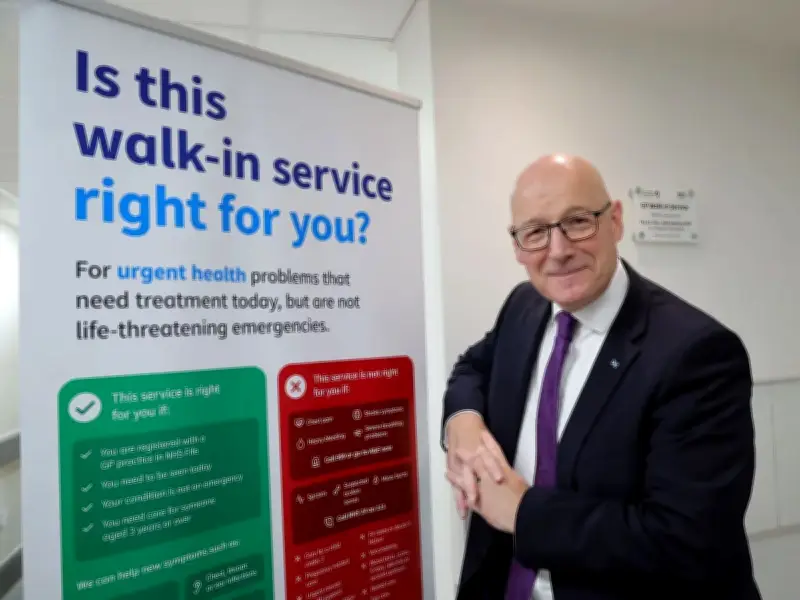
Shotts will soon be home to a new GP walk-in centre after an announcement from the Scottish Government. First Minister John Swinney has announced a further 24 areas across Scotland, including Shotts, will benefit from such provision, as the scheme is being extended to April 2029.
Since February this year, 11 walk-in GP services have opened across Scotland, as part of a pilot scheme to provide essential health and care in a way that’s quick and convenient for patients.
Scheme aims to offer same-day care
The aim of the GP walk-in pilot initiative was to test new ways of accessing same-day care from GPs, advanced nurse practitioners or other clinicians at a wider range of times than previously available. The walk-in centres are designed to provide more choice for patients, while helping to relieve pressure on wider NHS services.

Mr Swinney said: “I promised that my government would break from the status quo and introduce a new way for patients to access same day care – and we are delivering on that commitment.
“We are listening and want to create more choice for patients, closer to home and without the need for a pre-booked appointment.
“In the first six months since we opened the first service in February, more than 10,500 walk-in cases have been seen. As these services are phased in to become fully operational, seven days a week, I am confident that many more people will benefit.”
Local MSP welcomes move
Airdrie MSP Neil Gray, whose constituency includes Shotts, welcomed the move. Writing on social media, he said: “This was a SNP manifesto commitment, one which I campaigned hard on, and is now going to be delivered by the Scottish Government as promised.
“Details around its location and opening are being worked on and I will do what I can to see that progress as quickly as possible.”
However, the plans have come under fire from the Royal College of General Practitioners Scotland (RCGP Scotland), the Royal College of Pharmacy (Scotland), and the Chartered Society of Physiotherapy Scotland.
Professional bodies voice concerns
All three organisations have issued a joint statement ahead of the Scottish Government’s expected publication of the Programme for Government, outlining practical alternatives to GP walk-in centre pilots that would deliver meaningful improvements in patient access to primary care services. The statement calls on the Scottish Government to focus on measures that would deliver sustainable improvements in access and patient experience.
These include investing in modern IT and digital infrastructure, improving information sharing between general practice and community pharmacy, strengthening continuity of care and its well-established benefits, including improved patient satisfaction and reduced mortality, enhancing GP telephony and appointment booking systems, and taking action to address “missingness” across healthcare services.
The organisations argue that these reforms would have a far greater impact on improving access to primary care services while making better use of existing resources and supporting high-quality, coordinated care for patients.
Commenting, RCGP Scotland Chair Dr Chris Provan said: “As a GP, I am as frustrated as patients when difficulties arise in accessing appointments. Patients should be able to see their trusted GP in a timely way, and GPs are committed to supporting efforts that improve access to care.
“That is why we are calling on the Scottish Government to focus on measures that we know will make a real difference. This includes investing in IT and digital infrastructure, supporting practices to improve telephony and appointment booking systems, and tackling the barriers that prevent some patients from accessing healthcare.
“These practical solutions would do far more to help patients see the right healthcare professional at the right time than piloting GP walk-in centres, which risk duplicating existing services at significant cost, worsening health inequalities, and repeating approaches that have failed to deliver elsewhere.
“Ultimately, the most effective way to improve timely access to general practice is to increase capacity within the system. That means training, recruiting and retaining more GPs, and growing the number of appointments available to patients.”

Director for Scotland, Royal College of Pharmacy, Laura Wilson continued: “As a group of Royal Colleges and professional bodies, we are fully committed to improving access to and quality of primary care services, so patients can see the right healthcare professional at the right time and right place.
“Community pharmacies across Scotland are based on local high streets and in other community spaces. These services have high footfall and already provide a wide range of walk-in services for typical conditions such as urinary tract infections, respiratory and chest infections, ear, nose, and throat issues, skin conditions, and eye infections.
“GP walk in centres duplicate this offering and have the potential to divert a significant amount of resources away from where they are needed most.
“From a health inequalities perspective, Community pharmacies buck the inverse care law because their distribution is heavily concentrated in high-deprivation neighbourhoods where health needs are greatest.
“Instead of investing to duplicate resource, we would prefer to see investment directed into revolutionising the existing primary care offering; including by creating interoperable digital systems which allow for patient information to be shared with community pharmacy teams so that pharmacists have access to all the information required to be able to effectively treat patients in the community.”
Commenting on developments, Sara Conroy (CSP Professional Adviser for Scotland) added: “Primary care improvement funding has seen investment in the wider multidisciplinary team, including over 250 advanced practice physiotherapists in GP practices.
“There remains a need to continue to invest in a multi-professional approach to services in primary and community settings, to see patients earlier in the pathway, and to ensure access to the right professional in the right place at the right time.
“There must be a whole-system approach to improving primary care, and workforce planning to provide the healthcare staff and resources needed.”