In a leafy corner of Prestwich, tucked behind the golf club, sits Heathlands Village – a purpose-built care community run by the Federation of Jewish Services that has become the centrepiece of Andy Burnham’s vision for social care reform.
The Prime Minister, speaking at Jewish Care in Golders Green on Wednesday, named Heathlands as the 'gold standard' of what social care could be, as he promised to expedite the Casey Commission into adult social care, improve pay and standards in the social care workforce, and begin cross-party talks.
A 'gold standard' for social care
Burnham said the current state of social care is 'very bad for everybody' and must be reformed 'with urgency'. He pointed to the many people pushed into hospitals for lack of adequate care, the subsequent strain on the NHS, and the need for integration between a national health and national care service.

"It can break people if they're left without the support that they need," he told his audience. "People can see everything they’ve worked for wiped out by the cost of care."
The facility's origins date back to the 1860s, when Manchester’s Jewish community began establishing charities and homes for the elderly. Today, Heathlands can accommodate more than 100 people in residential, nursing and end-of-life accommodation.
Volunteers at the heart
Around 30 per cent of residents are state funded, with the rest paying privately. Residential accommodation costs around £1,300 a week, while council-funded residents receive about £742 per week, with the charity covering the shortfall. To fund the rest of its work, the Fed must raise £2.5 million a year.
The charity is one of the area's biggest employers, with around 300 staff, but its reach extends much further – some 500 volunteers carry out vital work in the local community, reaching approximately one in seven Jewish households in Greater Manchester.
Fed CEO Mark Cunningham believes the centre's success lies partly in that volunteer army. Volunteering can mean helping with shopping, driving someone to a doctor’s appointment, acting as an advocate when clinical jargon seems impenetrable, helping access benefits and pensions, or simply sharing a chat and a cup of tea.
The cost of care
Burnham highlighted the practice of 15-minute care visits used by many councils. "That's all that councils say they can afford for many people," he said.
"£100 a week on Universal Credit might not sound like a lot, but if you haven’t got it, it’s a fortune," said Mark, who became a social worker in 1996.
A team of trained social workers also works from the centre, engaging with anyone from families with a disabled child to victims fleeing domestic abuse, across all ages and "throughout the various phases and challenges of life".
"Whatever their problem is, we’ll try and solve it, and if we can’t, we will signpost them elsewhere," said Sara Ogden-Cunningham, who manages social work and community services.
She described the work as flexible and bespoke: "We get to think holistically and creatively. We might go into a four-generation family, it might be a child with special needs or an older parent. We have a lot of those sandwich generations…it’s not really a sandwich, it’s a club."
Distressing calls
Some of the calls are distressing. Sara recalled visiting a woman fleeing domestic abuse who was living with her child in a house with no furniture and no bed.
Raphi Bloom, director of fundraising, marketing and communications, described the first visit he made with Sara: "I walked into the house and the smell of damp stayed on my clothes the rest of the day."
"There is a stereotype that the Jewish community is all affluent and doesn’t need support - that couldn’t be further from the truth. The doors were hanging off, they had no food. She had sold all her jewellery and ornaments, and were making do with just a microwave and about £10 a week. She was the same age as my mum and she was so dignified but having to pawn her jewellery on Cheetham Hill Road."
The Fed helped the couple with a new fridge and to claim their state pension and some disability benefits – a complex system many older people, or those unfamiliar with the internet, struggle with.

A travesty
Mark has had a front row seat to more than twenty social care reviews since becoming a social worker in 1996. In his speech, Burnham called the lack of action a 'major dereliction of public duty' – something Mark agrees with.
"It gets kicked into the long grass all the time...it’s a travesty that Parliament hasn’t grasped this nettle. It’s unpopular, nobody wants to pay for it," Mark said.
Burnham acknowledged the challenge of funding and the risk of losing everything: "You can have as many headlines as you like about this tax or that, but when people are losing hundreds of thousands of pounds, everything they’ve worked for, well, what about them?"
"Unless we all take some responsibility, it’s just going to carry on," Mark added. "We will all need social care at some point - we’re going to have to pay for it one way or another."
Hospital is 'the worst place'
Burnham cited that the number of over-65s going to A&E had doubled to almost six million a year since 2010. Mark agreed that fixing social care would fix the NHS, and that hospital was 'the worst place' for the elderly.
"People end up in hospital needlessly and once you are, you’re on a pathway and it’s really difficult to get off," Mark said.
"A volunteer might notice someone is not well and refer them to a GP. They might discover a mild infection which, if left unchecked, could have led to hospitalisation and then the pattern of decline."
"I think there has to be a holistic, preventative approach to this, and a recognition that some of the solution lies in the community and not hospital wards. Social care doesn’t have to be over-elaborate - it’s about connections and community and doing the basics well. People are generally proud and dignified, they don’t want much intervention but just some support."
Adding fun back into lives
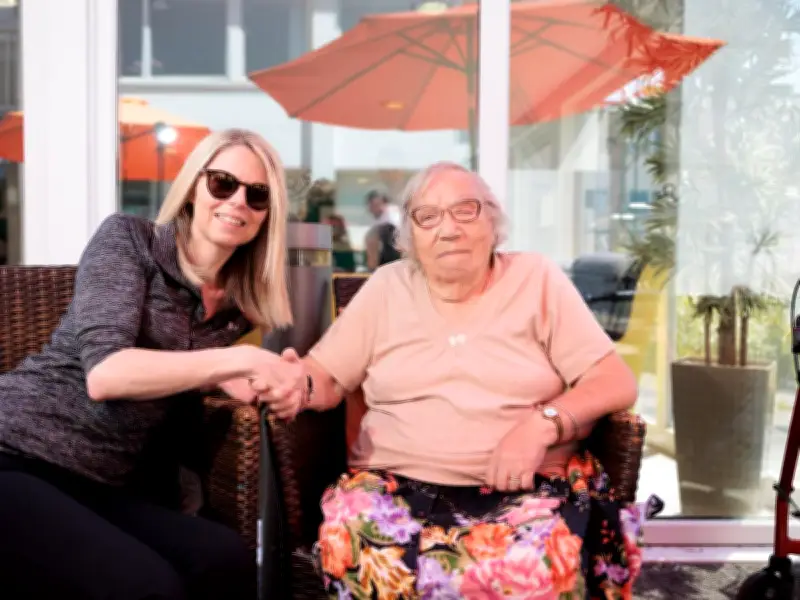
Heathlands offers far more than standard care. There is an industrial-scale kosher kitchen, a nursing facility, a hair salon, a synagogue, mental health support groups, a mums and tots group where toddlers sing with residents, a nursery, animal visits, day trips, music and art therapy, sports days, bingo and dance nights.
Whether it's an ice-cream van in the garden, trips out, animal visits, or music therapy, Heathlands is about "adding fun back into people’s lives," says Mark. "There’s a statistic that says 80% of people that go into a care home and don’t go outside again…not here."
Residents' stories
Heathlands' ethos is all about keeping people at home for as long as possible. The average age of residents is now 91, with several "in the hundreds". Saul Levy, 95, moved in three years ago after a brain haemorrhage and lives in one of the supported living flats, but says he "hardly ever" uses the extra help with dressing or showering.
"It’s done me the world of good, it’s given me another lease of life, truthfully. You can do exactly what you want, go to any activities you like. I get up when I like, shower myself, dress myself, go for breakfast. It keeps me independent."
Gerda Rothberg celebrated her 100th birthday a few months ago and is proud to still wash and dress herself – as well as holding court as Heathlands’ Queen of Rummy. "No-one can beat her," said volunteer Amanda Harris. "It’s very relaxing here," Gerda added.
Gerda came to Britain just before the war with her two sisters from East Prussia, escaping on the Kindertransport. Her story is part of the Fed's My Voice project, which documents the life stories of Holocaust survivors and refugees.
"It’s something I wanted to do for the generations to come, for the people who say the Holocaust never happened," she said. "It did happen, it’s a fact, it’s there in black and white."
A community re-engaging
After the synagogue attack in Heaton Park last year, Heathlands received an influx of messages, Sara said. People who had never come through the doors began approaching the centre, saying they had previously been Jewish "in name only". After the attack, they were scared and wanted to re-engage with their community.
"They wanted to be together with other Jewish people, to feel solidarity, a sense of security and identity," agreed Raphi.
The centre does serve non-Jewish people, but with its synagogue, kosher catering and celebrations of Jewish festivals, it is ideal for those who "wish to see out their days in a warm, loving, state of the art Jewish environment".
Staff are often there for people in their last moments. For clients with no family, the Fed arranges burials, gravestones and commemoration services. "We all feel that is a real privilege," Raphi said. "When Andy talks about his father, and how carers can bring a lucid moment out of him where he can’t, he genuinely means what he says. It’s personal to him."
A model for the future
Mark is confident that Heathlands’ success can be replicated elsewhere, with a strong voluntary sector. "We think we’ve got a really good model for social care and we're cautiously optimistic about the future - that we can improve the system we work within."