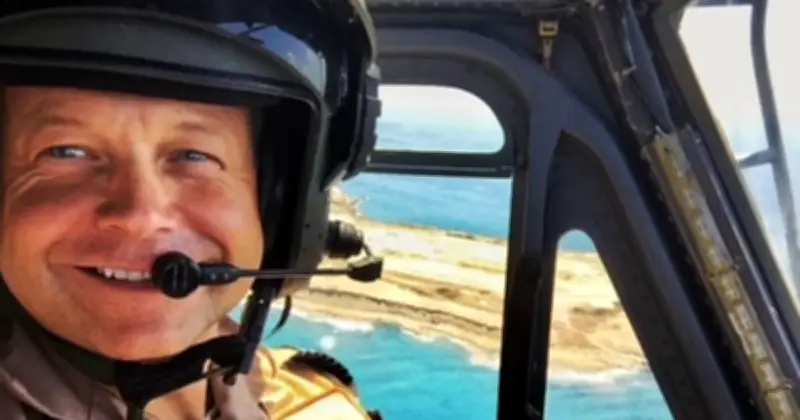
RAF veteran Pip Harding, who was told he had months to live after a stage-four brain cancer diagnosis, has shared an update more than two years later, saying he is doing well.
Group Captain Philip "Pip" Harding, a veteran of Iraq, Afghanistan and Northern Ireland, was diagnosed in March 2024 while serving with US forces in Hawaii. Scans revealed two large tumours on the left side of his brain, and he was initially told he had between six and 12 months to live.
Specialist treatment discovered after farewell
In September 2024, hundreds of RAF colleagues gathered for an emotional farewell at RAF Benson in Oxfordshire, fearing he would not survive. Shortly after, Pip discovered a specialist treatment called oncothermia, which was not available through the NHS and cost around £1,000 per session.
Friends, family and RAF colleagues raised £36,000 in just two weeks to fund 36 sessions, alongside his existing chemotherapy. The fundraising campaign has since raised more than £44,000.
Nine-hour operation and ongoing scans
Pip underwent a gruelling operation on April 1, 2024, during which surgeons removed part of his skull to access the tumour. He recalled: "They removed part of my skull to get into the tumour. It felt like the operation lasted about two minutes because I went to sleep and then woke up." He added: "But it actually lasted about nine or ten hours."
Although surgeons removed much of the tumour, cancer remained, and Pip subsequently underwent six weeks of radiotherapy alongside chemotherapy. He returned to Britain with his wife and children in September 2024 to be closer to his wider family.
Around 420 RAF colleagues and friends gathered at RAF Benson for the farewell, which took place inside an aircraft hangar where he had previously served as a squadron commander. Pip explained: "It was a bit of a goodbye because I didn't have long to live at that point." Despite being seriously unwell, he managed to deliver a speech, saying: "I wasn't particularly well, but I spoke and I said a few words. And got a huge ovation which was just very very moving."
Treatment results and new chapter
Pip began oncothermia in November 2024 alongside chemotherapy and dietary changes, continuing treatment until April 2026. He said subsequent MRI scans showed the tumour had reduced significantly in size, although it has not disappeared completely.
He continues to undergo MRI scans every three months and says he is doing well despite the uncertainty surrounding his condition. He explained: "Alongside the chemotherapy and the diet that kind of has shrunk it down and then it's continued to shrink down in every 3 months MRI scan that I have."
Pip remains realistic, saying: "I seem to be lucky, I suppose, in that the treatment seems to be working for me at the moment, which is great, but you just don't know how long it's going to work."
After 33 years of service, Pip is preparing to leave the RAF on medical grounds in the new year. Having joined in 1993, following in the footsteps of his parents, he became a helicopter pilot and commander of 78 Squadron. He hopes to pursue public speaking, raise awareness of brain cancer and potentially become involved in the Invictus Games in 2027.
His ongoing fundraising campaign could help pay for future specialist treatments in the UK or overseas, including personalised cancer vaccines, immunotherapy and experimental clinical trials.