
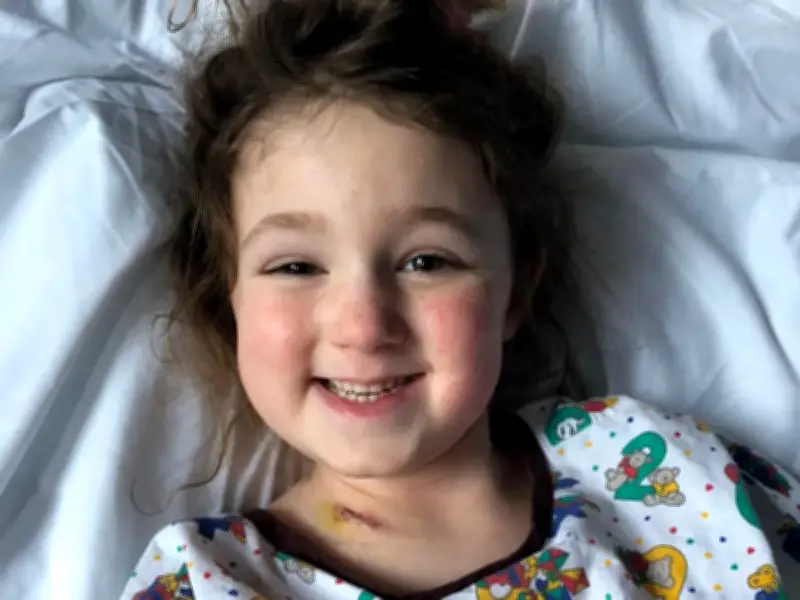
Sally Brown, whose nine-year-old daughter Jessie died in her arms on Mother's Day 2024, has described cancer as resembling a "serial killer that's taking children... and you can't catch them". Jessie was five when doctors identified medulloblastoma – the most prevalent malignant paediatric brain tumour – in November 2019, following symptoms of dizziness and vomiting.
Sally and Mark Brown, from Whitstable, Kent, have since established Jessie's Argonauts, a charity supporting research into gentler, more successful treatments, enabling other children facing a comparable diagnosis to experience the future Jessie was denied.
Diagnosis and treatment
Before her diagnosis, Sally described Jessie as a "sturdy, fit and active" youngster who adored animals and relished swimming sessions. During summer 2019, aged five, Jessie began experiencing fleeting episodes of lightheadedness, accompanied by headaches and sickness.
"Unfortunately, childhood cancer is rare, and I think it's a process of elimination when trying to diagnose something," Sally explained. "The first doctor said it was definitely viral, then it was believed it was gastric... because of the vomiting and the loss of appetite." All routine neurological examinations returned "completely normal" results, yet Jessie's vomiting persisted every two to three days.
After repeated consultations with different physicians, a GP contacted Sally, stating Jessie required scanning at their local hospital. "I was taken aback because it went from, 'Let's try and get this sorted as soon as possible', to, 'I think you should drop everything and leave work now'," Sally recalled. An MRI the next morning revealed Jessie had a brain tumour in November 2019.
Surgery and recovery
Jessie was rushed by emergency ambulance to another hospital, where specialist neurological consultants assumed responsibility for her treatment. Within 24 hours, a shunt was fitted into her brain to remove accumulated fluid, and the clinical team prepared for her subsequent operation.
"We explained to her that there was a 'naughty lump' inside her head that we had to get out, but I never used the word 'cancer'. I didn't want her to be afraid," Sally explained. Jessie then faced a 14-hour procedure to extract as much of the 4cm tumour as surgeons could manage, with the medical team successfully removing 90% of the growth.
The consequences were "initially horrific", Sally described, as Jessie transformed from being an "easy-going, steady child to one who was emotionally labile". She became irrational, distressed, angry and frustrated, while experiencing constant nausea, severe dizziness preventing her from walking, and difficulties speaking and swallowing. She required a stomach tube for nutrition and medication, and one month after the procedure commenced six weeks of radiotherapy.
Remission and relapse
At this stage, Jessie's biopsy findings confirmed she had medulloblastoma – a diagnosis Sally had "never heard of" previously. "We wanted so desperately to be told her tumour was benign, but it was horrific to learn that it was very aggressive," Sally said. Following radiotherapy, Jessie underwent six months of intensive chemotherapy, during which she suffered life-threatening infections and required several emergency blood transfusions.
By the close of 2020, Jessie was declared in remission. According to Brain Tumour Research, only 60% of children survive a diagnosis of medulloblastoma beyond five years, and successful treatments often lead to long-term side effects. Jessie began junior school in September 2021 and, despite struggling with numeracy, "she was doing well" and enjoyed walking her dog, Max.
In March 2022, the couple received the news that the "cancer was back" – and while further treatments were available, nothing was "regarded as curative". Sally said: "They basically just said that it was a terminal diagnosis and that we could have treatment if we wanted. But they were very clear that it would be to prolong her life, not to save it or cure her. There are no targeted treatments available for it."
Final months and legacy
Jessie initially reacted positively to her first chemotherapy regimen, though eventually began displaying indicators that the disease was advancing. Her oncologist secured exceptional funding for a therapy involving injections straight into her brain, which she "tolerated this really well". Sally explained: "We knew that the treatments currently available to her would not cure her, but we wanted to buy her time, and we were hoping for a miracle."
By December 2023, neurological complications emerged, with Jessie unable to manage even writing a comma. No curative options existed globally, no upcoming clinical trials were available in the UK, and Jessie's cancer ceased responding to therapy. Having examined every possibility, the couple decided against further treatment.
The parents were determined to provide Jessie with "as many life experiences as possible", taking her to numerous farms and wildlife centres while arranging various animal encounters. Jessie even penned a letter to David Attenborough – whom she'd dreamed of marrying since the age of three – and received his response mere days before losing consciousness. Jessie passed away on March 10 2024, on Mother's Day, aged nine, supported by her nurses and the palliative care team.
Following her death, Sally and Mark donated Jessie's brain tissue to The Institute of Cancer Research (ICR). Through their charity Jessie's Argonauts, they're now determined to "try and make a difference" by financing additional research and treatments for the disease. Sally said: "We had felt so disheartened that there had been nothing available for Jessie – not a single clinical trial that we could access nor any new drugs to treat her. But we now want to try and make a difference. Jessie was such a kind, special little girl, and she always wanted to help other people. This is something that she would have wanted us to do."




