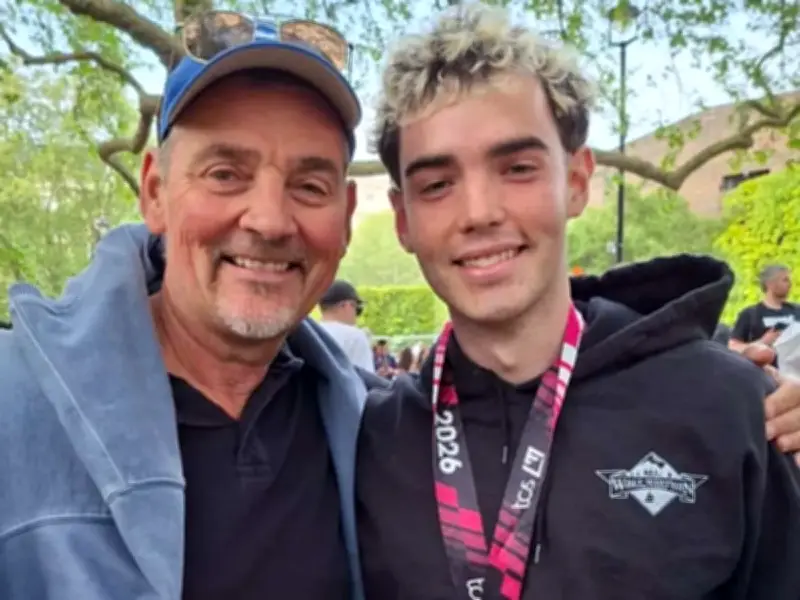
A 22-year-old lifeguard from Manchester says a football injury helped save his life after it led to his cancer being diagnosed early enough to treat.
Student Charlie Wyre took a blow to the head following a football tackle in February 2026. The next day he noticed a swelling on his neck and went to the GP, where he was given painkillers.
By March 10, the swelling was getting bigger and becoming painful, so he went to A&E at Leicester Royal Infirmary, where he was given antibiotics for a lymph-node infection.
Diagnosis and treatment
Two weeks later, at a follow-up appointment, Charlie had a biopsy, which led to him being diagnosed with stage three Non-Hodgkin lymphoma, a blood cancer. He had also been struggling with extreme fatigue in the lead-up to his diagnosis and would find himself napping after work every day.
Charlie, who works as a lifeguard in Manchester, said: "It did seem odd; it was just a knock to the head from someone's elbow as I went into the tackle."
"I was surprised when I noticed the swelling the next day, but I thought it was a trauma injury. I guess that injury actually saved my life by making the cancer visible. Otherwise it could have taken longer before the cancer was noticed and the diagnosis could have been worse."
He added: "It was so unusual for me to be feeling tired. I wondered if it was me adjusting to working life. I would get home from work and I just couldn't move."
Impact and recovery
The tests at the hospital showed that the cancer had spread above and below his diaphragm, and there were bunches of cancer cells around his body. Charlie started six sessions of chemotherapy on April 17, and was given the all-clear on September 22 2025. Six months later, he was told the cancer was in remission.
Charlie said: "I couldn't believe this was happening to me. I was in shock, but I think I protected myself by not allowing myself to feel scared. It felt weird to be given that diagnosis - the worst was happening."
Despite the chemotherapy making him sick, Charlie graduated with a first-class degree in international relations and history from Loughborough University in summer 2026. He also ran the London Marathon in four hours 55 minutes in April 2026 and raised over £18,000 for Teenage Cancer Trust, a charity that helped him and his family during his treatment.
He said: "I just focused on what I could do about it; that was my defence mechanism."
"Chemotherapy was horrible, but I knew it was the way through this, so I did all the treatment and took all the pills absolutely on time. As soon as I was able to do anything, like get out of bed or get some fresh air, I did it."
Charlie is running again for the charity next year and hopes to run it in under four hours.