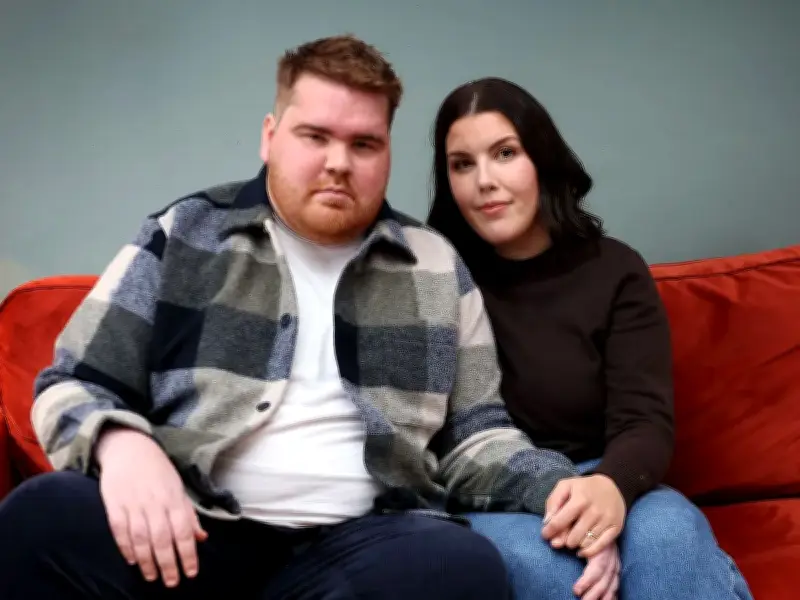
Jamie Kehoe, 31, from Stretford, was told he had 12 to 18 months to live after a dentist visit for tingling and numbness in his mouth. He and his wife Hannah are now cherishing family life with their six-month-old son Elliot.
Jamie, who previously worked in marketing, began experiencing numbness in his mouth in 2024 and booked a dental appointment. The dentist could not find anything wrong, but Jamie was also experiencing other strange symptoms.
Signs something was wrong
Hannah noticed something was not right when Jamie kept tripping over the dog. "I said to him, 'Stop kicking the dog,' and he said, 'I'm not kicking the dog, I'm walking in a straight line,'" said Hannah. "So then we kind of thought, maybe we need to see someone about this."
Jamie booked an appointment with his GP, who became concerned after performing checks and a cranial nerve examination. He was immediately referred to Salford Royal Hospital.
Devastating diagnosis
A scan revealed a mass on Jamie's brain stem, and a biopsy confirmed a grade four glioblastoma. A glioblastoma is a fast-growing, malignant brain tumour. Symptoms can include headaches, nausea, seizures, vision problems, and changes in behaviour and balance.
According to the NHS, brain tumours can affect people of any age, although they tend to be more common in older adults. More than 12,000 people in the UK are diagnosed with a primary brain tumour each year, of which about half are cancerous.
The diagnosis left the couple in a state of "shock". Jamie was referred to The Christie Hospital in Manchester and put on a course of radiotherapy. Hannah says the tumour was the result of a "very rare genetic mutation", and because of its location on the brain stem, it was not treatable with surgery.
Treatment and family milestones
Jamie found his first radiotherapy appointment "terrifying". Hannah added: "They didn't offer chemotherapy because they said it would make him really unwell and it wouldn't give him much more chance of survival. So they said radiotherapy's like the gold standard for this tumour. So it was every day for six weeks, Monday to Friday, six weeks."
During the first round of therapy, Jamie and Hannah brought their wedding plans forward and married in November 2024. They had their honeymoon in Cornwall in the winter despite Jamie feeling unwell.
Jamie was later given a new cancer drug as part of a trial for glioblastoma patients, which he took from March 2025 until August this year. "So that helped Jamie," said Hannah. "He had really positive scans for about a year. We actually ended up doing IVF and had our son, so that's another blessing that came out of it."
Hannah continued: "When he was diagnosed, the initial prognosis was about 12 to 18 months with treatment. So he's surpassed that. But when he had his most recent scan... basically, Elliot was born, and his symptoms started coming back. So we had a good few months when I was pregnant with Jamie being fairly well. He was working again, out walking the dog, really independent. And then pretty much as soon as the baby came, he started kind of losing his balance a bit. Slurred speech slowly came back a little bit. And at the same time, he'd had a scan the week that Elliot was born, and they waited until he was a month old to tell him the tumour had regrown. So in March, the tumour regrew and they said it's going to be months, it's not a long time. So they then offered him another course of radiotherapy, which he took. And he's just finished that in May."
Poetry and awareness
Jamie has written poetry to record and make sense of his experience. Before his illness, he wrote comics and short stories but kept his poetry to himself until he told Hannah he was publishing a book. "When we started dating, Jamie actually used to write me a story every day and text it to me, and it was a bit of an adventure story," said Hannah. "So he'd write me the next part and then give me an option at the end of it, and then I would choose what I wanted this character to do. And then he'd go to work early in the morning, have his coffee and write me the next bit. So he's always written."
Jamie's debut poetry collection, I Used to Write Stories, has been published, with proceeds going to brain tumour research. The collection includes poems about buying wallabies half-price at the Trafford Centre, meeting God at the Christie, and not being able to sneeze anymore.
The book is available in Kindle format on Amazon, and an audio version read by poet Christian Foley is on Bandcamp. Jamie also posts poems on his Instagram page, thegliopoet. The collection is named because a little-known symptom of a brain tumour, especially in Jamie's case, is brain fog, which makes it hard to follow complex narratives, so he found poetry a quick and effective way to explore his feelings.
Jamie is also hosting an exhibition of his poetry at Stretford's Unofficial Museum on King Street on October 17 and 18. He will be there in person to meet people, talk about his work, and sell physical copies of his poetry collection.
Hannah said: "You see people who have cancer, especially in the media, and it's 'I'm seizing life,' 'I'm doing this,' 'I'm living,' 'F U to cancer.' And for Jamie, it was like, well, no, this is devastating. This is how I actually feel day-to-day. That's what I get from his poetry. You see more of an insight into the bad bits, because everyone knows cancer's bad, cancer kills, but you don't know the day-to-day nuances."
Since being diagnosed, Jamie is keen to spread awareness of glioblastomas and brain cancer, encouraging anyone with symptoms to get checked by their GP as soon as possible. According to The Brain Tumour Charity, symptoms can include headaches, nausea or vomiting, balance problems, sight problems, trouble remembering things, trouble speaking or understanding, tiredness, trouble thinking, depression, seizures, and personality changes.