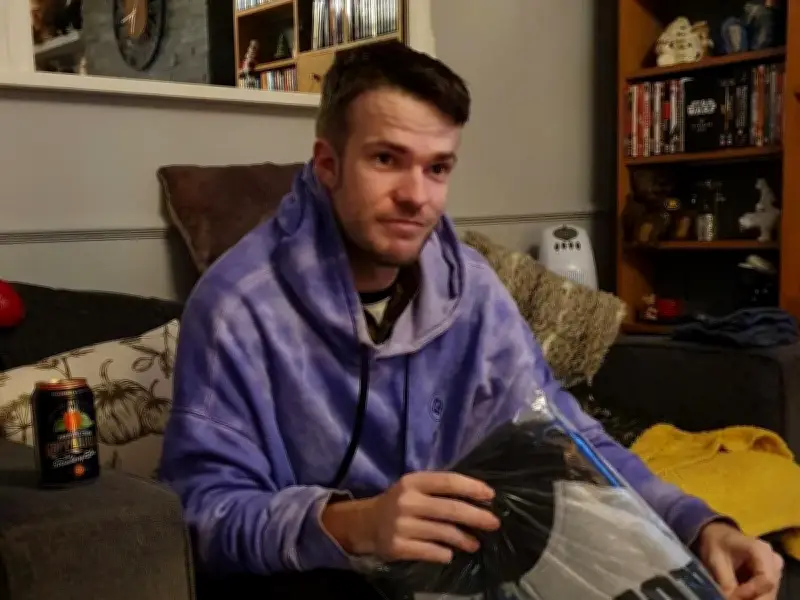
A "fit and healthy" 31-year-old man has been told he has no longer than 10 years to live after being diagnosed with a brain tumour. His mother has said research into brain tumours is "decades behind" other cancers.
Butlins activity instructor Bob Carroll-Hallett, 31, from Shoreham-by-Sea, West Sussex, had spent the last 11 years helping holidaymakers get active. Coupled with his love of walking everywhere, he was in peak physical health when he suffered a seizure out of the blue and was diagnosed with a grade 2 astrocytoma in December 2023.
Before undergoing surgery, nurses even had to double-check Bob's age, because in every other way he had "the health of a teenager". The surgery was successful, but following growth of the tumour, he now faces a second operation on November 13.
Mother campaigns for more research funding
Bob's mum Wendy, 54, is working with the charity Brain Tumour Research to support its call for the Government to support a national annual spend of at least £45 million a year on research in order to improve survival rates and patient outcomes in line with other cancers such as breast cancer and leukaemia.
Brain tumours kill more children and adults under the age of 40 than any other cancer yet research funding remains critically low, the charity said. Just 1% of the national spend on cancer research was allocated to brain tumours between 2002 and 2021, it added.
Wendy, also mum to Christopher, 31, and Rebecca, 36, said: "When I looked at the scan of Bob's brain, I saw this big white lump which filled me with sheer terror. When he had surgery, we were really naive, thinking that the surgeon was like a god who would pull out this lump and then everything would be all right."
"Even though the operation went well, with the surgeon removing more of the tumour than expected, the tumour has since grown and Bob has been told he has just eight to 10 years to live. When we heard those words, our world fell apart and it looked like the light went out of Bob's eyes."
"It's hard to comprehend because Bob has always been so fit and healthy. He walks everywhere. From the age of 18, he would walk the six miles from Shoreham-on-Sea to Brighton to meet his mates and then walk back again."
Seizure at work led to diagnosis
Following a seizure at work, Bob, who has been an activity instructor for 11 years, had an MRI scan at Colchester Hospital, which revealed the tumour on his brain. After an awake craniotomy in November 2023, he returned to his job at Haven in Clacton-on-Sea in Essex.
Bob has check-up MRI scans every six months. The most recent scan in September showed the tumour had grown, so Bob will now have a second operation on November 13 at the Royal Sussex County Hospital in Brighton.
Wendy said: "After the initial operation, Bob was sat up in bed with a great big scar on the back of his head, but he had the biggest grin on his face. It was such a relief and we were all laughing and joking because he was just so happy."
"The initial result said the tumour was benign, so we thought everything was okay. To then be hit with such a devastating life expectancy was awful. We were told that, when an astrocytoma comes back, it tends to come back aggressively. It's scary."
Fundraising for Brain Tumour Research
In September, Wendy, together with her husband Martin and Bob, did a Walk of Hope for Brain Tumour Research, walking 15 miles from Brighton Marina to Goring in Worthing. Now, Wendy is taking on the charity's 99 Miles in November challenge, covering the distance through a combination of walking, running and swimming.
She said: "I felt I had to do something to raise money and awareness of this devastating disease. If I can be out there wearing a Brain Tumour Research t-shirt, then I feel like I'm making a difference and I'm helping Bob."
"I keep hearing about trials happening in other countries, but why aren't they here in this country? These trials should be available instead of people having to travel abroad."
The money Wendy raises will help to fund work taking place across the charity's six Centres of Excellence, including at the Brain Tumour Research Centre of Excellence at the University of Plymouth, where scientists are investigating high-grade astrocytomas to help drive forward better treatments and outcomes.
'Hard to accept' diagnosis
Bob, who is now preparing for his second surgery, said: "It's very hard for me to accept my diagnosis. I tend to not really think much about the future, I prefer to take each day as it comes."
"I'm incredibly proud of mum for taking on these fundraising challenges. I've never really known her to be much of a distance walker, but she's worked hard and she'll do whatever she can to help me and others with this disease. It means everything to me."
Dee Solley, community development manager at Brain Tumour Research, said: "We're incredibly grateful to Wendy for taking on our 99 Miles in November challenge and turning what has been such a difficult time for her family into something positive. Bob's story is a powerful reminder of the devastating impact a brain tumour can have, not only on the person diagnosed but on everyone around them."
"One in three people knows someone affected by a brain tumour and nearly 13,000 people are diagnosed with a primary brain tumour each year. This is why we urgently need the Government to support an increase in the national investment in research into brain tumours to at least £45 million a year. We need sustained investment if we are to develop kinder, more effective treatments and give brain tumour patients the best possible chance."
Brain Tumour Research funds sustainable research at dedicated centres in the UK. It also campaigns for the Government and larger cancer charities to invest more in research into brain tumours in order to speed up new treatments for patients and, ultimately, to find a cure. The charity is the driving force behind the call for a national annual spend of £45 million in order to improve survival rates and patient outcomes in line with other cancers such as breast cancer and leukaemia.