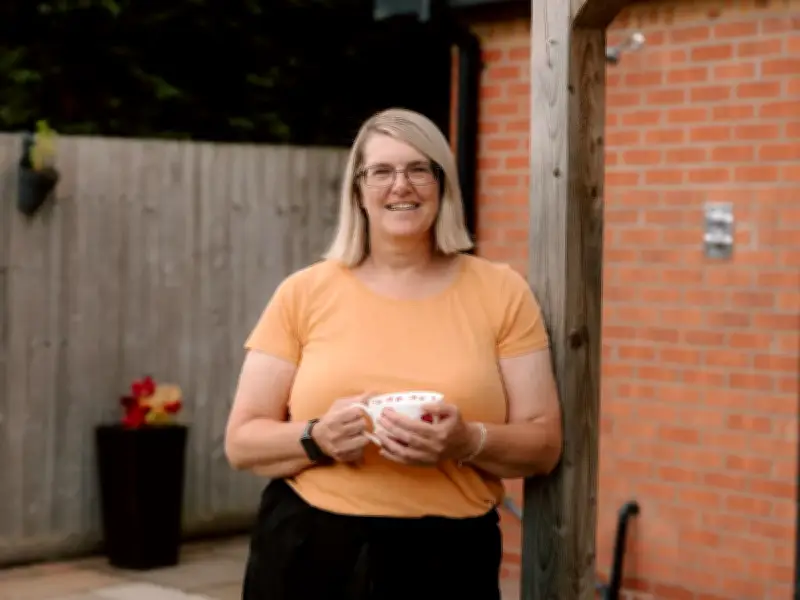
A landmark change from today means women like Allison Lawson, who have a heart attack, should be prioritised by the NHS and no longer dismissed. It was while drinking a cup of coffee with her neighbour that Allison first noticed the signs that she was having a heart attack.
It started with tiredness, then a strange discomfort in the middle of her chest, and within half an hour she was lying in an ambulance being blue-lighted to hospital. It turned out she was having a spontaneous coronary artery dissection (SCAD) - a type of heart attack that predominantly affects women and which, until today, had been deprioritised by the medical establishment.
New international guidance upgrades treatment
Allison, 53, said: "I felt strangely tired and slightly uncomfortable. Then as I left, I started to feel a burning pressure in the middle of my chest, which just kept building."

She added: "When I got home, I felt clammy and pain began to travel down my left arm and up into my jaw. I stayed fit, didn't smoke and wasn't overweight, with no family history of heart problems, so I never thought I would have a heart attack. But before I knew it, I was speaking to an NHS 111 operator who clearly thought it was serious, and was being rushed to hospital in an ambulance."
Allison had never heard of a heart attack caused by a SCAD. It means a heart attack caused by a tear in the coronary artery. Four out of five such heart attacks happen to women and often occur during or soon after pregnancy.
Recategorised as 'primary' heart attacks
Allison is telling her story as new international guidance has been issued to the NHS and other health systems around the world to upgrade how they treat SCAD heart attacks and others which predominantly afflict women. The Mirror attended the European Society of Cardiology Congress in Munich where they were recategorised as "primary" heart attacks. They will now be prioritised for an immediate echocardiogram or angiogram by the NHS to confirm diagnoses.
The world's biggest heart conference heard how there has been an "unconscious bias" among medics who assume heart attacks are a man's problem. Tens of thousands of women face deadly NHS delays every year due to having their heart attack initially misdiagnosed. Research shows women are 50% more likely to receive an incorrect initial diagnosis.
Many people who have SCAD heart attacks have few or no risk factors for cardiovascular disease such as high cholesterol, smoking or diabetes. There are about 1,500 SCAD heart attacks per year in the UK.
Allison's experience and recovery
Allison, a financial assessment officer, said: "My heart attack caused by SCAD came completely out of the blue. It wasn't a traditional cause of a heart attack but I was lucky that the paramedic who responded had seen one recently and suspected it was the same thing, so could make the hospital doctors aware of that from the outset."
She added: "For me, diagnosis was vital - before I knew what this was, I felt absolutely terrified by the lack of knowledge about what had happened to me. If the new heart attack definitions could help more people get an accurate and speedy diagnosis, it would really change things."
Allison, who lives with her partner Matt, 53, immediately had an angiogram which is an X-ray test that uses a special dye to provide a detailed picture of blood flow. Doctors did a coronary angioplasty – a procedure where a tiny balloon is used to open a narrowed artery, making space for blood to flow more easily. Then Allison spent three days in a cardiac intensive care unit.
Allison said: "The environment was surreal - machines beeping, nurses checking vitals, and me lying there trying to make sense of it all. I was completely drained, physically and emotionally. I felt like I’d been hit by a truck. The staff were incredible, but I still felt like I was watching someone else’s life unfold. It felt scary to be so out of control of what was happening to my body."
Allison, from Saxilby in Lincolnshire, still struggles with fatigue and the emotional aftermath of her heart attack, but has found support from other people who have had SCAD heart attacks. Since hers in September 2024, Allison has learned how to ride a motorbike, passing her test in January.

She said: "I want to help others feel less alone, and to make sure SCAD is recognised and understood, not just by doctors, but by anyone who might one day face it. The new international heart attack definitions feel like an important step in that direction."
The Leicester Biomedical Research Centre has uncovered genetic links to SCAD, suggesting that some people may be biologically at more risk. This helps explain why it can affect healthy individuals without warning. The exact causes of SCAD still remain unclear.