

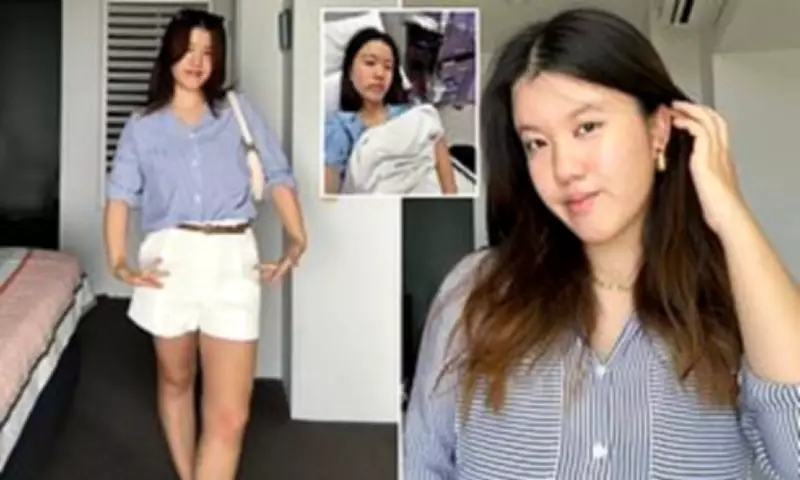
A 'fit and healthy' woman has recounted how a terrifying episode of uncontrollable bleeding led to a shock diagnosis of a rare cancer typically seen in women three times her age. Sarah Lai, a 23-year-old university graduate working as an allied health assistant in Queensland, first noticed something was wrong in February 2024. She experienced extremely heavy bleeding that became so severe she was rushed to the hospital, but after waiting four hours in a busy emergency department, her symptoms eased and she went home before being seen.
She later visited her GP, who prescribed tranexamic acid (TXA) to take whenever the bleeding worsened. Her GP also suspected her uterine lining may have thickened, but scans came back normal. At the time, Sarah had no reason to believe she could be seriously unwell. She was young, active, and otherwise healthy, and also had polycystic ovary syndrome (PCOS), which she assumed could be linked to the abnormal bleeding.
In August 2025, her period lasted 14 days. 'I started to get a bit suspicious because I didn't have any pain or cramping at all,' she said. On day 15, the bleeding became impossible to control. 'The bleeding got so bad that my oral medication didn't work. I was bleeding everywhere, there was blood all over the floor, there were blood clots the size of my fist coming out, and I just couldn't control it.' She returned to hospital, where doctors gave her a strong IV dose of medication to slow the bleeding, along with an oral synthetic progesterone tablet. The treatment worked, but emergency doctors told her to return to her GP for further scans and a referral to a gynaecologist.

Days later, a pelvic ultrasound showed alarming results: her uterine lining was 19mm, while a healthy woman's lining would usually be 2-4mm during her menstrual cycle. Her GP was immediately concerned and wrote an urgent referral to several gynaecologists. One specialist saw her the following week and reassured her that, due to her health and age, there was less than a 1% chance of cancer. However, to be safe, a hysteroscopy was recommended. Sarah underwent the procedure without complications and was told results would take three to four weeks. Instead, she received a phone call just 10 days later asking her to come in urgently.
On October 8, she was told she had grade 2 endometrial adenocarcinoma, the most common type of endometrial cancer. 'At just 23, I became one of the youngest in Australia ever diagnosed with something that not even my specialists were ready for,' she said. Staging was not immediately possible because endometrial cancer is usually staged after a hysterectomy, but at 23, Sarah was not ready to make that decision. Instead, doctors organised a CT scan and MRI to estimate how far the cancer had spread.
After the appointment, Sarah went home in shock and denial. Later that night, reality hit: 'I cried all night, and my whole family was in denial as well.' She felt profoundly isolated, as most people with endometrial cancer are much older. While waiting to see other specialists, she had a Mirena IUD inserted during her first hysteroscopy, which doctors hoped could help thin the uterine lining if the cancer was caught early enough.
When Sarah finally met her gynae-oncologist, she was told the scans suggested the cancer was stage 1. Her specialist recommended fertility treatment discussions and then another hysteroscopy three months later to see how the cancer cells were responding. That second procedure took place in January, and the results were extraordinary: her body completely responded to treatment, and there was no evidence of disease. Because of this, she did not need the hysterectomy, chemotherapy, or radiation she had feared.
While the news was overwhelmingly positive, recovery brought emotional confusion. 'I feel like I went through so many identity changes. At first, I had to adjust to having cancer, and now I have to adjust again, being a survivor,' she said. Her family remained her strongest support throughout the ordeal, but cancer also changed some friendships. After documenting her diagnosis online, she found unexpected support from strangers and built a 'mini online community'.

The experience has changed how she sees her body, work, and future. 'Having cancer has made me face my own mortality in a way that no one else has to,' she said. She also faced misconceptions, such as being asked why she wasn't bald or receiving unsolicited medical advice. Now, as both a healthcare worker and cancer survivor, she believes the experience has changed the way she relates to patients.
Sarah had no genetic mutations and no family history of endometrial cancer. 'The cause of my cancer remains unknown. I'm a healthy individual, and I somehow got cancer. No cause whatsoever, just a spontaneous mutation,' she said. Her message to other young women is simple: do not dismiss abnormal bleeding, even if you are young, fit, and otherwise well.





