An inquest has heard that a newborn baby died after doctors told her mother that life-threatening internal bleeding was likely "trapped wind". Kimberly Newark, 31, went to Princess Royal Hospital in Haywards Heath, Sussex, on September 14, 2024, while 34 weeks pregnant and suffering excruciating abdominal pain. Maternity staff attributed her symptoms to trapped wind and gave her painkillers.
She was later moved to a ward for observation, but shortly afterwards began experiencing more severe stabbing pains in her abdomen, which she described as "agony". When medics examined her, they found the baby's heart rate had dropped alarmingly, and Kimberly was rushed to theatre for an emergency caesarean section.
Ruptured artery discovered during C-section
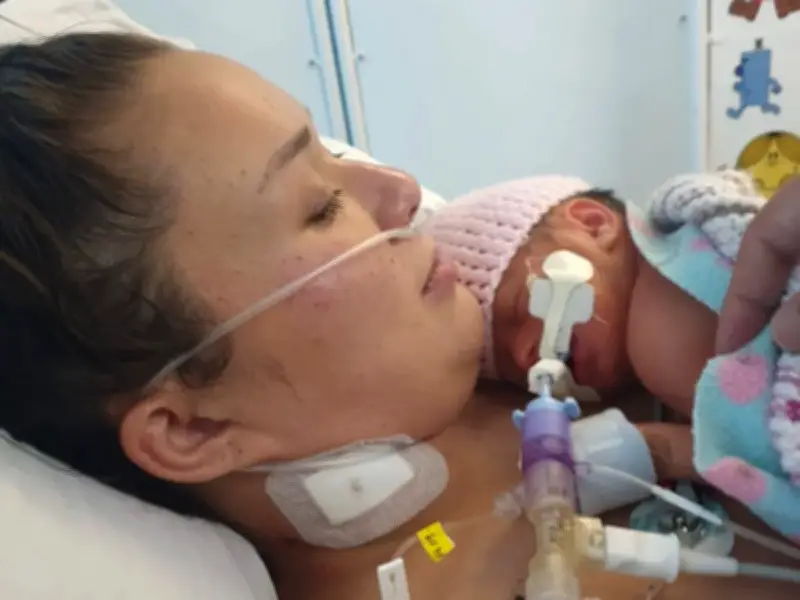
During delivery of baby Olivia, doctors found that Kimberly had suffered a rupture of a major blood vessel - the splenic artery - rather than trapped wind, causing her to lose about 11 litres of blood. Baby Olivia was born via C-section but was not breathing, was pale, unresponsive and "floppy". She was resuscitated and transferred to a specialist baby unit, where she was later found to have suffered severe hypoxic-ischaemic encephalopathy, a condition that occurs when a baby's brain does not receive enough oxygen or blood flow around the time of birth.
Kimberly was rushed into intensive care and put in a coma, and she and Olivia were later transferred to the Royal Sussex County Hospital in Brighton. Tests later showed Olivia had no brain activity, and doctors broke the devastating news to Kimberly and her partner Yann. The couple took the "heartbreaking" decision to remove ventilator support, and Olivia died on September 19, 2024, just six days old.
Concerns raised before admission
The inquest at Horsham was told that the couple had repeatedly raised concerns about Kimberly's deteriorating health in the days leading up to her hospital admission. As well as suffering from anaemia, constant nausea and exhaustion, she was also experiencing stomach and back pain. When the pain became excruciating and she fainted at home, possibly falling onto her stomach, the couple dialled 111 and Yann drove her to hospital.
On arrival, Kimberly told doctors she was in extreme discomfort, had vomited, suffered diarrhoea and was in almost constant severe pain in her abdomen. She was examined in A&E and, when it was found she had low blood pressure, she was moved to a side cubicle and seen by a consultant. She was told the pain was most likely caused by "trapped wind" and was given Buscopan - an antispasmodic stomach medication - and paracetamol. She was admitted to the Bolney Ward, an antenatal/postnatal unit, and her partner Yann was sent home and told to return the following day.
Emergency surgery and review
Less than an hour later, her condition deteriorated further. In a written statement, Kimberly said: "The pain became unbearable. I could no longer take it and screamed in agony. I pressed the bell." However, she said: "I was told to be quiet as there were other people on the ward who were sleeping." Shortly afterwards she fainted across the bed and was aided back into bed before tests were carried out.
Medics found that Olivia's heartbeat had dropped to just 40 beats per minute, and a decision was taken to carry out an emergency C-section. During the procedure, surgeons at the Princess Royal discovered internal bleeding and called Christie Swaminathan, an acute general surgeon on duty in Brighton. He rushed to Haywards Heath and carried out emergency surgery on Kimberly. Dr Swaminathan told the inquest he immediately suspected a rupture or pseudo-aneurysm of the splenic artery, saying the young mother was "most likely" suffering from a small bleed that became a "catastrophic" haemorrhage when the abdomen was opened and abdominal pressure was lost.
A full review of maternity services will be chaired by Donna Ockenden and is expected to assess the cases of more than 1,000 families, from 2018 onwards. It comes after up to 15 bereaved families raised concerns over the deaths of their babies between 2021 and 2023. Kimberly and Yann previously said their grief was made "so much worse" by learning other families had also experienced losing babies. They believe hospital staff missed vital warning signs and have instructed lawyers Slater and Gordon to represent them at the inquest.
A spokesperson for University Hospitals Sussex NHS Foundation Trust said: "We offer our heartfelt condolences to Olivia's family for their loss, and for the trauma and grief they have endured, and continue to live with. We sincerely hope the inquest helps to answer any questions Olivia's family may have about her care, and we will do everything possible to help the coroner in their work. We also remain keen to meet with the family again afterwards, if they wish to do so, and we are committed to always improving how we listen to, and learn from, all of the families we serve." The hearing continues.