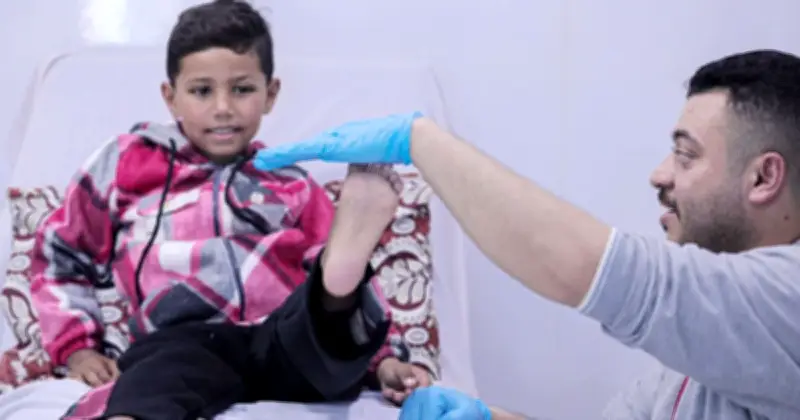
Medics have warned that young survivors of the war in Gaza such as six-year-old Yaqoub Shehab are facing “unprecedented suffering” as families seek treatment for complex injuries. The orphan has endured a 15-month treatment odyssey including 15 surgeries since the blast that killed his parents and three-month-old baby brother. Their home in Khan Younis was destroyed in a nighttime attack in May 2025.
Critical condition after midnight search
His aunt, Abeer Shehab, said: “The house was completely wiped out. We found Yaqoub after about three hours of searching as it was midnight. He was in very critical condition. It was clear he had lost a lot of blood.”
Yaqoub suffered head trauma, fractures and third-degree burns covering most of his limbs, requiring many procedures including skin grafts. His older brother Murad, eight, also survived but had a complex hip fracture.
Physiotherapist describes unprecedented cases
Khalil Abu Ghazal, a physiotherapist at British charity Medical Aid for Palestinians’ (MAP) Solidarity Polyclinic, said Yaqoub’s feet were initially at risk of amputation.
He explained: “External fixation was used, and his wounds were left to heal gradually, despite the immense challenges posed by his condition and the harsh conditions in Gaza.
“What we are seeing today in terms of complex, multi-layered injuries is unprecedented. I worked in the hospital during the war and witnessed the overwhelming pressure caused by the influx of huge numbers of injured patients at once.
“In many cases, a single patient required multiple specialties, including fractures, burns, and shrapnel injuries across the body.”
Khalil added: “This war has changed everything. We have faced circumstances we never imagined.
“The scale of suffering is unprecedented, and what we are seeing now is that every case requires a long and complex treatment journey, at a time when resources remain extremely limited.”
Children ask for their parents
Abeer said the boys barely spoke for two months, then started repeatedly asking for their Mama and Baba. She added: “When a child is deprived of everything essential, safety, parents and a normal childhood, and goes through such trauma, it is difficult to comprehend how they process it. They wake up in a completely different world after losing everything familiar.
“What Yaqoub has endured is unimaginable. His pain after the surgeries, the severe burns on his legs, the constant crying despite strong painkillers — nothing helped. He cried day and night especially during wound dressings.”
Yaqoub began receiving treatment at MAP’s clinic last September. His injuries initially left his legs “completely stiff, like stone”, Abeer said, but with rehabilitation he has started to regain movement.
He and Murad were evacuated to Egypt in May, with their grandfather. Abeer, who was not allowed to join them, said: “Being separated from them is very difficult.
“The children are now, to some extent, able to move around without their crutches, and I am happy to see them making this progress. But they have been through so much trauma.”
Ceasefire but continued attacks
Yaqoub’s grandfather, Sobhi Shehab, said the war has “erased so much of what once gave life meaning, from our memories, our daily lives, and even our hopes. Still, we continue to pray for peace, for life to return as it once was, and for our children to live a normal, safe life.”
Israel and Hamas agreed a ceasefire almost one year ago but MAP said healthcare facilities and workers have continued to come under fire. Earlier this month, it reported that a patient had been killed by Israeli military quadcopter gunfire at a centre in Jabalia, northern Gaza.
Aseel Baidoun, MAP's deputy director of advocacy and communications, said: “When a patient is killed inside a health centre by Israeli forces, the damage does not end with one life.
“It can leave an entire community, already living on the brink, afraid to seek treatment. People who are sick, injured, or dying may now decide that going to a health centre is a gamble not worth taking.”
You can support Medical Aid for Palestinians' October campaign here. Children will not be left behind, says SOBHI AWAJA When Yaqoub first arrived at the clinic, he was only coming in for wound care. He was an exhausted child, physically weak, with clear signs of trauma. His injury was not only physical. From the very beginning, it was evident that he needed much more comprehensive support. He was therefore quickly enrolled in our integrated rehabilitation programme.
What we witness every day is deeply painful. A large proportion of the cases we receive are children, many of whom have sustained complex injuries as a result of bombardment or at some point even while trying to access aid.
Some have lost their entire families. These are not just medical cases, but human stories marked by deep loss and trauma.
As healthcare workers, what weighs on us is not only the scale of the injuries, but also the awareness that, despite all our efforts, we may not be able to help everyone reach full recovery.
Even so, we hold firmly to one principle: Leaving no one behind.
Given the nature of the injuries we deal with, which are often severe and complex, we have developed a comprehensive rehabilitation programme that integrates psychosocial support, physiotherapy, and occupational therapy. This allows us to address each case holistically as much as possible.
We also place great importance on training caregivers, as continuity of care outside the clinic is essential. We ensure they are equipped with the knowledge needed to continue exercises at home, and we maintain ongoing communication with patients, because recovery cannot happen without consistent follow up.
In the end, our role is not only to provide treatment, but to stand beside them, support them, and walk with them through this journey, even in the most difficult circumstances, ensuring they are not left alone.
Sobhi Awaja is MAP Rehabilitation Point Coordinator in Gaza