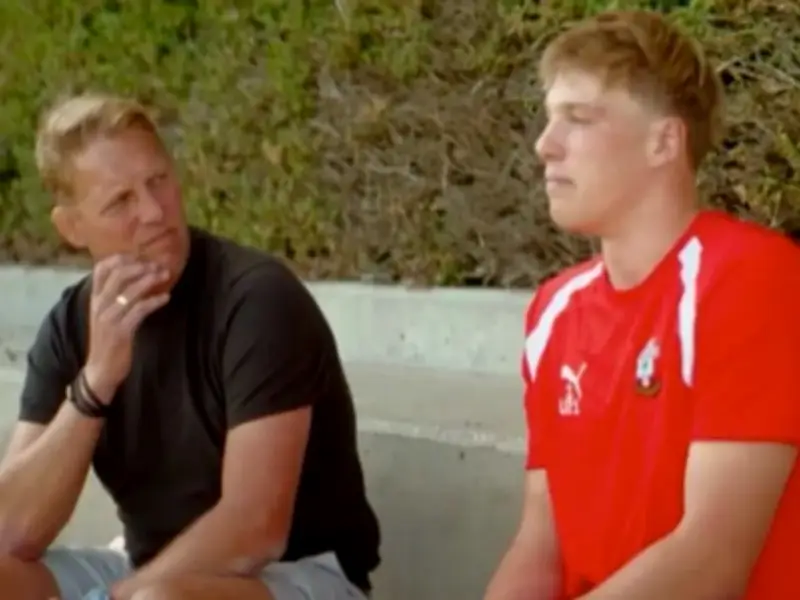
Former England rugby captain Lewis Moody has opened up on his battle with motor neurone disease (MND) in a new documentary, with his wife and two teenage sons left heartbroken by the shock diagnosis.
After noticing weakness in his shoulder while exercising, the Leicester Tigers legend was told he had the life-limiting neurological condition in September last year and he went public with his diagnosis the following month. MND affects motor nerves in the brain and spinal cord, causing muscle weakness, stiffness and paralysis and impacting a person's ability to walk, talk, swallow and breathe.
While treatment can slow the progress of the disease, it is currently incurable and it claims the lives of over half of those with the condition within two years of diagnosis, with rugby league legend Rob Burrow and former Scotland international Doddie Weir among those to die with MND in recent years.
Wife notices physical changes 'all the time'
In the months that have followed his diagnosis, Moody has proven inspirational with his resilience and bravery in the face of adversity, throwing himself into fundraising challenges. However, a new TNT Sports documentary - Lewis Moody vs MND - has laid bare the devastating impact his diagnosis has had on him and those around him.
The documentary, which airs on Friday, September 25, sees the former England flanker discuss his condition with his wife Annie, who admits she notices physical changes in him "all the time" and admits the future will be difficult for them, both physically and mentally.
"I see change all the time, your shape or your fasciculations," she tells Moody during an emotional heart-to-heart. "I think mentally it will be very hard for you. Physically it will be hard for me, because I'll have to physically support you as well as mentally."
Annie later adds: "It's scary. We're scared. I know it'll be really hard. Hard for Lewis — he's going to be trapped in his own body and that's terrifying. That's so upsetting."
Sons speak of tears and fears for the future
During the documentary, Moody also speaks to his teenage sons Dylan and Ethan, having admitted that "there were tears" when he first broke the news of his diagnosis to him.
Dylan - an 18-year-old professional goalkeeper with Southampton - choked up as he discussed the future in an emotional conversation with his dad, explaining that he has been driven to follow in his footsteps and represent England on the international stage.
"A month after your diagnosis, I had the [Under 17s] World Cup," he explained. "That was probably the best experience in football I've had. Just three weeks abroad in the heat playing at a World Cup for your country with all your mates.
"[Moody's diagnosis] makes you think more of what you're missing at home. I don't know what I'll return home to. I just tried to make the most of it while I'm away.
"Every day was the hardest I've ever trained. I was in an England shirt like you were, so it felt similar. I'd rather it be on my mind than it not be because it helps me day-to-day, having something to drive me."
Meanwhile, 16-year-old Ethan - who dreams of playing Test rugby for England like his dad and is currently part of Bath's youth academy - admits he "worries about the future".
"Sport helps because you can just let all your anger out, especially in rugby," he added. "Just hurt someone, basically. It probably doesn't sound great but you can hurt somebody."
Moody 'at peace' after specialist reassurance
Despite everything that he and his family have been through, however, Moody says he is "at peace" with his diagnosis, having received reassurances from a medical expert that it is not directly linked to his rugby career.
"One of the questions that someone asked me recently was, 'You must be devastated that rugby's put you in this position?'" Moody said during the documentary. "I was like, 'Is he meaning motor neurone disease?' I was just baffled by it, but it made me ask the questions of the specialists, 'Is that the reason I am here?'
"I literally asked [them] that direct question. And [he] was like, 'Rugby isn't the reason you have MND. There are a number of things that come together, coincidentally or not, that you are more predetermined or disposed to than anyone else. It might be genetic. It might be lifestyle.
"So, I suppose it was a relief in many ways because in my head I was like I was almost angry at the person for asking that question, but it made me question it more and make sure that I checked in with the specialist."