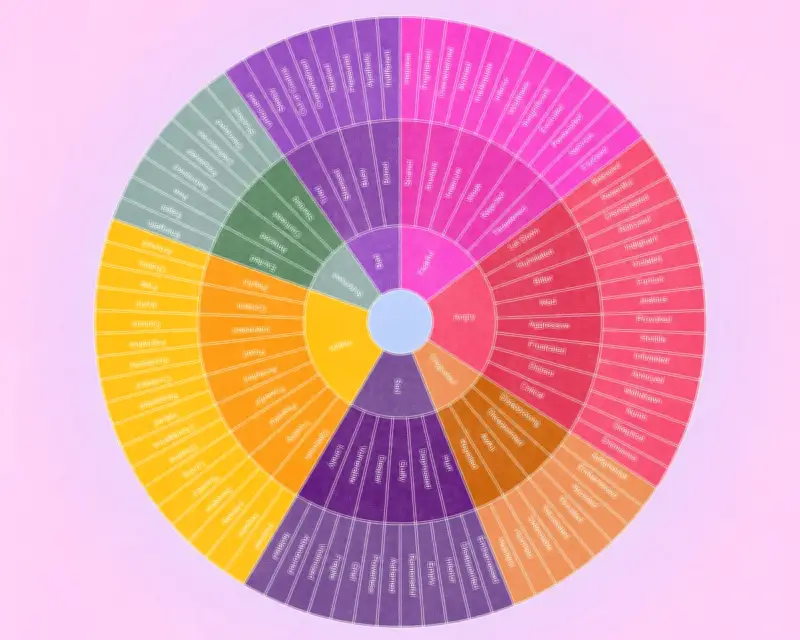
The feelings wheel, a simple tool created by US psychologist Dr Gloria Willcox in the early 1980s, helps people identify and name their emotions by moving from broad terms to more specific ones. It has gained popularity in therapists' offices and classrooms in recent years, partly due to its visual appeal—available as a laminated poster, a wooden desk chart, or even stitched onto a cushion.
Naming emotions is a core skill most people develop as children, but research indicates it is harder than it seems. About 10% of the general population have significant difficulty identifying their own emotions, a challenge that can make it harder to know what to do about them.
What is emotional granularity?
Emotional granularity, first identified by neuroscientist Lisa Feldman Barrett in 2004, is the ability to recognise and name emotions in a precise way, rather than lumping them into broad categories like "bad" or "sad". Dr Katie Hoemann, an assistant professor of psychology at the University of Kansas, describes it as "being able to experience and articulate your emotions in very nuanced, context-specific ways."
The extreme opposite is alexithymia, a trait whose Greek translation means "no words for emotions". Affecting roughly one in 10 people, it involves extreme difficulty or a complete inability to identify and label one's own emotions. It is not a diagnosis in itself but is commonly associated with autism and can also be a feature of mental health conditions like depression and post-traumatic stress disorder.
Why does naming emotions matter?
Research indicates that higher emotional granularity is associated with positive outcomes, including lower levels of mental illness, more efficient emotional regulation, and reduced chances of relapse for substance users in recovery. Dr David Kimhy, associate professor of psychiatry at the Icahn School of Medicine at Mount Sinai, notes that "across the board, higher emotional granularity has been linked with better mental health outcomes and social functioning."
Emotions act as an internal feedback system, helping people evaluate what they like and dislike, avoid danger, and react appropriately. More specific emotions are more informative, allowing individuals to select and regulate their behaviour. For example, recognising loneliness rather than just sadness might prompt someone to reach out to a friend or join a group. Conversely, a person with low emotional granularity might never move past a non-specific feeling of sadness.
Can the feelings wheel help?
Emotional granularity is not a fixed trait but a skill that can be learned and cultivated. Tools like the feelings wheel provide vocabulary and basic skills, but practice is essential. Using the wheel in contexts like journalling helps people reflect on experiences and make meaning out of moments in their life, according to Hoemann.
Experts suggest that mindfulness, mood-tracking, and structured therapy like cognitive behavioural therapy (CBT) can also build emotional granularity. CBT highlights the interplay among thoughts, emotions, physical sensations, and behaviours, helping develop awareness of all four. For those struggling significantly or experiencing alexithymia, consulting a mental health professional is particularly important rather than using a self-help tool in isolation. Hoemann warns against overthinking, noting that "there can be too much of a good thing"—the wheel should be used to label and sort through experiences, then put away.