

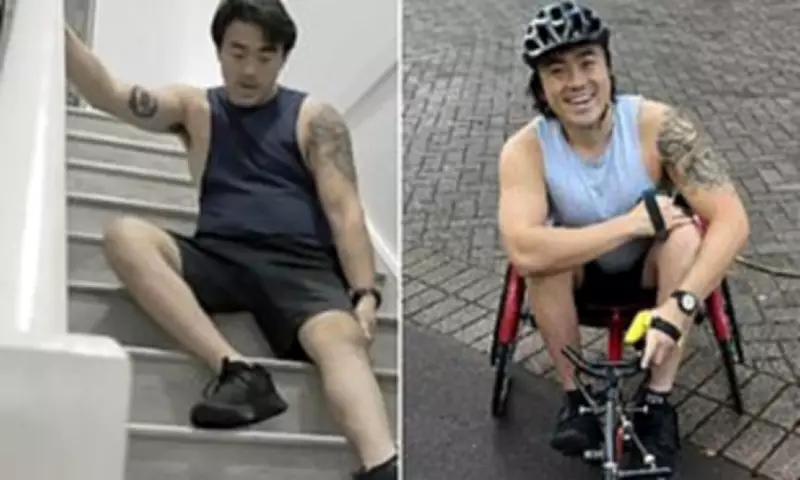
Paralysed Triathlete Faces Daily Stair Crawl After NDIS Withdraws Support
An Australian man left paralysed from a devastating cycling accident has been forced to crawl up the stairs of his own home multiple times each day after the National Disability Insurance Scheme cancelled his accommodation funding. Jolly Duong, once an avid triathlete with a promising athletic future, now confronts an exhausting and physically demanding routine simply to access his bedroom and bathroom.
Life-Altering Accident and Remarkable Recovery
In 2024, Mr Duong's life changed irrevocably during a cycling trip with friends. The brakes on his bicycle catastrophically failed, sending him careening down a mountainside. He landed head-first onto a rock, completely severing his spinal cord at the T5 vertebrae. The injury left him paralysed from the chest down. Through immense determination and rigorous rehabilitation, he achieved a significant milestone by completing the City to Surf event in his wheelchair, showcasing his resilient spirit.
NDIS Decision Leaves Him Without Suitable Accommodation
After months of hospital treatment, Mr Duong was discharged into NDIS-provided medium-term accommodation, which offered a safe environment and a degree of independence. However, just six months later, the NDIS terminated this support. The agency determined that his two-storey family home was sufficiently suitable for his needs, effectively withdrawing the accommodation assistance.

'They cancelled the medium-term accommodation and effectively said "well, you're at home",' Mr Duong explained in an interview with A Current Affair.
The Gruelling Daily Reality of Accessibility
With his bedroom located on the second floor, Mr Duong now must crawl up a full flight of stairs several times daily. The process is arduous and time-consuming, taking approximately eight minutes each ascent. He relies solely on his upper body strength to lift his entire weight step by step.
'It's challenging, but it's my every day at the moment,' he stated. 'I felt initially that it was a claim of independence of I'm able to access my own stairs on my own terms. But as time goes on and as fatigue hits harder and harder, it is very inhumane.'
Fighting for Home Modifications and Public Support
Mr Duong has formally requested NDIS funding for essential home modifications, including the installation of a lift estimated to cost around $100,000. These modifications would allow him to remain in his home safely and maintain his pre-accident lifestyle. The NDIS has denied this request, prompting him to launch a GoFundMe campaign to raise the necessary funds independently.
'I am fundraising to raise funds for the required home modification, which NDIS will not fund,' he said. 'A few years before my injury, I did a knockdown rebuild of my home and had not considered the possibility of being a wheelchair user. My bedroom is on the second floor, and without a lift, I will not be able to maintain my pre-accident lifestyle without major changes to the first floor.'
In addition to fundraising, Mr Duong has initiated a petition calling for action, which is scheduled to be tabled in the House of Representatives, seeking broader systemic change.
NDIS Response and Broader Criticism
The NDIS issued a general statement defending its role, describing the scheme as 'life-changing for hundreds of thousands of Australians with a disability.' The agency emphasised that it 'can only approve supports that meet the reasonable and necessary criteria under the NDIS Act' and that decisions are based on 'available evidence at the time.' It also noted participants' right to seek reviews through the Administrative Appeals Tribunal.
When questioned specifically about Mr Duong's case by Daily Mail, an NDIS spokesperson declined to comment on individual circumstances. This response has drawn criticism from prominent figures, including Dr Nick Coatsworth, the former deputy chief medical officer during the COVID-19 pandemic.
'I would say that many people have lost faith in the NDIS,' Dr Coatsworth remarked, highlighting growing concerns about the scheme's implementation and support adequacy.

This case underscores ongoing debates about disability support, accessibility, and the practical challenges faced by individuals navigating the NDIS system, raising critical questions about the criteria for 'reasonable and necessary' supports in life-altering circumstances.





