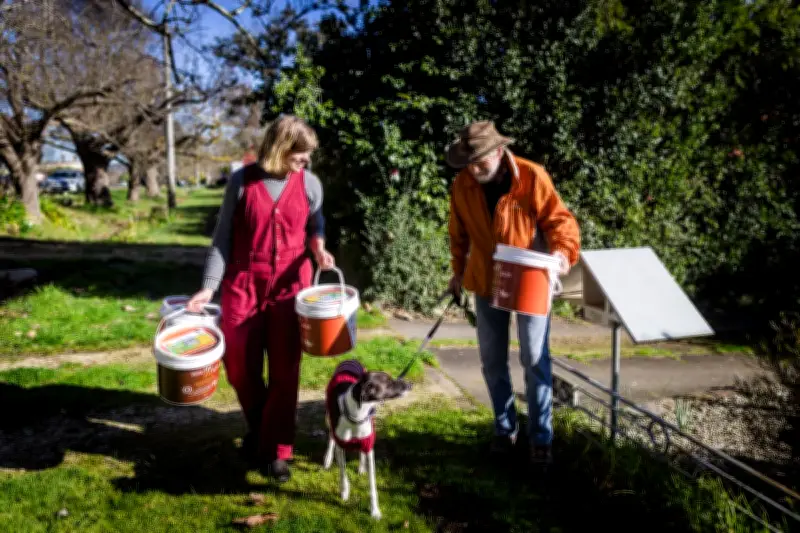
The Yimby Castlemaine group in Victoria has demonstrated that community-led composting can effectively divert organic waste from landfill, collecting approximately 50,000 buckets from over 650 households since 2020. Volunteers like Mikaela Beckley and Ian Foster walk neighbourhoods to swap full buckets for clean ones, then weigh and record the material at home.
Why Organic Waste Matters
Australians generate about 14.6 million tonnes of organic waste annually, with half collected via kerbside bins. When left in landfill, organics produce methane, a greenhouse gas far more potent than carbon dioxide. However, organic material is also a valuable resource; about 62% is already diverted into mulch or compost.
Dr Robert Crocker, a senior lecturer at Adelaide University, says the old dump model is dead. “Fogo is valuable, and that is why the waste managers want it. Unlike landfill, which is very expensive to look after responsibly, Fogo can make them a bit of money, and can then be sold on as compost, back to the community.”
Castlemaine's Yimby Model
Yimby Castlemaine formed in 2020, creating a network of over 50 composters. When Mount Alexander Shire Council announced a Fogo bin rollout for 2025, Yimby petitioned with over 1,000 signatures urging a “Go slow on Fogo” to gather data and hear community concerns. Lucy Young from Yimby says, “We are confident that this community can design a bespoke organics recycling system to care for the organics in this shire and put them back into the soil.”
The group envisions a neighbourhood-based system with more support for home and on-farm composting, plus a behaviour change program. The council says it is still considering the Fogo service and will respond to the petition at its next meeting.
National and Global Context
Many Australian households already use composting, worm farms, or bokashi systems. Crocker believes councils should encourage more community involvement, as seen in Sweden’s community waste hubs or Japan’s Kamikatsu town, where residents sort waste into 40 categories. “The community needs to be engaged and educated … that is probably what our friends in Castlemaine are attempting to do,” he says.
Other Australian initiatives include the City of Melbourne’s composting hubs and the Peel platform for sharing compost bins. Crocker adds, “The idea is [to be] part of the circular economy, which is to keep products in use for as long as possible, and in this reduce waste and give our environment time to recover.”
Local Solutions for a National Challenge
Young acknowledges the Yimby model may not suit every area, but it shows what motivated communities can achieve. “Perhaps Fogo makes sense in highly urbanised settings where the density of housing excludes access to land, and perhaps there are no communal spaces. But if decision-making at a local level could be more collaborative, then perhaps communities could decide how best to recycle their organics.”