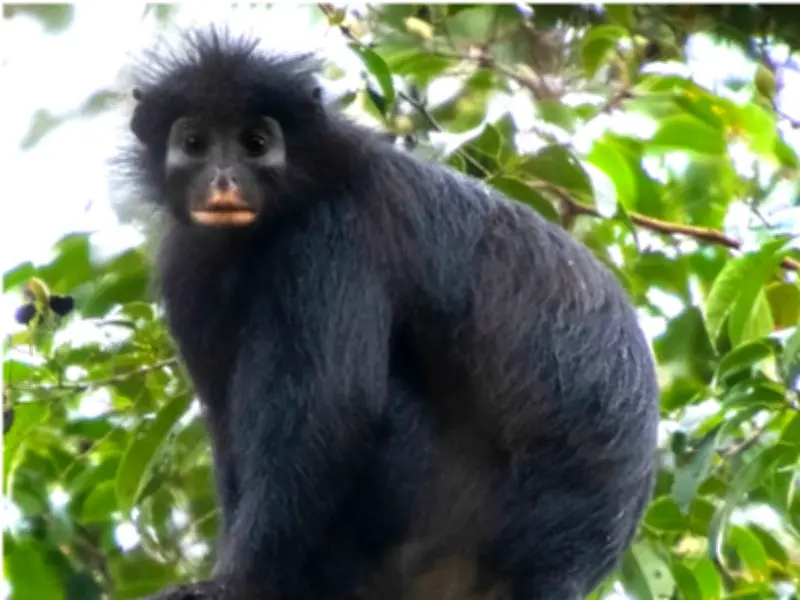
A new monkey species featuring striking orange lips has been confirmed in Africa, almost 20 years after it was first sighted. The small, black-furred and long-tailed primate, named Colobus congoensis and commonly known as Likweli, is part of the Colobus genus native to Africa. It was discovered in the Lomami National Park, in the interfluve region of the Lomami and Congo (Lualaba) rivers in east-central Democratic Republic of Congo (DRC).
Discovery and Significance
Colobus congoensis is only the fifth new species of African monkey to be discovered in the past 75 years. The monkey was first seen in 2008 during an exploration of the Lomami Basin. Two explorers photographed only part of the unidentified monkey in a high forest canopy but strongly suspected it was not any of the monkey species they already knew from the region. After the 2008 sighting, Likweli monkeys were not seen again until November 2018.
Between then and 2022, the monkeys were spotted 114 times. However, the newly discovered species is not well known to local communities, despite extensive knowledge of other primates. Residents in only eight out of the 52 localities surveyed by researchers bordering the new species' range reported knowledge of the primate and could accurately describe it.
Physical Characteristics
Research published in the PLoS One journal states: "The dark glabrous [smooth] face is marked in both males and females by a prominent patch of bare skin that is pinkish to orange-cream in color, surrounding the mouth and extending from the upper lip and philtrum to the inferior portions of the nasal alae." The extent of the coloured patch varies from individual to individual, with some having much of their lower face covered, while others' is more restricted. The black skin surrounding the patch and covering the eyelids and area around the eyes gives the monkey a "mask-like appearance".
Conservation Status and Threats
The new species has been described as a "rare and cryptic monkey", largely restricted to high, closed canopy forests. The research team who described and named the new species has proposed for it to be classified as endangered due to its small range area and population size. Increased hunting pressure and habitat conversion were also factors that led to the decision.
The researchers, who described the new species as "remarkable", said: "Protection of Lomami National Park, within which most of the C. congoensis range occurs, and engagement of local communities in not hunting the species are the most important actions needed to ensure the conservation of C. congoensis." The research was carried out by experts from DRC, the United States and Germany.