Egypt's Great Sphinx of Giza could be hiding the remains of a long-extinct crocodile species, but a scientist has warned against trying to find the fossils by damaging the ancient monument.
The claim follows the discovery of a new species of extinct crocodile in the Mokattam Formation, a thick layer of limestone in northern Egypt that dates back 54 million years. The same limestone was used over 4,000 years ago to build the iconic statue.
New species identified from ancient limestone
Researchers studying the rock mass uncovered a brand-new species in the limestone, which has preserved prehistoric marine fossils, including fish, sharks and early whales. The newly identified crocodile has been named Herugavialis cairensis, after the ancient Egyptian god Heru, which the Sphinx is believed to depict.
The fossilised skull, like the Sphinx's famously missing nose, is missing the tip of its snout. It was first discovered almost a century ago during excavations in the Mokattam Formation in the 1920s. Scientists originally believed it belonged to the "false gharial", Tomistoma schlegelii, one of the living gavial species.
Expert warns against damaging the Sphinx
Lead author Dr Paul Burke, of the Swedish Museum of Natural History, said: 'It could! It was built from the same rocks where Herugavialis was found, so who knows.'
'What I don't recommend is tearing apart the Sphinx to see if there is!'
Co-author Professor Philip Mannion, of University College London, said: 'We decided to name the new crocodile after the Egyptian god Heru, who was possibly the inspiration for this iconic monument.'
Distinctive skull reveals ancient lifestyle
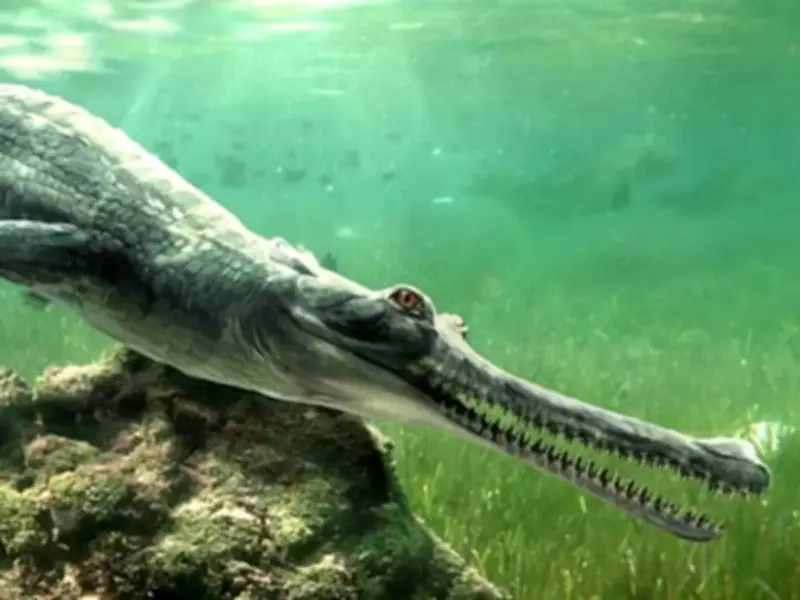
Although the fossil is slightly damaged, its distinctive skull shape has given palaeontologists clues about how the animal once lived. Herugavialis belongs to the gavial family, crocodiles known for their long, thin snouts. Today only two living species remain, found in freshwater habitats across the Indian subcontinent and South East Asia.
Advances in palaeontology, including CT scans to examine the inside of the skull, have revealed key differences between the two, confirming the skull was from a previously undiscovered species of extinct crocodile. Scientists think that Herugavialis would have once shared its home with at least two other species of long-snouted gavials.
Dr Burke said: 'Herugavialis has a long, thin snout with razor-sharp, pointed teeth, similar to the extant Indian gharial, Gavialis.'
'The Indian gharial feeds primarily on fish, so we think that Herugavialis did the same. In addition, the Mokattam Formation where Herugavialis was recovered from, also preserves plenty of fish fossils, so we assume they fed on these species.'