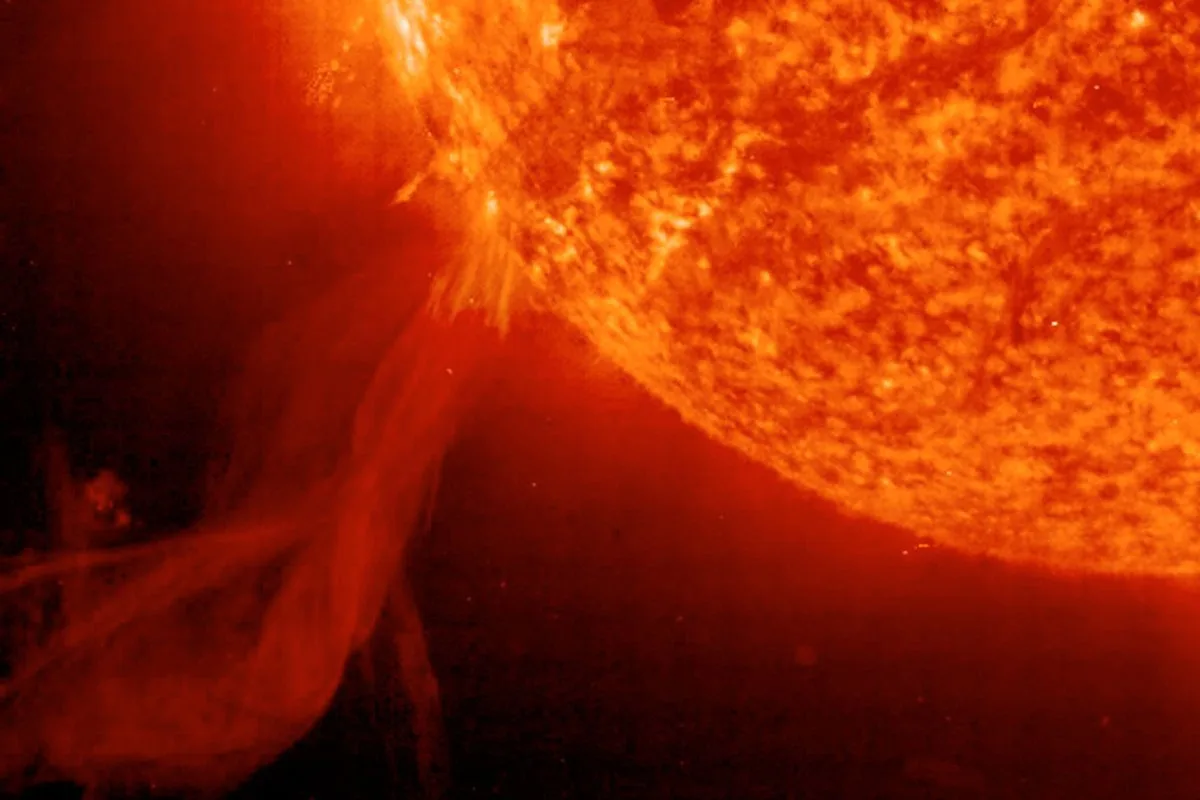
The Sun released a massive solar flare on Sunday, causing radio blackouts in parts of the world and prompting forecasts for Northern Lights displays. The flare, classified as an M5.8-class event, erupted from sunspot region AR4436, which is currently rotating to face Earth.
According to the US National Oceanic and Atmospheric Administration (NOAA), the initial burst of electromagnetic radiation triggered a moderate radio blackout over the Atlantic Ocean and parts of eastern Africa. This disrupted high-frequency radio communications, primarily affecting aviators and mariners.
The solar flare also produced a coronal mass ejection (CME), a cloud of magnetised solar plasma travelling at around 650 kilometres per second. The CME is expected to pass Earth on Tuesday night, with parts of the plume grazing the atmosphere and potentially creating aurora displays.
Weather permitting, the Northern Lights could be visible at more southerly latitudes, including parts of the UK and northern US. The Met Office's latest aurora forecast noted the potential for a glancing CME arrival early on 13 May, which may enhance the auroral oval and allow sightings across northern Scotland and similar geomagnetic latitudes where skies are clear.
NOAA's Space Weather Prediction Center is monitoring the CME's arrival, but noted that modelling indicates most of the material should pass well behind Earth's orbit. However, a glancing blow or shock arrival cannot be ruled out late on 12 May into early 13 May.