
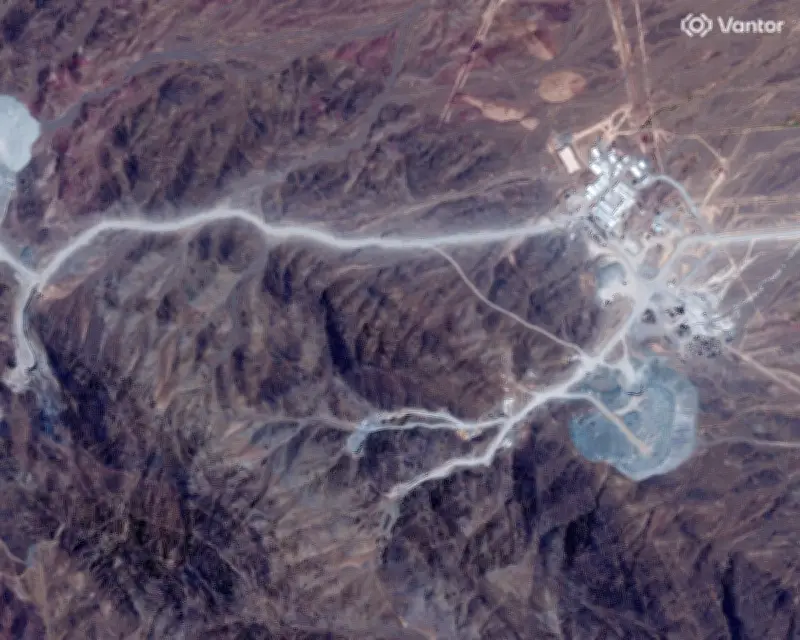
Donald Trump has returned to threatening Iranian nuclear sites amid the most sustained outbreak of violence between the US and Iran since a ceasefire was agreed in April. The current US strikes aim to force Iran to reopen the Strait of Hormuz, but on Tuesday the president reiterated threats against a site linked to Iran's nuclear programme.
Referring to Pickaxe Mountain – known in Iran as Kuh-e Kolang Gaz La, a fortified underground site near one of the country's primary nuclear enrichment facilities – Trump told reporters that the military would be “hitting that area pretty soon, and very heavily”.
Where is Pickaxe Mountain?
Pickaxe Mountain is located 220km (140 miles) south of Tehran and 2km (1.2 miles) from the Natanz nuclear facility. The Natanz site, which houses two of Iran's uranium enrichment plants, has been bombed before – during the war started by the US and Israel on 28 February, and during the 12-day war of 2025.
Little is known about the complex inside the mountain, but experts believe it is still under construction and estimate it is buried almost 100 metres inside the mountain. The facility was not targeted in either of the US-Israeli strikes in 2025 and 2026, according to the Institute for Science and International Security (ISIS), a US-based thinktank focused on nuclear non-proliferation.
What is the history of Pickaxe Mountain?
Construction began in 2020, according to ISIS, after what Iranian authorities reported at the time as an explosion caused by an act of sabotage at the Natanz facility. Iran said the sabotage caused significant damage, and in September 2020, Iran's then nuclear chief Ali Akbar Salehi said the country had started building a “modern, larger and more comprehensive hall in all dimensions in the heart of the mountain near Natanz” for making advanced centrifuges.
Rafael Grossi, chief of the International Atomic Energy Agency (IAEA), said in March that Iran had previously announced its intention to have nuclear activity at Pickaxe Mountain. “This was part of their quite systematic intention to put their most sensitive facilities underground,” he said.
What has Iran built at Pickaxe Mountain?
ISIS, which has analysed satellite imagery of the site, says it features two pairs of entrances and that a security wall around the facility was recently completed. Since the US and Israel began launching strikes, a pair of eastern tunnel portal entrances has been hardened and partially backfilled to obstruct ground vehicle access, but they have not been sealed fully, the thinktank reports.
Sam Lair, a fellow at the Foreign Policy Research Institute who also reviewed recent satellite imagery, told Reuters that increasing the strength of the tunnel entrances would complicate “targeting with penetrating munitions like bunker busters”.
Is Pickaxe Mountain functioning and what could it be used for?
Trump's threats earlier this month included an admission that US intelligence sees “no activity there”. “They're not doing well with their nuclear situation. Every time we hear about it, we blow it up. So they don't like talking about it. But we'll probably give Pickaxe a shot relatively soon,” he said.
ISIS said in its report that its assessment “is that the facility is not yet operational, but construction continues”, and that it was unclear when it could be operational based on satellite imagery alone. The thinktank says it is also unclear if Iran still plans on installing a large-scale assembly facility there. “Nonetheless, if Iran starts to rebuild its centrifuge manufacturing capability, it could plan to install a smaller centrifuge assembly facility in Pickaxe Mountain able to serve a nuclear weapons program,” the report said.
How might Pickaxe Mountain be attacked?
Experts assess the deeply buried complex as beyond the reach of the most powerful bunker buster bombs in the US arsenal. Aerial attacks also carry uncertainty because assessing their effectiveness can be difficult without on-the-ground intelligence. A Pentagon report after US strikes on Iran's nuclear sites in 2025 said the damage likely set back the nuclear program by one to two years, but with a large amount of uncertainty.
ISIS said the site “would be more suitable for ground forces to attack or sabotage … however, vulnerabilities may also exist that can be exploited by deep earth penetrating weapons via aerial attacks.” Ground operations have so far been a red line for Trump, and there has been no suggestion he is any closer to considering such a move.
Lair said: “We can infer that there are ongoing activities at Pickaxe Mountain the Iranians wish to continue, but are still concerned enough about a potential attack that they are taking steps to bolster their defences.”




