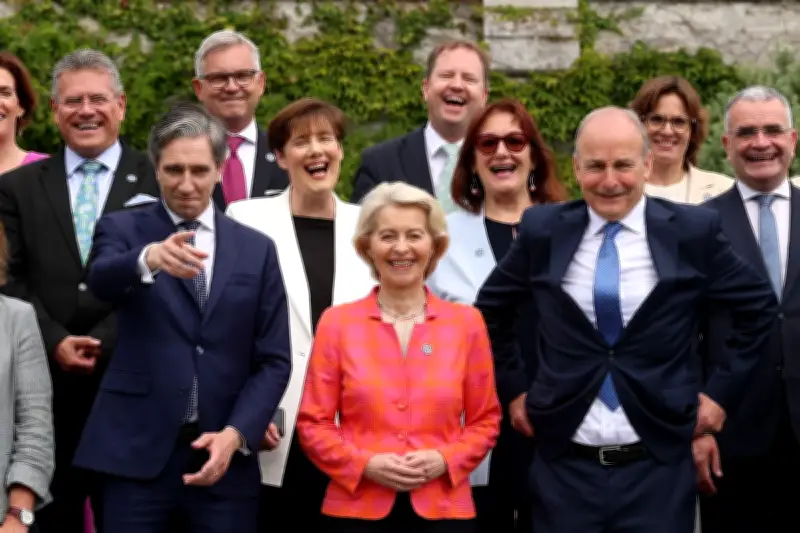
European Commission President Ursula von der Leyen has insisted that “no one does more” than the European Union for Gaza, pushing back against claims that the bloc has been slow to act against Israel. Speaking at a press conference in Cork, Ireland, on Friday, the former German defence minister addressed questions about the EU’s response to the situation in Gaza and the West Bank.
EU defends its role in Gaza
Von der Leyen stated that the EU is the world’s largest provider of assistance to the Palestinian people. “Since October 23 we have earmarked over 2.7 billion euros in humanitarian aid and budget support,” she said. “We have organised 85 humanitarian aid bridge flights, and delivered more than 5,600 tonnes of essential supplies. So, this, I think, is important to know – no one does more than us.”
Her comments came after being asked why the European Commission appeared to be “dragging its feet” on action against Israel. She rejected the criticism, emphasising the scale of EU aid and the complexity of reaching consensus among member states.
Settlements and sanctions
Von der Leyen described the continued expansion of illegal Israeli settlements in the West Bank as “utterly unacceptable” and the violence used to achieve it as “abhorrent”. She noted that a proposal to suspend trade preferences under the EU-Israel Association Agreement was made 10 months ago by the commission and would have a “significant economic impact”, but “remains on the table of the member states to vote with a qualified majority”.
“So, the ball is in the court of the member states,” she said. She also acknowledged that “many” member states have proposed sanctioning Israeli minister Itamar Ben-Gvir, but “no consensus has been reached”. “You see, there is activity, and a lot of activity going on in the Council right now, no move forward with a solution or an agreement on how to proceed,” she added.
Ireland’s EU presidency
Von der Leyen and a delegation of EU commissioners met Irish ministers in Cork as Ireland began its six-month term as president of the Council of the European Union. The presidency officially started on Wednesday with a ceremony at Dublin Castle attended by Ukrainian President Volodymyr Zelensky. Ireland will host hundreds of EU meetings and visits by EU leaders and officials during this period.
Taoiseach Micheál Martin said that Ireland would work to “strengthen the European Union’s role as a principled global actor”, including by pushing for peace in the Middle East.
Other issues: EES queues and social media
Von der Leyen also addressed technical problems with the EU’s Entry/Exit System (EES), which has caused long queues at European ports and airports. She admitted there is “still quite a lot of work to do” to solve these issues, noting that the system “did not change the legal frame about rules of entering and exiting the European Union, it just creates transparency about abiding to the rules that are set for entering or exiting the European Union”.
On social media, she said she hoped an expert report due on July 13 would provide a “comprehensive concept about social media delay for different age groups”. After that, the Commission will work on a legal proposal. “It is not a question of when children or teenagers would have access to social media,” she said. “It is more a question of when social media has access to our children and teenagers.”
Visit to Cork
Von der Leyen and the EU commissioners arrived in Cork on Thursday, Martin’s home city. She was greeted at Cork City Hall and presented with a vase etched with the slogan for Ireland’s presidency – “Ní neart go cur le chéile – Strength with unity”. The delegation also visited the Tyndall National Institute to learn about research on semiconductors and other innovations. Von der Leyen praised the institute, saying it “perfectly sets the tone of the Irish presidency and the innovation powerhouse that is”.
Ireland’s presidency priorities focus on three themes: competitiveness, values, and security.