
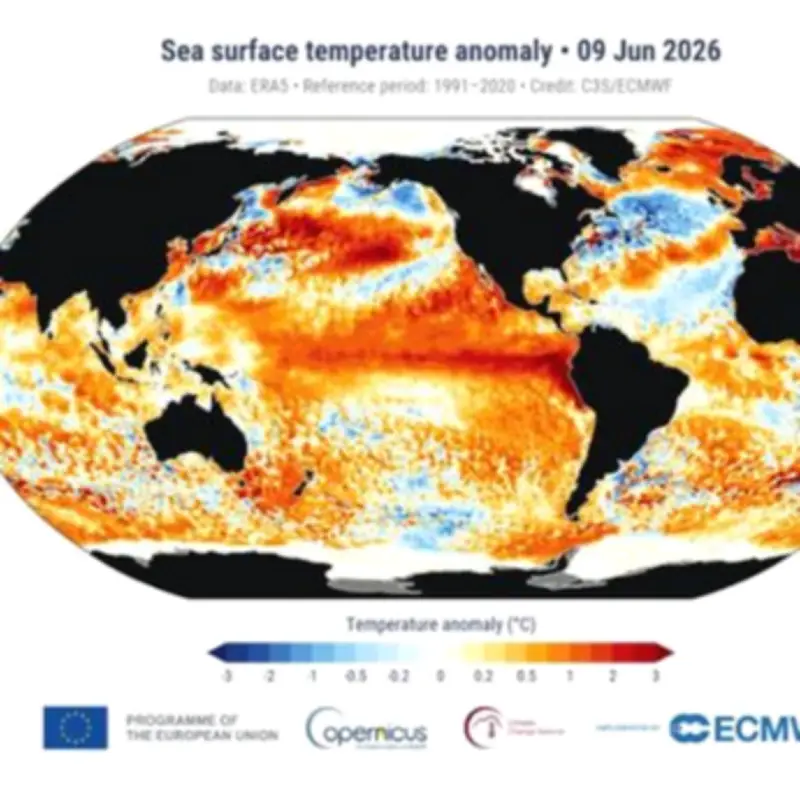
El Niño has officially been declared for 2026, and the Met Office has outlined how this global weather phenomenon could influence conditions in the United Kingdom over the coming year.
Official Declaration
Although anticipated for several months, the US National Oceanic and Atmospheric Administration (NOAA) formally declared El Niño on Thursday, June 11. This phenomenon is characterized by warming sea surface temperatures in the central and eastern tropical Pacific Ocean, which can alter weather patterns across vast regions of the globe.
Experts warn that El Niño is expected to exacerbate global warming already driven by fossil fuel pollution, likely intensifying extreme weather events worldwide. Meteorologists predict it could rival or surpass the record El Niño that began in 1997, which triggered extensive damage from heatwaves, floods, droughts, tornadoes, and wildfires.
Met Office Guidance
The Met Office indicates that current guidance suggests the developing El Niño is likely to be a 'very strong event,' with sea-surface temperature anomalies potentially exceeding 2°C in the central and eastern tropical Pacific—a significant figure compared to historical records. However, there remains 'significant uncertainty' about the event's ultimate intensity.
Professor Adam Scaife, head of long-range forecasting at the Met Office, stated: “Met Office predictions have been signalling for some time that this latest El Niño is likely to be a significant event – perhaps one of the most intense on record – with the potential to bring severe impacts to a number of regions of the world as the event unfolds. It is also highly likely that the El Niño will cause a temporary spike in global annual temperature, with the residual heat potentially making next year the hottest in the global series from 1850.”
United Nations Secretary-General António Guterres described El Niño as an “urgent climate warning,” saying in a video message that “El Niño conditions will pour fuel on the fire of a warming world.”
Global Impacts
Columbia University climate scientist and El Niño expert Muhammad Azhar Ehsan noted that northeastern Africa is likely to experience weather whiplash, shifting from intense drought to dangerously heavy rains. In the United States, El Niños can cause more intense storms with heavier rainfall in the south, but they often benefit the US agriculture industry, according to Jon Gottschalck, operational branch chief at NOAA’s Climate Prediction Centre. The most significant US effects typically occur in winter, with wetter conditions in the south and warmer, drier weather in the Pacific northwest.
The weather extremes caused by an El Niño also depend on its timing. Usually, El Niños form in summer, peak in late autumn or early winter, and fade by the following spring. However, Ehsan’s team forecasts that this El Niño will peak a month or two earlier, based on strong early signs from recent weeks.
UK Effects
Explaining how El Niño might affect the UK, the Met Office emphasized that it is just one of several factors influencing European and UK weather patterns. The Met Office stated: “Its impacts here in the UK are typically indirect, but it can increase the likelihood of more unsettled conditions later in the year, including a higher chance of milder, wetter and windier weather during autumn and early winter.” It added: “El Niño can also be associated with colder and calmer late winter periods in the UK. However, any potential impacts will be assessed in more detail later in the year as forecasts evolve.”




