
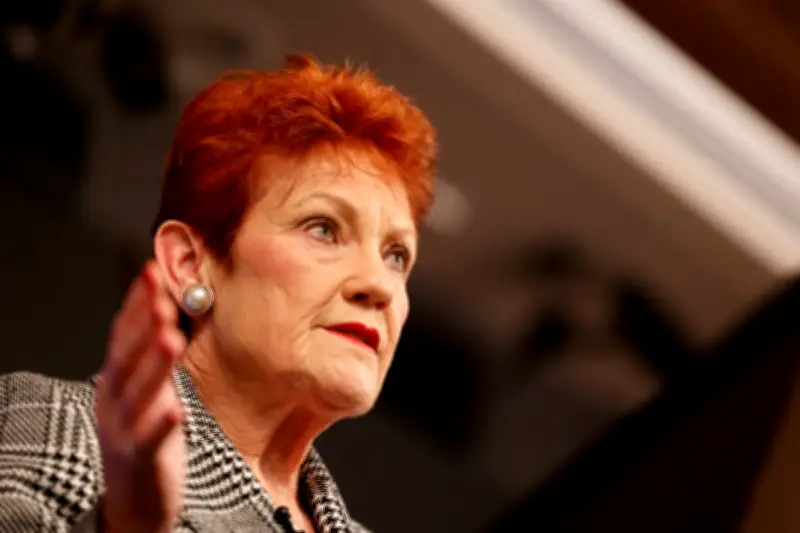
Economists have warned that One Nation could wind back the clock by decades for working mothers, damage productivity, and worsen gender inequality, following a controversial address by leader Pauline Hanson at the National Press Club on Wednesday.
Hanson appeared to suggest women should not be paid by their employers while on maternity leave, hinted at major changes to the childcare system, and called for income splitting for families to incentivise a parent staying home with their children.
Hanson's Stance on Paid Parental Leave
“If women take time off and they are not paid their wages because they’re not working, fair enough. Why should business pay? But they’re not at work. That’s the difference. That’s why the pay gap is there,” Hanson told the press club.
Paid parental leave is not compulsory for employers, though many offer it to attract staff. All employees are entitled to 12 months of unpaid leave. The government paid parental leave scheme from 1 July will offer parents 26 weeks at the national minimum wage.
Economists' Warnings
Leonora Risse, an associate professor in economics at Queensland University of Technology, said any move away from paid leave could have serious financial implications for women. “Questioning these policies is actually winding back the clock to many decades back, where it wasn’t an even playing field, and the gender gap was much wider,” Risse said.
“It isn’t just the financial implications for women, it is also setting women back in terms of decision-making, having financial independence, having a say, having status and respect in society.”
Risse added that competitive paid parental leave ensures women can remain in the workforce longer term and improve productivity. “If women can sustain their involvement and their attachment to the workforce and to their employer during their child-bearing years, that’s positive for productivity because it maintains a good job match,” she said. “We’ve worked really hard to validate that case and to prove that it has a productivity benefit as well as a wellbeing benefit.”
Income Splitting Proposal
Hanson has also pushed for income splitting for families with at least one dependent child, which could incentivise the lower-paid parent to remain at home or work less to look after children. The policy, which exists in other countries including France, would allow both parents to add their income together and split the total, meaning the income would be subject to two tax-free thresholds.
One Nation’s website states the policy will “encourage parents to look after their own children, and reduce the cost to the government of childcare, especially pre-school. It will also encourage homeschooling.”
Independent economist Silvia Griselda said policies to incentivise women staying at home could lead to skills shortages and a need for higher immigration. “Women, on average, tend to be more educated than men, so if you’re asking half of the workforce to not work … it means that we are kind of limiting the growth and the productivity of the Australian economy,” she said. “[And] if there is a shortage of skills in Australia, Australia has to overcome that through immigration.”
Risse said income splitting would need to be designed carefully to ensure women could remain financially independent. “One of the ways in which gender equality policies have progressed over time is for women to actually gain the right to have their own bank account, their own financial stream, and not to be dependent,” she said. “Income splitting could sound potentially equitable in practice, but it also introduces potential risk or compromise in terms of women’s financial independence.”
Childcare System Overhaul
Hanson also called for an overhaul of the childcare system, which now costs about $16bn a year. In her address, she said the system was “completely out of control” and should be investigated, and she wanted to see money go directly to parents rather than childcare providers. “I was a mother of four children. I didn’t have a university degree to look after my children. Why do we now expect these childcare centres to have students or people with some sort of degree to look after a child?” Hanson said.
Caroline Croser-Barlow, chief executive of early learning advocacy group The Front Project, said childcare was essential for working parents. “We have an economy that expects two parents to work and then say we’re not willing to invest in high-quality safe environments for your child,” Croser-Barlow said. “You wouldn’t let a plumber work on a house without a map of the plumbing, right? So why would you let people looking after your children, developing their brains, without having had the opportunity to learn and understand what really works?”
She said paying parents directly had “very high fraud risk” and could risk quality and safety.
Griselda said the policies, put together, would be damaging for households and the economy. “Her point is we don’t like to pay tax, that we should reduce the tax, that’s why we shouldn’t pay for parental leave or childcare. Let’s let the mother stay home. This in the long run, or even in the short run, will definitely limit the economy.”




