
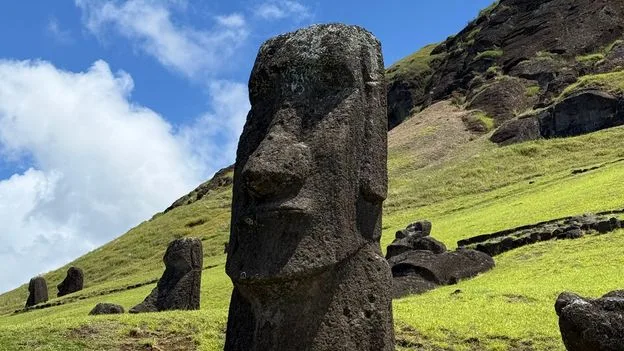
Easter Island, known locally as Rapa Nui, is facing a cultural crisis as its iconic moai statues suffer from severe erosion, exacerbated by climate change and rising sea levels. The roughly 1,000 monolithic human figures, carved between 1100 and 1600 AD from soft volcanic tuff, are gradually crumbling into the ocean.
Maria Tuki, a tourism worker on the island, recalls her father's prophecy: 'The moai would go back into the ocean one day.' Her father, who died in 2020, was a renowned contemporary moai sculptor. Many of the statues are positioned on coastal platforms called ahu, leaving them vulnerable to salt spray, wind, and rain. Moisture from the sea causes salt crystals to form within the porous rock, leading to flaking and cracking.
Conservation efforts are underway, with community leaders exploring options such as chemical treatments and 3D scanning using drones to document the statues before they are lost. Some argue that the statues should be left to natural decay as part of their lifecycle, while others call for relocation to safer ground.
The moai were created by Polynesian settlers to represent ancestors and were toppled in the late 18th and early 19th centuries, possibly due to religious conflict. In 1995, Rapa Nui National Park was designated a UNESCO World Heritage site, highlighting the global significance of these statues.




