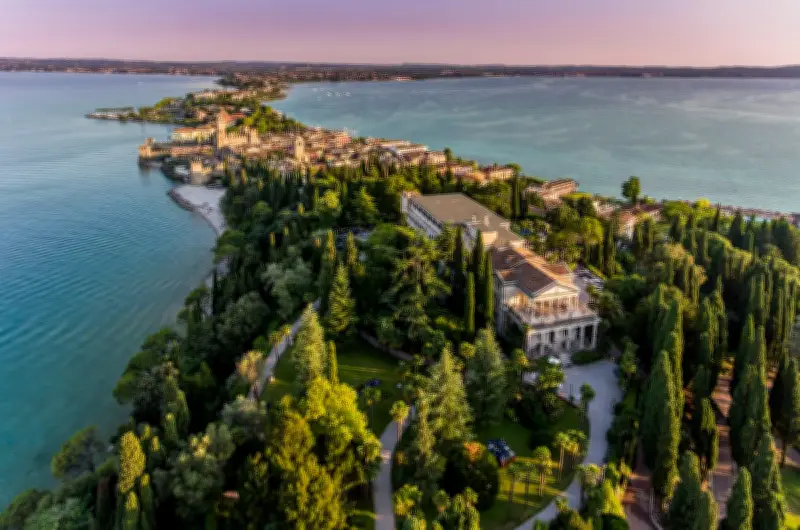
Lake Garda's White Secret: Villa Cortine Palace and the Rise of Lugana Wine
The journey to Lake Garda's Villa Cortine Palace takes less time than some commutes. A morning flight from London to Verona, half an hour by road, then Sirmione rises ahead, walled, water-bound, and almost indecently pretty. The landscape changes with suspicious ease. Olive trees appear, the air turns citrus-edged, and Lake Garda arrives as a climate, a colour, an appetite. By evening, tourists drain from Sirmione's narrow streets and the peninsula is handed back to stone, water, and those fortunate enough to be sleeping there.
Near its tip stands Villa Cortine Palace, a Relais & Châteaux hotel hidden within private parkland beyond the medieval walls. Marble statuary emerges from umbrella pines. Below, speedboats pause above thermal springs which mesmerisingly bubble through the lakebed. Beyond the trees lie the Grotte di Catullo, the immense remains of a Roman villa from the Augustan age, evidence of the wealthy lives drawn to this extraordinary promontory two millennia ago.
Exploring the Grounds and the Wine Revelation
Revenue manager Niels van den Berge led me first through the grounds: a kitchen garden, a veranda where proposals habitually happen, and paths winding through cypresses. From my room, Garda shimmered, broad enough to resemble a sea. Most visitors come for the lake. Increasingly, they should come for the wine. Before arriving, such a claim would have surprised me. It surprises me less now.
The explanation begins inland, where Garda's beauty acquires a darker undertow. At San Martino della Battaglia, a tower rises above vineyards and a former battlefield. From its summit, everything appears orderly: rows of vines, low hills, the lake beyond. Nearby, an ossuary records the human cost which the panorama conceals. Soil once fought over now yields one of Italy's most distinctive white wines.
Lugana Wine: A Diamond-Shaped Region of Distinction
Lugana occupies a diamond-shaped stretch of vineyard along Garda's southern shore, spanning five municipalities across Lombardy and Veneto. The terrain appears deceptively gentle, yet Garda engineers its advantage. Temperate breezes move from the lake across the vineyards, ventilating the vines, moderating summer heat and creating a mild climatic cradle in which Turbiana ripens slowly while retaining freshness and tension.
The region sits on pale glacial clay deposited when vast sheets of ice retreated and reshaped the southern lake basin. Growers speak of this clay with unusual affection. During summer it hardens towards concrete. After rain it becomes dense, adhesive and difficult to work. Yet it stores water through increasingly hot growing seasons and drives roots deep into the subsoil. The same three words surfaced repeatedly over two days: salinity, freshness and longevity. Longevity, especially.
Recognised as Lombardy's First DOC in 1967
Recognised in 1967 as Lombardy's first DOC, and among Italy's earliest, Lugana is built predominantly around Turbiana. Although the rules permit up to 10 per cent of other non-aromatic white varieties, most producers use Turbiana alone. The easy description is citrus, blossom and almond. The interesting description arrives later. Tamlyn Currin of JancisRobinson.com described Lugana to me as 'intensely littoral'. The phrase feels exact. These are wines shaped by boundaries: water and land, Veneto and Lombardy, youth and maturity.
Tasting Through the Decades: From 1997 to 2021
At Le Morette, founded by Gino Zenato in the early 1960s as a vine nursery and still studying Turbiana from the root upwards, a 2017 Riserva remained complete and charged, carrying citrus and blossom into something deeper and more architectural. At Tenuta Roveglia, a 2011 Lugana tasted under both screwcap and cork demonstrated two different journeys through time. The screwcapped bottle remained taut and youthful. Its cork-sealed counterpart had broadened and acquired layers of development. Then came a 1997 Vigne di Catullo. Many supposedly serious white wines struggle as they approach three decades. This one did not.
Cascina Maddalena is among the denomination's smallest estates. With winemaker Mattia away on a family holiday, his parents stepped in to host. Family portraits lined the walls and the boundary between home and winery appeared almost non-existent. Clay, its flagship, is produced in limited quantities and only in selected years, before maturing in concrete. The 2021 carried tangerine, stone and tension. The 2018 was more compelling still - bright, limpid and precise, as if the region's defining soil had passed directly into the glass.
Innovative Winemakers and Sustainable Practices
At Selva Capuzza, Luca Formentini - composer, sound researcher, and winemaker - stopped ageing Menasasso in oak from the 2017 vintage, seeking a clearer expression of Turbiana. At the sustainable Montonale, Roberto Girelli's Orestilla 2016 provided another surprise. Mature yet vivid, broad yet precise, it suggested a wine still climbing rather than descending. Girelli told me the family was developing a release intended to spend three years in ceramic vessels and another seven in bottle before sale. Ten years before release requires confidence or madness. Perhaps both.
What surprised me most was not simply the quality, but the breadth. Traditional-method sparkling wines appeared unexpectedly, followed by amphora wines, riservas, late-harvest bottlings, and barrel-aged grappas. Across two days, I never tired of drinking Turbiana. The best examples seemed to occupy territory between white Burgundy, Loire Chenin, and Rhône whites, while remaining unmistakably themselves. One began to wonder whether producers fully appreciate the treasure resting in their cellars.
Sweet Silence at Villa Cortine Palace
The test came back at Villa Cortine Palace. At the gates, an inscription reads: 'Within sweet silence, restless thoughts and trembling worries slowly melt away into forgetfulness.' Later, at Le Gardenie, the coincidence felt almost too neat. The wine was Ottella's Back to Silence, a skin-contact white from the Lugana zone fermented in amphora. Chef Mattia Bartoli's menu drew from the lake and its hinterland: roasted cuore di bue tomato with tomato essence, Vacche Rosse Parmesan fonduta and puffed buckwheat; ravioli del plin with formaggella from Tremosine, saffron from Pozzolengo, and capers from Gargnano; roast pigeon with banana chutney, sorrel and a crisp leg; then a Sacher reworked through apricot and verbena. Herbs and fruit from the hotel's garden threaded its grounds back onto the plate.
The strongest impression was lightness of touch. Nothing shouted - not the food, the wines or the hotel - yet almost everything stayed with me. Such self-possession runs through the denomination. Producers discuss thirty-year-old bottles with the ease others reserve for yesterday's vintage, pouring mature wines with little interest in announcing what they have achieved. The prevailing mood is riservatezza: reserve, discretion, understatement. Perhaps Lugana remains underrated not because its wines lack quality, but because those behind them have allowed the wine to make its own argument.
For two thousand years, Lake Garda has drawn visitors. Romans built villas here. Renaissance travellers followed. Grand hotels came later. After two days, the question was no longer whether Lugana deserved greater attention. The evidence sat repeatedly in the glass. The greater mystery was how a region capable of producing wines like these had escaped wider notice for so long.