
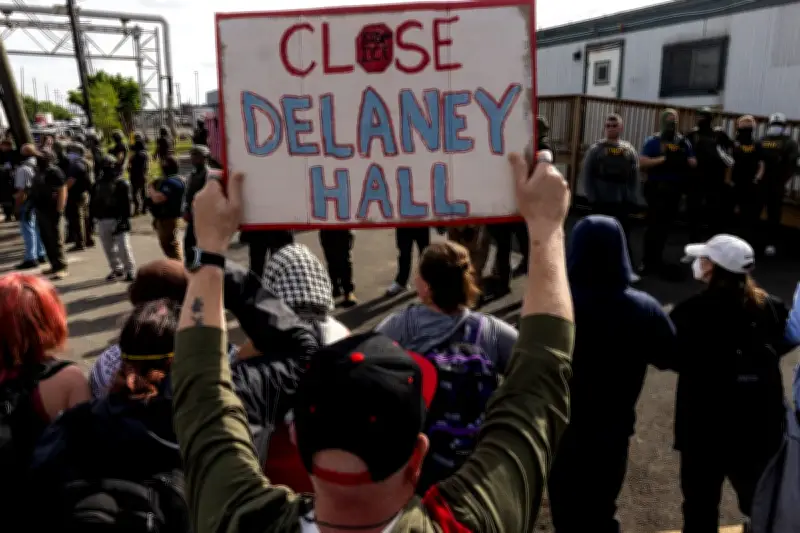
For more than two weeks, at least 300 detainees at the Delaney Hall immigration detention center in Newark, New Jersey, have been on a hunger and labor strike. They describe 'horrible' conditions: spoiled food, inadequate medical care, and poor living conditions. Some allege physical abuse by guards, including being beaten and pepper-sprayed, leading to hospitalizations. They demand a meeting with New Jersey Governor Mikie Sherrill and the immediate release of all detainees from the privately operated 1,000-bed center. In response, the Department of Homeland Security has partly restored family visitation and released pregnant detainees. Protests outside Delaney have escalated, with violent clashes between demonstrators and law enforcement. ICE agents have used batons, pepper spray, and stun guns against protesters, journalists, and a US senator. Federal authorities arrested demonstrators for alleged assault, and Sherrill deployed state police, leading to over 60 arrests in one night. Meanwhile, ICE transferred Martin Soto, a suspected strike leader held in solitary confinement.
Historical Context of Migrant Detention
Jessica Ordaz, a historian and professor at the University of Colorado Boulder, author of The Shadow of El Centro, explains that the current situation fits a long history of immigrant incarceration and resistance. Strikes have also been reported in New Mexico and California over water quality, mold, and lack of medical care. 'The conditions we are seeing today have been present for generations,' Ordaz says. 'There have always been protests from inside, but the system of immigration control hasn’t been curtailed.'
Reaction to Delaney Hall
Ordaz finds the situation 'maddening' because many elements—detention, poor treatment, lack of food or medical supplies, protest repression—repeat decade after decade. The only change is that the system has gained more resources and power.
History of Resistance
The policing of migration became institutionalized with anti-immigrant laws targeting Chinese immigrants in the 1800s. El Centro, a detention center in California, started as a camp in 1945. Undocumented Mexican labor built the prison that would imprison their families. Labor plays a key role: the government used forced labor, threatening detainees with job loss, food deprivation, deportation, or physical harm. Detainees were paid as little as two cents for their labor, a thread of racial capitalism continuing today.
Forms of Protest
Escaping was the earliest protest. In the 1940s, detainees worked in border areas and often escaped successfully. By the 1960s, petitions, hunger strikes, and legal advocacy emerged as tactics. Hunger strikes became prominent at El Centro, where braceros (Mexican laborers) protested poor food quality. Food was often used as punishment, with low-quality meals causing illness.
Conditions and Risk
Conditions have always been bad. Detainees risk their lives to draw public attention. Some turn to suicide or self-harm because they 'have nothing else to lose,' Ordaz says.
Tangible Changes
At El Centro, some demands were met, like shade and indoor time during extreme heat. However, decades later, conditions have regressed. Some detainees were deported, transferred, or hospitalized with severe wounds. Success has been marginal.
Multi-Tactic Approach
Solidarity between inside and outside is crucial. Powers that be bend only under external pressure. Activists work with politicians, stage sit-ins, and build coalitions. While systemic change is slow, activism can secure individual releases and reduce ICE resources, minimizing the carceral state.
Broader Patterns
Ordaz emphasizes looking at roots: the US has recruited migrants and caused global displacement. 'Abolish ICE' alone is insufficient, as ICE is a recent agency. Understanding empire and why people migrate is key to addressing the ongoing repression and resistance in detention centers.




