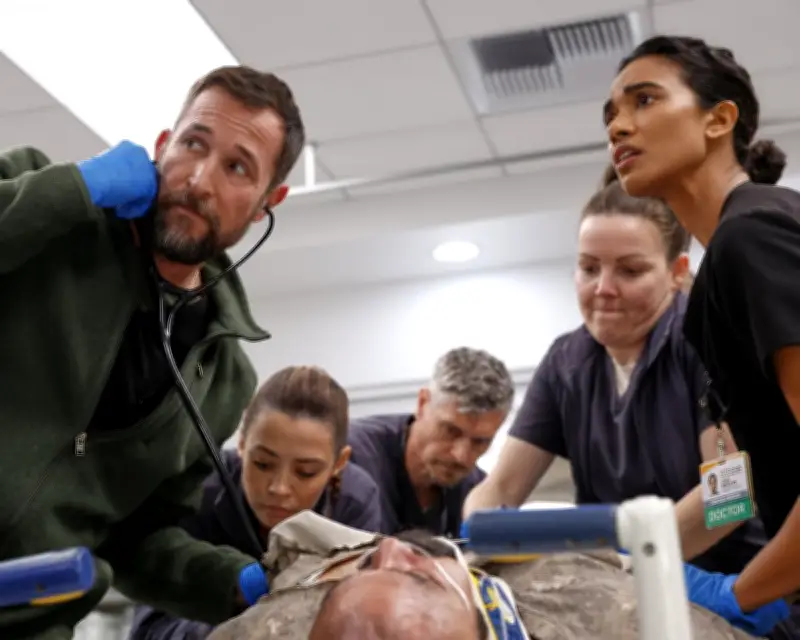
The Pitt, HBO's gritty medical drama set in a Pittsburgh emergency department, has been hailed as the most hopeful show on television despite its intense portrayal of life-and-death cases and systemic healthcare challenges. The series, which concluded its second season with a Fourth of July finale featuring fireworks, group hugs, and karaoke, has already been renewed for a third season, set to begin production this summer and air in January 2027.
Award-Winning Accuracy and Impact
The Pitt has been praised as the most medically accurate drama ever made. Its debut season in 2025 won five Primetime Emmys, including Outstanding Drama Series, and the second season is expected to repeat that success. The show follows a real-time format, interweaving medical cases with the personal struggles of staff at a fictional Pittsburgh emergency department.
Adam Kay, a former NHS doctor and author of This Is Going to Hurt, described the show as a cautionary tale for UK viewers: “Watching The Pitt in the UK, we can look at it as the ghost of Christmas future – the land of the not-so-free healthcare.”
Addressing Hot-Button Issues
The series tackles contentious topics such as ICE agents, abortion restrictions, gun violence, opioid addiction, and anti-vaxxers, all set against a backdrop of overcrowded waiting rooms and staff assaults. Despite the bleakness, the show is full of heart and humanity. Salon.com called it “a vision of care and connection amid expanding national trauma” with “a halo of optimism,” while The New Yorker described it as “a counterintuitive comfort watch.”
“There’s definitely comfort in competence – watching a bunch of professionals who know what they’re doing,” Kay added. “Although the main comfort I get from it is the knowledge I don’t have to work in that environment any more.”
Optimism in Challenging Times
Dr. Rob Perry, vice-president of the Royal College of Emergency Medicine, emphasized the show’s uplifting core: “At its core, The Pitt is a show about doctors and nurses fighting to do the best job they can in challenging circumstances. You can’t get more hopeful and uplifting than that. There’s something deeply satisfying about seeing lives saved.”
Even when patients don’t survive, the show finds moments of hope. Attending physician Michael “Dr Robby” Robinavitch, played by star and executive producer Noah Wyle, observes a moment of silence after a patient’s death, and staff perform an “honor walk” for organ donors. Small acts of kindness, such as offering a homeless man a shower or treating a rape victim with sensitivity, highlight the healing power of empathy.
Teamwork and Real-World Advocacy
“Emergency medicine is very much a team sport,” said Perry. “We all rely on our colleagues every day.” Kay echoed this: “It’s about trusting the science and the scans, but also each other.”
Off-screen, Wyle, the son of a nurse, has lobbied for healthcare reform and led a Capitol Hill rally in support of hospital staff. “I know Noah Wyle isn’t actually a doctor,” said Perry, “but he’s spent many years playing one – first in ER and now The Pitt – which gives him a certain authority with the public. I love that he cares enough to use his influence to try to change things for the better.”
Carly McCarter, who runs the Pitt Fan Page, said: “Noah has so much compassion and wants to help others. All us fans are proud of the work he’s done and continues to do. The Pitt truly is a force for good.”
The third season will be set in early November, four months after season two, covering the buildup to the holidays and cuts to Medicare.