Ryan Calais Cameron's latest play, The Afronauts, restores nobility to the mission of Edward Mukuka Nkoloso, a former revolutionary who attempted to send two cats and a seventeen-year-old girl into orbit at the height of the Space Race, much to the shrugging and smirking of the rest of the world. The play is now showing at the Royal Court Theatre until 19 December.
A Cinematic Production with Big Ideas
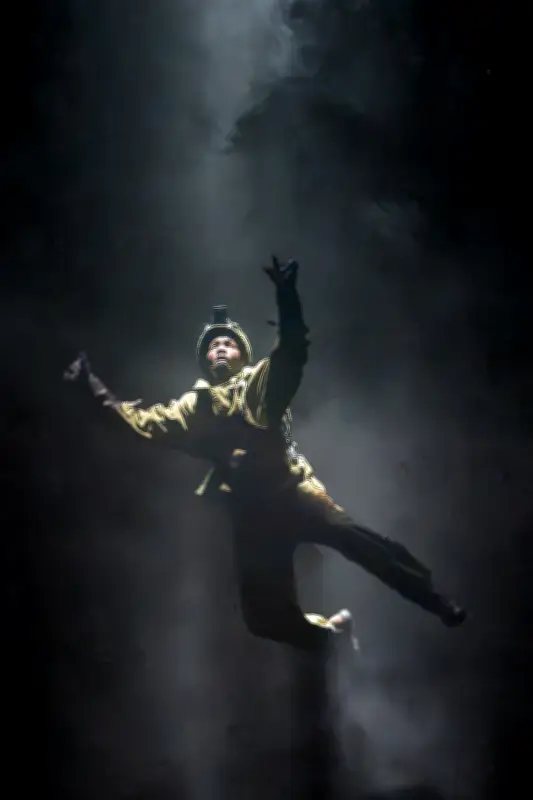
Cameron and co-director Monique Touko bring a cinematic eye to a beautiful production. The play starts with blasts of light, stirring music, archive footage and an astronaut tumbling in space above the stage. Soutra Gilmour's set features a round stage with a yawning hole above, an aperture made of green marble, promising infinite space above it.
However, too persistently, you get the sense that Cameron is trying to force a play from a brilliant idea. Scenes run too long, with too much repetition, and while ideas clash elegantly, they are squeezed into a pretty schematic bit of writing: a love interest fires up, every character gets their big speech. You long for the thriller-ish tightness of his last play Retrograde, or the bruising, form-breaking vignettes of his smash hit For Black Boys.
Characters and Performances
At first, Cameron revels in showing us the literal planks of wood and old tyres that are the materials of this programme. Star astronaut Matha (Ama Qamata in a strong debut) is being trained up by Nkoloso alongside a ragtag group of misfits, watched over by Pamela Nomvete's Auntie Grace, who is there to look after their spirits, and to keep these Afronauts connected to their ancestors.
Lucian Msamati gives a typically detailed performance as the independence fighter turned space boss Nkoloso, capturing a man trying to reconcile two polar instincts: sometimes he's all military discipline and drills, blowing a piercing whistle to bring the recruits to order. The rest of the time he laughs and fantasises and talks in wise-sounding aphorisms.
Selective Retelling and Strongest Moments
Cameron never lets scrappiness and silliness leave the script for too long. He holds us in suspense between the space programme as elaborate joke and as serious ambition. But he is selective in his retelling. Gone are the two trained cats, as well as the fact that this was to be a Christian mission to space, and the training exercises that involved rolling in an oil drum down a hill.
The loss of those more absurd elements means that Cameron can take Nkoloso's ideas seriously, but you lose the sense of him as a great satirist, as some have suggested he might have been, making fun of the billions of dollars being spent on American and Soviet missions while billions of people were starving on earth. The play is strongest when it reflects on the programme as the great ambition of a newly independent country stretching its wings. A few superb scenes stand out: the first liftoff moment, the rousing ending. The rest is a fascinating story told in familiar strokes.