A mashup of Shakespeare's tragedy and Radiohead's 2003 album at the Barbican is a short, sharp jolt of adrenaline that may introduce both the Bard and the band to a new audience, even if it won't please purist fans of either. The 100-minute show is part play, part gig, part hectic dance piece, with the text brutally sifted to its basics. Dressed in shades of mordant black, it is urgent, forceful and compelling.
A Democratic Collaboration
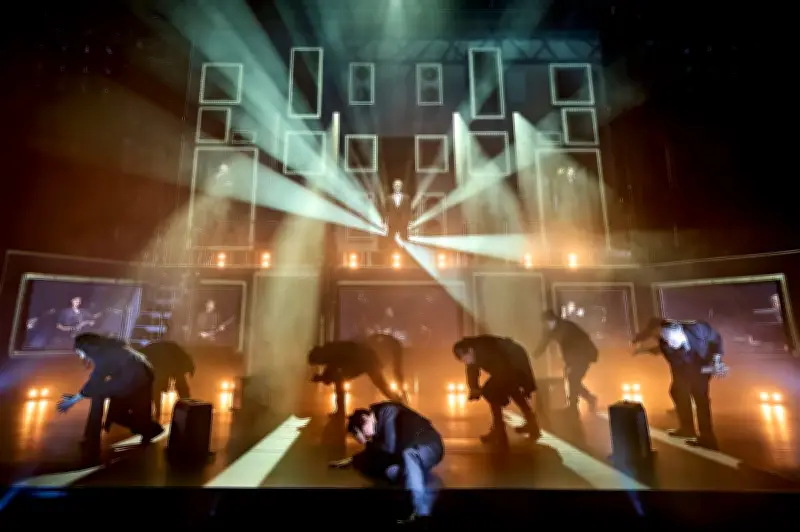
The venture is a collaboration between co-directors Christine Jones (whose company AMP created the set with Sadra Tehrani) and Steven Hoggett, and Radiohead's frontman Thom Yorke, who also did the orchestrations. The story becomes as much about the supporting characters as Samuel Blenkin's etiolated, neurasthenic Danish prince. The band, housed individually in glass booths at the foot of an Elsinore castle wall made up of speakers, insulation cones and backlit arrow slits, are on an equal footing with the actors.
Vocalists Ed Begley and Meg Hill appear in doorways halfway up, briefly and jarringly recalling figures in a cuckoo clock. Monochrome particles seep down this wall like platelets of blood, coalescing into the spasming, vengeful face of Hamlet's murdered father.
Music and Movement
The music is less prominent than at the Manchester premiere at Aviva Studios two years ago, with Yorke's songs mostly broken down into keening phrases and drum-driven riffs. Hail to the Thief, originally a response to George W Bush's controversial 2000 election win, becomes a ghostly soundtrack for events that may well be happening in Hamlet's disordered mind. This is sensed particularly when his jerky dance movements are echoed by the hapless Rosencrantz and Guildenstern, as if they are possessed by him.
Choreographer Jess Williams kicks things off with a routine that is a mixture of euphoria and seizure. All the characters are afflicted by forces they can't control, from the ambition of Paul Hilton's straining Claudius to the desire Claudia Harrison's Gertrude feels for him. Blenkin's Hamlet and Ami Tredrea's Ophelia are caught up in each other, and after a flirtatious jig they are discovered entwined by her brother Laertes (Brandon Grace).
Cast and Cuts
The core cast from 2025 has been reunited. Blenkin still resembles a tousle-haired shoegazer who's been up all night chasing a fugitive lyric. Tredrea's spirit as Ophelia is striking, and Blenkin's Hamlet performs the To Be or Not to Be soliloquy directly to her, which she spookily echoes later before her watery death. There is a brief, lovely moment of thwarted empathy between her and Alby Baldwin's Horatio.
Other famous speeches, including several of Hamlet's and Horatio's closing encomium, are condensed or cut entirely, and the scenes with the players reduced to one brief dumbshow. The gravedigger becomes an ominous, spectral figure: Merryl Ansah appears out of the earth singing a mournful snatch of the HTTT track Scatterbrain. The tweaks to Shakespeare's language are capricious, with "ye" and "you" used indiscriminately. Hilton's Claudius, writhing with repressed guilt, mutters "let the f***ing axe fall". The final duel is a brutal, combative dance routine where Hamlet and Laertes wrestle for control of a dagger and the poisoned spew gouts of blood into the faces of their nearest.
The show isn't perfect. Hamlet is quite a witty chap in the original while here a mood of monolithic, monochrome, art-rock earnestness presides. But in London as in Manchester, this bizarre, inspired hybrid artwork strikes me as exactly the sort of thing the RSC should be doing alongside its more traditional core work. The show runs until 23 January at the Barbican.