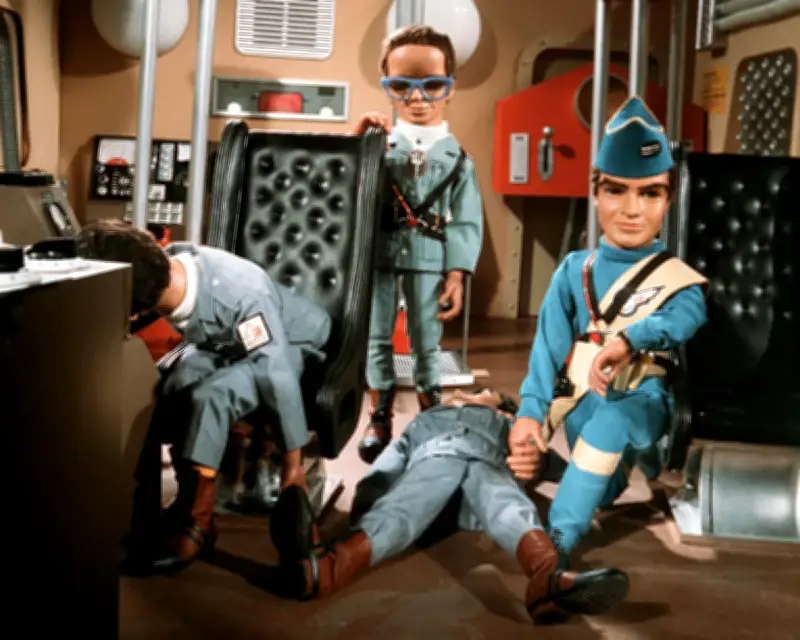
Thunderbirds was far more than puppets on strings – it was a strikingly optimistic view of humanity. The British TV show followed five brothers and their wealthy father in the year 2065 as they go on valiant rescue missions – with no strings attached.
A Vision Born from Disaster
The year is 2065, and a philanthropic, fabulously wealthy ex-astronaut – Jeff Tracy – dedicates his life to saving humanity. Their headquarters? A mid-century vintage James Bond-style villa, situated on an island somewhere in the Pacific Ocean. From here, Jeff and his five handsome, talented sons blast off in hi-tech vehicles to stage daring rescues. These almost totemic, futuristic feats of engineering? Thunderbirds.
First airing in 1965, the TV series had a daring, strikingly optimistic view not just of the future, but of humanity as a whole. It all started when its creators, Gerry and Sylvia Anderson, who were already making ambitious and successful TV shows, learned of a disaster unfolding in Germany. A mine had collapsed, sealing 50 men deep underground, and a group of brave volunteers set out to rescue them.
Inspiration and Creation
“That’s something he became obsessed with,” says Jamie Anderson, son of Gerry and Sylvia, and CEO of Anderson Entertainment. “The idea that these people were trapped, and suffering, and that they had no idea that not too far away, people they’d never met before were making great efforts to save their lives.”
This moment, Anderson says, led to the creation of Thunderbirds: “He thought, what if you could create a group that could get anywhere in the world, super fast, and rescue people in danger?”
Thunderbirds charts the adventures of International Rescue, a secret organisation dedicated to carrying out this wonderfully optimistic mission. Anderson says his father grew up in poverty during the second world war, which claimed the life of his brother, who was killed during RAF operations. “A child growing up in that is going to seek the opposite, right?” he says.
In fact, Gerry’s brother Lionel was another direct inspiration for Thunderbirds. “Lionel was one of those really annoying people who was handsome, smart, witty, artistic, could dance, was musical, confident … this guy had it all, did it all. He was the original Tracy brother! You can spread all those characteristics across the boys, and they’re kind of like the light of Lionel hitting a prism and being split into the five brothers,” says Anderson.
The Puppets and the Show's Legacy
Those five brothers became the pilots of the Thunderbirds, the futuristic vehicles deployed by International Rescue. Brothers, it should be noted, played not by humans … but marionettes. But why puppets?
“They never wanted to use puppets!” says Anderson. “They wanted to make Hollywood epics with real, proper actors, not with fibreglass marionettes. So much of Thunderbirds is born out of embarrassment. Working with these ‘bloody puppets’, dangling by carpet thread, with painted-on eyes. Dad’s constant quest was, what can we do to make them look better? To de-puppetify the puppets?”
The sheer scale of Thunderbirds becomes almost overwhelming when you realise that Gerry and Sylvia were essentially turning out 50-minute-long films, cast entirely with puppets, moving through and interacting with countless bespoke sets and props, acting out deceptively complex stories in globe-spanning locales. The level of detail in Thunderbirds remains, to this day, bewildering.
Over its 36-episode run (followed by two feature-length films), viewers watched in awe as Thunderbirds plunged them into stories flitting between classic disaster films, spy capers, space-age sci-fi and cold war intrigue. And for each challenge, International Rescue had an answer. Thunderbird 1, a sleek hypersonic rocket plane, was used for recon, piloted by Scott Tracy. Thunderbird 2, a surreal snub-nosed aircraft carrier, carried pods which deployed a never-ending array of specialist equipment, piloted by Virgil. Thunderbird 3? A spaceship piloted by Alan. Thunderbird 4 was a sleek little submarine, piloted by Gordon, and deployed by Thunderbird 2. Finally, Thunderbird 5, the space station from which International Rescue handled worldwide comms, helmed by John Tracy.
But which Thunderbird is the best, and why is it Thunderbird 2? “Yes, that is the question,” says Anderson. “It’s obviously 2!”
Lady Penelope and Real-Life Impact
Though the series focused on the Tracy brothers and their valiant rescue missions, the spotlight was often stolen by Lady Penelope: a model, socialite and a secret agent who frequently collaborated with International Rescue. She brought a touch of MI6 mystique and humanity to the proceedings. Often accompanied by Lord Parker, her resourceful valet, she was based on – and voiced by – Sylvia, who injected heart and warmth into the show. “Sylvia brought in such an awareness of culture and character and style,” says Anderson. “The look, the feel of the 60s, which was always looking towards the future. It was bright, positive.”
So positive, in fact, that it went on to inspire the creation of a real International Rescue (the International Rescue Corps) in the 1980s. “Dad was president, and I was briefly vice-president, before it closed a few years back. They were volunteers who went around the world and helped people in need, so there was a real-life impact.”
After more than 60 years on television, Thunderbirds remains an incomparable piece of TV history. It’s a show about a billionaire who dedicates his life, time and money to helping those in need – with no strings attached. And doesn’t that just sound FAB? Thunderbirds is available to stream on 9Now in Australia, on ITVX in the UK, and on Peacock Premium in the US.