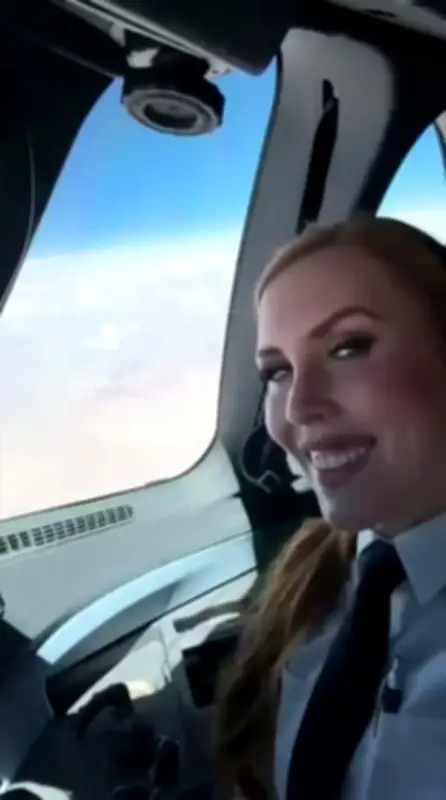
Female airline pilot Raja Katz has revealed that passengers often react with surprise when they see her in the cockpit, though she says the reaction is more common on short-haul flights than long-haul ones.
Speaking exclusively to the Mirror, Katz, who posts on social media as @raja_in_the_sky, explained that the pilots and cabin crew she flies with have never questioned her competence, but passengers sometimes show surprise when they realise a woman is flying the plane.
Passenger reactions on short-haul flights
Katz said the reaction happened more often when she was flying short-haul, because on smaller aircraft there is barely any physical distance between where passengers board and the cockpit door, so people would see her walk in and react on the spot. Long-haul jets are bigger, and there is much less contact between passengers and the flight crew, so she hardly ever gets those moments now.

She acknowledged that any form of discrimination is unacceptable, but added that sometimes it is more of a surprise on some faces when a woman is flying rather than rejection, and she understands that reaction because it is still rare.
Becoming a pilot
Katz realised she wanted to be a pilot when she was around 12 or 13 years old, despite not knowing any pilots, let alone a female one. At 15 she started flying gliders, which turned the fascination into something concrete. Looking back, not having a role model or mentor of her own is a big part of why she now spends so much time trying to help increase representation for female pilots.
She explained that there are broadly two ways into the profession: an airline's own cadet programme, which is comparatively rare and highly competitive, or a private flight school that you fund yourself, which is the far more common route. Either way, you start with classroom training covering air law, meteorology, navigation and aircraft systems, and sit a set of legal exams, either alongside or before practical flying.
Practical training starts on small, single-engine aircraft and builds up from there, adding a multi-engine rating, an instrument rating and multi-crew training. Once the required theory exams are completed, you hold a "frozen" ATPL (Airline Transport Pilot License), which becomes full once enough flight hours are built up. The final step is the type rating: the license for one particular aircraft type, such as an Airbus A320 or a Boeing 737, most often provided or paid for by your employer once you're hired.
What a typical day looks like
Katz said there is no such thing as a typical day as a pilot, and every day is different. Flying long-haul, you start your working day at your home base anywhere between early morning and late evening, depending on the flight. You report for duty, meet your fellow pilots, and meet the cabin crew to go over safety-relevant aspects and procedures for that flight.
After boarding, you finish flight preparations: entering the route into the onboard computer, calculating takeoff speeds, and briefing the crew on the departure. Once loading is done and everyone is on board, the aircraft is pushed back, taxis to the runway, and after checklists is ready for takeoff. During cruise, pilots constantly monitor weather, routing and terrain, and build contingency plans in case they need to land immediately.
Katz's long-haul sectors typically run between seven and 14 hours. As the aircraft gets closer to its destination, the entire approach and descent procedure is briefed in detail. After landing, passengers disembark, the aircraft is handed over to maintenance for routine checks, and the crew heads off to clear immigration and get to the hotel.
Clearing up the co-pilot misconception
Katz said there is one thing she would love to clear up: the difference between "pilot" and "co-pilot". Many people assume the co-pilot is somehow the backup, someone who is there just in case and doesn't really fly the plane. That is not how it works.

Both the captain and the first officer, which is the correct term for what most people call the co-pilot, hold the same type rating for that aircraft and are both fully qualified to fly it. They take turns being "pilot flying" and "pilot monitoring" from one leg to the next, so on any given flight, it might be the first officer's hands on the controls for takeoff and landing, not the captain's. Katz is a first officer herself, so she flies plenty of those sectors, take-offs and landings included, exactly like a captain would.
The real difference between the two roles is seniority and responsibility. Captains have more experience and additional command training, and they carry the final legal authority and responsibility for the flight. But day to day, both are pilots in every sense of the word. For more information on learning to become a pilot, including the qualifications needed and the costs involved, visit the Civil Aviation Authority website.