An investigative documentary released on Netflix on August 19, 2026, examines alleged systemic safety failures at Boeing and the death of whistleblower John Barnett. Freefall: A Reckoning for Boeing is a sequel to the 2022 film Downfall: The Case Against Boeing, which looked at two Boeing 737 Max crashes in 2018 and 2019 that killed 346 people.
Directed by Rory Kennedy, the new film focuses on Barnett's battle with Boeing and his later suicide, along with testimony from other whistleblowers who claim managers sometimes told them to overlook safety problems. Following Boeing's 1997 merger with McDonnell Douglas, the company was accused of being run by Wall Street executives focused on profit rather than being an engineer-led organisation.
Tenerife and Japan Airlines disasters
The company faced allegations of prioritising cost-cutting and outsourcing vital engineering work, and has continued to face production crises, including improperly installed wiring and unsealed door plugs that blew out mid-flight on Alaska Airlines Flight 1282 in January 2024.

On March 27, 1977, two Boeing 747 passenger jets (KLM Flight 4805 and Pan Am Flight 1736) collided on a foggy runway at Los Rodeos Airport (now Tenerife North Airport) in the Canary Islands, Spain, resulting in 583 fatalities. Known as the Tenerife Airport Disaster, it remains the deadliest aviation accident in history. A bombing at Gran Canaria Airport earlier that day had forced planes, including the KLM and Pan Am flights, to divert to the smaller airport in Tenerife.
That diversion overwhelmed the small airport, forcing pilots to taxi up and down the active runway because taxiways were blocked. Thick fog then reduced visibility, and a fatal misunderstanding followed. The Pan Am jet was taxiing on the runway but missed its intended exit. At the same time, the KLM pilots mistakenly believed they were cleared for takeoff and accelerated, crashing into the hidden Pan Am plane. The impact and resulting fire killed all 248 people on board the KLM plane and 335 of the 396 people on board the Pan Am plane, with all 61 survivors in the front section of the aircraft.
Japan Airlines Flight 123 was a domestic flight travelling from Tokyo to Osaka on the evening of August 12, 1985. Just 12 minutes after takeoff, the Boeing 747 suffered a severe structural failure and explosive decompression. After flying under minimal control for 32 minutes, the plane crashed in the area of Mount Takamagahara. The aircraft had 524 people on board, and the initial crash killed all 15 crew members along with between 460 and 490 of the 509 passengers. An estimated 20 to 50 passengers survived the initial crash but died from their injuries while awaiting rescue, leaving only four survivors.
Mid-air collision and shoot-down
The crash, which claimed 520 lives in total, is the deadliest single-aircraft accident in aviation history and remains the deadliest aviation incident in Japan. Japan's Aircraft Accident Investigation Commission, assisted by the U.S. National Transportation Safety Board, concluded that the structural failure was caused by a faulty repair by Boeing technicians following a tailstrike seven years earlier. When the faulty repair failed, it caused rapid decompression that ripped off a large portion of the tail and led to the loss of all hydraulic systems and flight controls.
The Charkhi Dadri collision occurred mid-air when Saudia Flight 763 (a Boeing 747) and Kazakhstan Airlines Flight 1907 (an Ilyushin Il-76) collided over Haryana, India, on November 12, 1996, killing all 349 people aboard both aircraft. It was found to have been caused by the flight crew of Kazakhstan Airlines Flight 1907 failing to maintain their assigned altitude. The Kazakh Ilyushin Il-76 descended past its cleared altitude of 15,000 feet into the path of the ascending Saudi Arabian Airlines Flight 763 at 14,000 feet.

Three key factors contributed. The Kazakh flight crew's English was poor, and only the flight engineer spoke English, forcing them to rely on a radio operator for continuous Russian translation of Air Traffic Control (ATC) instructions. The crew also exhibited confusion and poor communication during their descent. Additionally, the ATC radar at Delhi's Indira Gandhi International Airport was a primary surveillance radar, meaning controllers could see the planes' distance and bearing but could not independently verify their altitudes. Neither aircraft was equipped with a Traffic Collision Avoidance System (TCAS). The accident led the International Civil Aviation Organization to make TCAS mandatory for commercial aircraft, establish English as the universal language for aviation communication, and mandate that arrival and departure routes at busy international hubs be separated.
737 Max crashes and groundings
Malaysia Airlines Flight 17 was travelling from Amsterdam to Kuala Lumpur when it was shot down over eastern Ukraine by a surface-to-air missile on July 17, 2014, killing all 283 passengers and 15 crew members. All contact with the aircraft, a Boeing 777-200ER, was lost when it was about 50 kilometres from the Ukraine-Russia border, and wreckage landed near Hrabove in Ukraine, 40 km from the border. It was said to have been shot down by Russian-backed forces. The Russian government denied involvement, but on November 17, 2022, following a trial in absentia in the Netherlands, two Russians and a Ukrainian separatist were found guilty of murdering all 298 people on board. The Dutch court also ruled that Russia was in control of the separatist forces fighting in eastern Ukraine at the time.
China Airlines Flight 611 was travelling from Taiwan to Hong Kong International Airport when it disintegrated midair and crashed into the Taiwan Strait, just 20 minutes after takeoff, killing all 225 people on board. The in-flight breakup was caused by metal fatigue cracks from a tail strike at Kai Tak Airport on February 7, 1980. The aircraft had not been properly repaired according to Boeing policies and manuals. The crash remains the deadliest in Taiwan and the second-deadliest in China Airlines history, behind China Airlines Flight 140 with 264 fatalities.
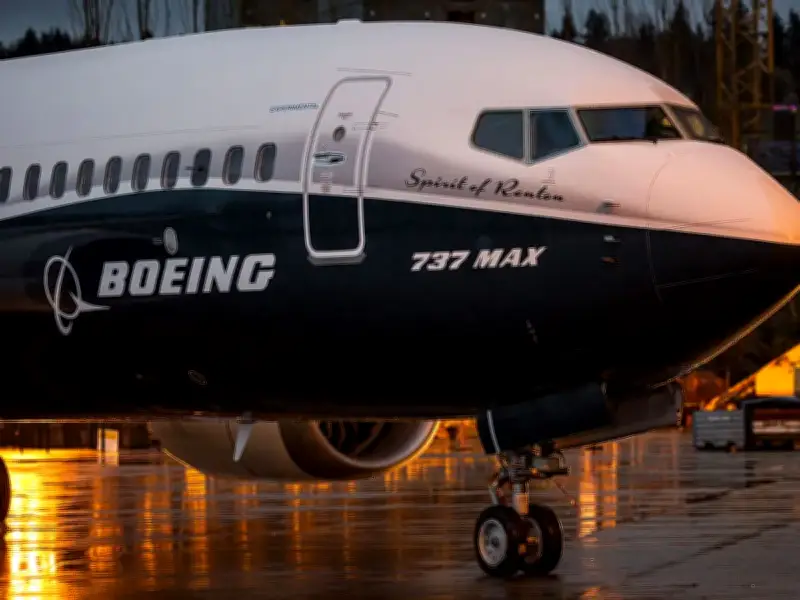
Lion Air Flight 610 was travelling from Soekarno-Hatta International Airport in Tangerang to Depati Amir Airport in Indonesia on October 29, 2018, when it crashed into the sea 13 minutes after takeoff. All 189 passengers and eight crew on board the Boeing 737 MAX 8 were killed. A subsequent investigation, led by the National Transportation Safety Committee, revealed that a new software function called the Maneuvering Characteristics Augmentation System (MCAS) caused the aircraft to nose down. The system had been intentionally omitted from aircraft documentation for aircrews by Boeing. Investigators concluded that an angle-of-attack (AoA) sensor was miscalibrated due to improper maintenance, sending erroneous data to MCAS. The problem had occurred on the same aircraft during its preceding flight, and pilots had recovered using a standard checklist. But during the fatal flight, the pilots did not properly follow the checklist, with the result that MCAS remained active and repeatedly put the aircraft into an unsafe nose-down position until it crashed.
Just five months after the Lion Air crash, Ethiopian Airlines Flight 302 crashed near the town of Bishoftu on March 10, 2019, just six minutes after takeoff, killing all 149 passengers and 8 crew members. The crash was again caused by a fault in MCAS. Due to a sensor failure, the aircraft's nose was repeatedly pitched down against the pilots' inputs, eventually leading the plane to crash. It was the second accident involving a MAX 8 and prompted a two-year worldwide grounding of the jet and an investigation into how the aircraft was approved for passenger service.