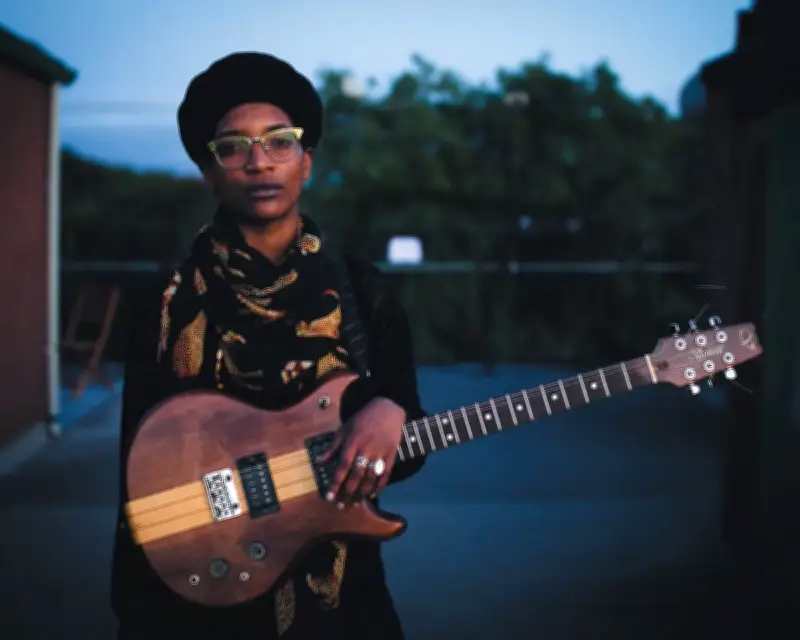
In 2021, Kenyan-Scottish singer-songwriter Beldina Odenyo was on the brink of major stardom. That October, aged 31, she headlined a gig at Edinburgh's Usher Hall, delivering an instantly legendary performance; barefoot, cloaked and bone-shaking in its intensity. Two weeks later, Odenyo took her own life.
A sister's futile attempt to bring her back
This tender and grief-stricken documentary, which opens a year after her death, is directed with remarkable care by Louise Lockwood. It forms a sensitively drawn portrait of a visionary artist haunted by trauma, through her teenage video diaries, the words of those who loved her, the handful of exquisite songs she left behind – kept in a folder on her hard drive named “passable demos” – and the determination of her older sister, Leah McAleer, to keep her astonishing voice alive. A deeply painful venture that she understands is itself a product of her insurmountable grief.
“All of this is a futile attempt to bring her back,” says McAleer while listening to Odenyo's songs in the studio, her sparse guitar-playing sent through an amplifier to sound as though she's in the room. Earlier, she put it even more starkly: “I need to finish her album.”
From Kirkconnel to the Usher Hall
And what an album it is, propelled by musical genius, the poles of suffering and survival between which Odenyo was buffeted, and her tremendous voice. “I love music,” says the often cocky, often crying 15-year-old at the start of Bel, in one of the charismatic video diaries delivered from her bedroom in the ex-mining village of Kirkconnel, Dumfries and Galloway, to her future fans. “I want to be a musician. I want to be famous, to show the world my skills …” she laughs, “and just rock their socks off.” In another video she notes: “I'm quite mad as a person. I don't give a fuck, to be honest.”
Odenyo was born in Kisumu, western Kenya, and for the first few years of her life lived with her mother and siblings. She met her father for the first time at around the age of six or seven. “A few weeks later,” she says in an interview, “I was in Scotland.” McAleer's memory of what happened and why Odenyo was taken from her mother by her father is equally fractured – neither family spoke about the devastating loss that reverberated through her life. “My father came back [from Kenya] with a small child,” says McAleer. “I just remember the shock … and her pristine white dress. She didn't cry. She didn't speak for three days.” All this silence and shock was channelled into her music, and that once-in-a-generation voice.
A close study of mental illness and racism
Bel is also a close study of mental illness, its healing but also precarious relationship with creativity, and the devastating impacts of exile and racism. In Kirkconnel, where Odenyo was the only black kid in her school, “she was set on fire once,” says her best friend, Frances. “She had a chain wrapped around her neck … it was horrific physical abuse.” In Glasgow, during a mental health episode in which an ambulance was called by a friend because she was self-harming, the police arrived first. Odenyo said they broke down her door, threw her down the stairs, and demanded to know if she had HIV because “people from where you're from do”. By the time lockdown hit she was living alone in Paisley, increasingly isolated, ill and vulnerable. It was then that she uploaded those “passable demos” to her computer.
It's a harrowing watch, bringing tears over and over again, brimming with voices traumatised by her suicide. The poet Jackie Kay was blown away by Odenyo's self-possession: “Bel didn't feel the need to smile or ingratiate herself with an audience.” Ex-boyfriend and fellow musician Lewis Semple remembers first hearing her sing in Glasgow: “Her voice fucking blew me away. I was shaking in my seat.” For venue booker Joe Rattray, she was “someone who makes a place cooler”. For Scottish singer-songwriter Kathryn Joseph whose sublime song The Bird was covered by Odenyo at that Usher Hall gig, “she was someone who understood humans … and pain.” At the end of Bel, footage from the Usher Hall gig plays again. Then Odenyo's voice cuts out. A long, painfully apt silence ensues alongside stills of her flat, her musical equipment, her cables, her glasses. It's beautifully done.
A memorial to love
In many ways Bel belongs to McAleer, a dignified and humane presence throughout. She was clearly a mother figure to Odenyo – they were “adultified children” who “grew up fast” is how she puts it – and speaks with incredible articulacy and self-awareness considering the immediacy of her grief. At Odenyo's graveside in Kenya, where she wanted to be buried close to her mother and where the documentary ends, McAleer plays her album, which she's worked tirelessly to release independently, and confesses: “I feel on a very deep level I let her down.” Which couldn't be further from the truth: Bel is a memorial to her love.
Ultimately, though, it's Odenyo's music that most powerfully tells her story. She performed as Heir of the Cursed, a name that came to her in a dream and turned out to be a translation of the Tetela name of the assassinated Congolese leader Patrice Lumumba. These few heartbreaking, sometimes foreshadowing songs, into which Odenyo poured all that she could not say, are played throughout the film. Bel aired on BBC Four and is on iPlayer now.