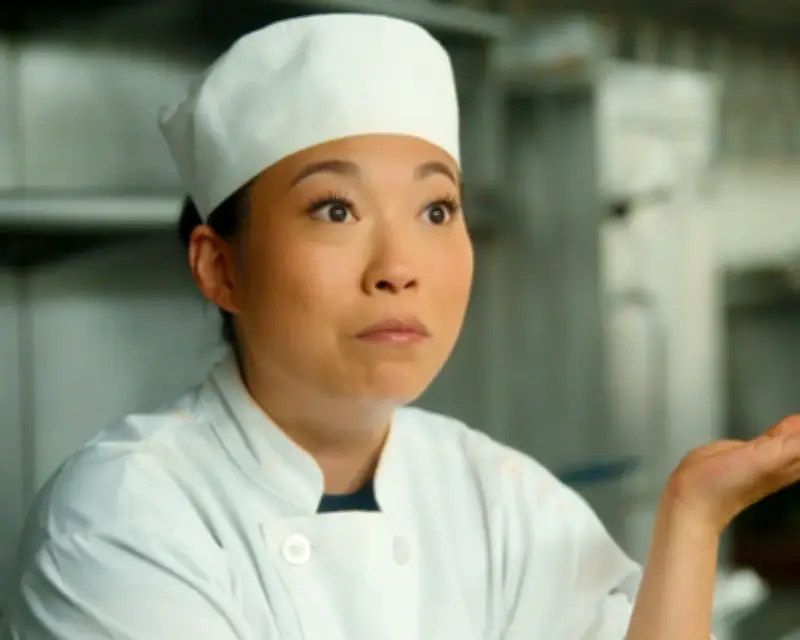
Awkwafina: The Unlikely Cook on Apple TV starts both very well and very badly. The host's absolute ignorance of how food works – or pans, or knives, or plates – has a refreshing authenticity. Too often in these shows, where a celebrity goes on a journey to acquire basic knowledge, their lack of exposure is pretended or hammed up. But actor, rapper and comedian Awkwafina – real name Nora Lum, which she uses for this series – is the real, wholly baffled deal.
As a kitchenphobe myself, I see the truth in her crouched stance by the oven or hob, fearful yet hostile. We see her pour milk over eggs she has just lobbed into a pan, the tentativeness with which she approaches spatulas and ladles, the hatred in her eyes when presented with raw ingredients. It speaks to someone who has remained truly untouched by the culinary arts.
A Family Legacy Revived
On the other hand, the scripted voiceovers are bad. “I’ve been known to set soup on fire,” she says. “Which is impressive. As it’s a dish that’s mainly water.” Fortunately, someone in charge reduces their number as the series continues.
Nora is, in a frankly unexpected twist, a descendant of “Chinese restaurant royalty”. Her great-grandfather Jimmy founded the famous Lum’s restaurant in Flushing in Queens, New York, in the 1950s. Her family – including her father and the grandmother who raised her after her mother died when she was four – worked there until it closed in 1982. Her grandmother, Powah Lum, is 91 in the show and still a force to be reckoned with. When Nora asks why Grandma didn’t teach her to cook, Grandma answers, “You too lazy.”
A Chaotic Culinary Education
Nora is not a lazy presence on screen. She is a ball of energy and charisma, whether mastering wok skills at the Culinary Institute of America (“This should be both harrowing and entertaining to watch,” she says) or exchanging gags with her Crazy Rich Asians co-star Jimmy O Yang as they drive to Texas to sample Asian-American fusion cuisines.
The aim is that she will open a restaurant, which soon changes to a more plausible pop-up restaurant in nine months’ time. It will pay homage to Lum’s and to the experience and heritage of the Cantonese, Korean (like Nora’s distaff side), and other immigrants who came to the US and made their way by setting up eateries.
As she travels to various states and learns how to make bulgogi sausages in Fredericksburg, a Peking duck in San Francisco at Mister Jiu’s, or joint a chicken in 19 seconds with 80s celebrity chef Martin Yan, Nora and her companions piece together the wider immigrant story. The next generation were encouraged to become lawyers and doctors, escaping the relentless hard work of kitchens. Most family restaurants, like Lum’s, disappeared. But in the last few years, the grandchildren are coming back – crucially, choosing to come back – to start new businesses, often in the old places.
A Moving Tribute
Grandma Powah sadly died just after filming, but she makes it to the opening night of Nora’s pop-up homage to Lum’s restaurant (“She’s a paid actor,” Nora tells customers, “but it means a lot”), with walls lined with family photographs and a menu full of old favourites with modern twists. When Nora asks if she liked the food, Powah says, “I ate a lot. I am proud of you. All the time.”
This was a fine thing. I don’t need a second helping, but it was a fine thing.