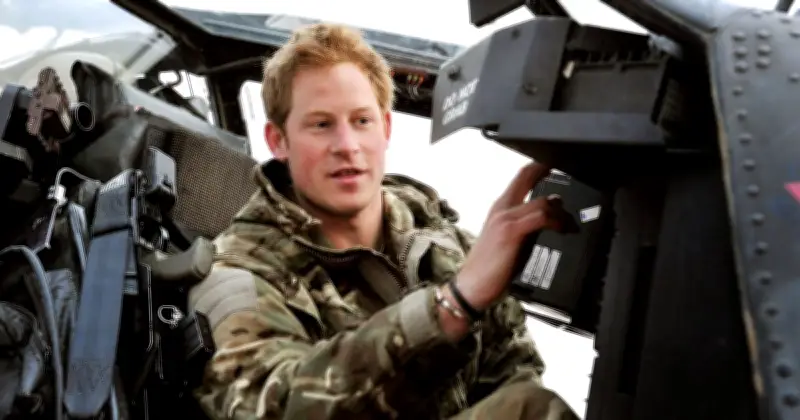
Prince Harry could face a greater long-term threat from Islamist extremists than from Russia following his admission that he killed 25 Taliban fighters in Afghanistan, a former senior British Army officer has warned.
Chip Chapman, a military and counterterrorism expert, suggested that revelations in Harry's 2023 memoir Spare could continue to pose a security concern decades after the book's publication. Speaking exclusively to the Daily Express, Chapman said he was more concerned about Harry being targeted by extremists over his military service than by Russia.
Enduring threat from extremists
Chapman referred to the Ummah, an Arabic term for the worldwide Muslim community, while discussing the potential threat to Harry. He explained that his concern was not necessarily retaliation from the Taliban, but the possibility of an individual extremist being motivated by Harry's admission.
Referring to the Duke's memoir, he said: "I remember briefing lots of people at the time that that would worry me long term, not necessarily because of the Taliban, because I've never believed that the Taliban are global jihadists."
Chapman suggested that Harry's admission could remain a source of grievance for some individuals long after the publication of Spare. He said: "Any Muslim with a grievance may say, I remember him saying that he killed 25 people," adding, "and therefore he becomes a target because of that rather than because of the Russians."
Comparison to Salman Rushdie attack
The former Army officer compared the potential long-term danger to the attack on author Salman Rushdie, who was seriously injured when he was stabbed during a public appearance in New York in August 2022. The attack came 34 years after the publication of Rushdie's controversial novel The Satanic Verses in 1988.
Referring to the attack on Rushdie, Chapman said: "It's the Salman Rushdie enduring event, as it were, because, of course, Salman Rushdie was maimed, lost his eye, 34 years after The Satanic Verses were published." He added: "And so I think there is still an enduring threat to him, but more so from jihadists than Russians. So that's where the target on the back comes, in my view."
Defence of Harry's comments on Russia
The former Army officer also defended Harry's decision to speak publicly about Russia, arguing that his comments were appropriate given that he was visiting Ukraine and supporting wounded veterans and participants in the Invictus Games. He said: "So was he right to comment? Because he was in Ukraine, he was."
Chapman also suggested that people in Britain could become complacent about the threat posed by Russia because of their geographical distance from the conflict. He said: "Because we're quite far away geographically from Ukraine, in the UK, we can be threat blind. So what he's making us aware of is being threat aware without being threat hysterical."
Turning to the possibility of Harry returning to the Armed Forces, Chapman suggested the Duke could still have reserve obligations following his Army career. He said: "One thing is, of course, he does have a reserve liability, as does anyone who served in the armed forces up to the age of 60."
Discussing the potential security risks posed by Russia, Chapman suggested that Harry's willingness to return to military service could influence Vladimir Putin's calculations in the event of a conflict. He said: "So if Putin or anyone else thinks that even a royal prince would serve, then we need to be careful, and that may alter their calculus." However, he cautioned: "I don't want to make too much of that."
Chapman also explained that Harry's royal status meant his comments would attract greater attention from the media and on social media, helping to raise awareness of the threat posed by Russia. Turning to the wider security implications, he explained that Harry's safety would continue to be assessed by those responsible for protecting him, regardless of whether he returned to military service.
He said: "Those who look after it will do that threat and vulnerability analysis and that's part of their job." He added: "He's the principal, and principal protection is the job of the security detail around him, be it a government organisation, protection folk in the Met Police or a private security company. That doesn't alter."
Chapman also explained that Harry's presence in a military unit would require appropriate security assessments, but would not necessarily mean additional protection beyond that provided to other personnel. He said: "There should be force protection for everyone if he were to serve in the Army in the future."
The Duke and Duchess of Sussex's office declined to comment when approached by the Daily Express.