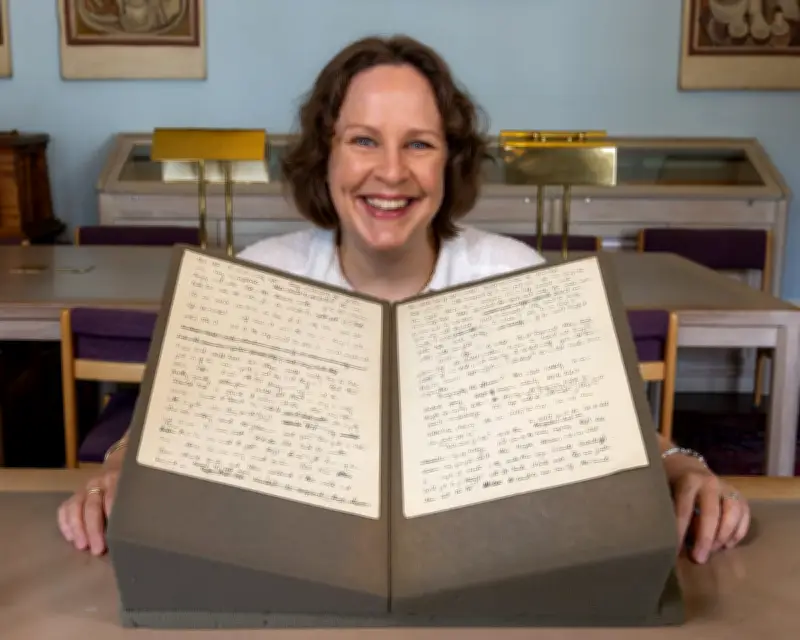
A Cambridge University academic has analysed a little-known short story by Alan Turing, written in the year after his arrest for gross indecency, arguing it reveals a 'playful, funny, cheeky' side to the father of modern computing.
Challenging the 'isolated mathematician' image
Professor Sarah Dillon, an English literature scholar at Cambridge, transcribed and studied the story, titled Pryce's Buoy, from the King's College archives. She said it challenges the popular understanding of Turing as an 'isolated mathematician', instead showing a man who loved literature, enjoyed life, and was not ashamed of his sexuality.
'I hope it will go some way towards resetting the narrative around Turing,' Dillon said. 'We think we know this figure and we don't. There was more to him than is popularly believed.'
The story's plot and characters
The six-page incomplete story, likely written in late 1952 or early 1953, features Ron Miller, a working-class sex worker, and Alec Pryce, a scientist famed for an invention. Dillon believes Alec is an autofictional representation of Turing. The racy tale follows Alec, tired after work and Christmas shopping, seeking fun, while Ron, broke and unemployed, considers sex for money.
Turing writes: 'If he let someone take him under the arches for 10 minutes he might get five bob.' Later, 'Ron caught Alec's eye and gave him a half-hearted smile. It was enough though.'
Critique of popular portrayals
Dillon criticised the 2014 film The Imitation Game, starring Benedict Cumberbatch, for perpetuating an inaccurate image of Turing as humourless and individualistic. 'That is the problem,' she said. 'It's a really good film but it's not accurate. It makes a lot of historical mistakes.' She added that the film depicts Turing as a 'Hollywood lone hero' that does not resemble the man himself.
Turing's legacy and the story's significance
Turing, a key World War II code breaker at Bletchley Park, was arrested in 1952 for homosexuality and agreed to chemical castration. He died in 1954 from cyanide poisoning, ruled suicide but disputed by some. In 2009, the UK government apologised for his treatment.
Dillon's findings, published in the Review of English Studies, aim to provide fresh insight. 'He's come to be seen as socially unaware, entirely concerned with logic and numbers, and pretty isolated. His short story reveals a very different man: playful, funny, cheeky, literary, and someone who really liked sex,' she said.